QUESTION IMAGE
Question
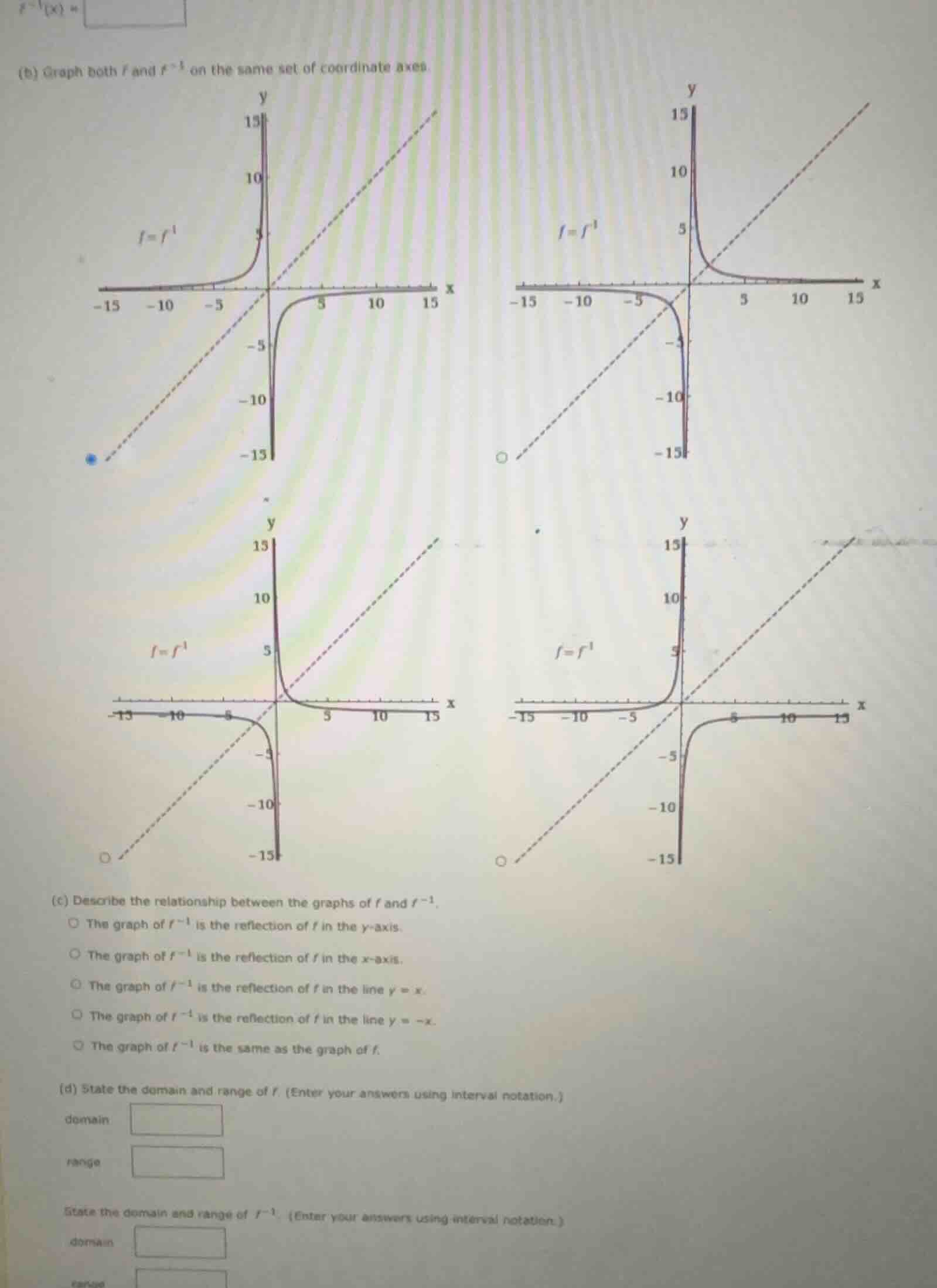
(b) graph both ( f ) and ( f^{-1} ) on the same set of coordinate axes.
(c) describe the relationship between the graphs of ( f ) and ( f^{-1} ).
- the graph of ( f^{-1} ) is the reflection of ( f ) in the ( y )-axis.
- the graph of ( f^{-1} ) is the reflection of ( f ) in the ( x )-axis.
- the graph of ( f^{-1} ) is the reflection of ( f ) in the line ( y = x ).
- the graph of ( f^{-1} ) is the reflection of ( f ) in the line ( y = -x ).
- the graph of ( f^{-1} ) is the same as the graph of ( f ).
(d) state the domain and range of ( f ). (enter your answers using interval notation.)
domain
range
state the domain and range of ( f^{-1} ). (enter your answers using interval notation.)
domain
range
Part (c)
To determine the relationship between the graph of a function \( f \) and its inverse \( f^{-1} \), we use the property of inverse functions: the graph of \( f^{-1} \) is the reflection of the graph of \( f \) across the line \( y = x \). This is a fundamental property in the study of functions and their inverses. Reflecting over the \( y \)-axis would correspond to \( f(-x) \), reflecting over the \( x \)-axis to \( -f(x) \), and reflecting over \( y=-x \) is not the standard inverse relationship. If \( f = f^{-1} \), the function is its own inverse, but this is a special case and not the general rule for inverse functions. So the correct relationship is reflection over \( y = x \).
- Domain: The domain of a function is the set of all \( x \)-values for which the function is defined. From the graph, the function has a vertical asymptote at \( x = 0 \), so \( x \) cannot be \( 0 \). Thus, the domain is all real numbers except \( 0 \), which in interval notation is \( (-\infty, 0)\cup(0, \infty) \).
- Range: The range of a function is the set of all \( y \)-values the function can take. From the graph, the function has a horizontal asymptote at \( y = 0 \), so \( y \) cannot be \( 0 \). Thus, the range is also all real numbers except \( 0 \), or \( (-\infty, 0)\cup(0, \infty) \) in interval notation.
For function \( f^{-1} \):
- Domain of \( f^{-1} \): The domain of the inverse function \( f^{-1} \) is the range of the original function \( f \). Since the range of \( f \) is \( (-\infty, 0)\cup(0, \infty) \), the domain of \( f^{-1} \) is also \( (-\infty, 0)\cup(0, \infty) \).
- Range of \( f^{-1} \): The range of the inverse function \( f^{-1} \) is the domain of the original function \( f \). Since the domain of \( f \) is \( (-\infty, 0)\cup(0, \infty) \), the range of \( f^{-1} \) is also \( (-\infty, 0)\cup(0, \infty) \).

Snap & solve any problem in the app
Get step-by-step solutions on Sovi AI
Photo-based solutions with guided steps
Explore more problems and detailed explanations
The graph of \( f^{-1} \) is the reflection of \( f \) in the line \( y = x \).