QUESTION IMAGE
Question
graph each equation.
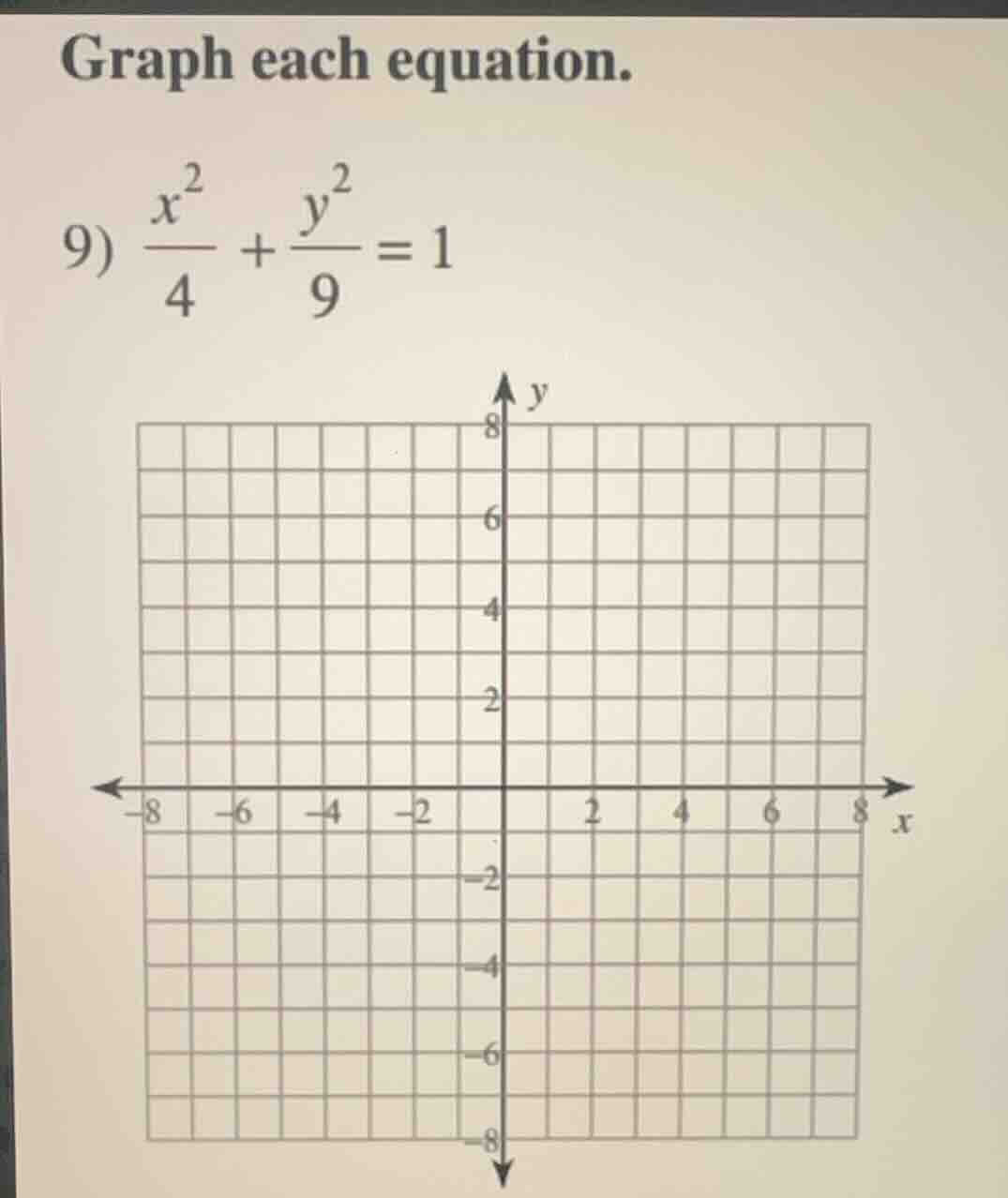
- \\(\frac{x^2}{4} + \frac{y^2}{9} = 1\\)
Step1: Identify the conic section type
The given equation is \(\frac{x^{2}}{4}+\frac{y^{2}}{9} = 1\), which is in the standard form of an ellipse \(\frac{x^{2}}{b^{2}}+\frac{y^{2}}{a^{2}}=1\) (since \(a^{2}=9\) and \(b^{2} = 4\), and \(a>b\), so the major axis is along the \(y\)-axis).
Step2: Find the vertices and co - vertices
For the ellipse \(\frac{x^{2}}{b^{2}}+\frac{y^{2}}{a^{2}}=1\), where \(a=\sqrt{9} = 3\) and \(b=\sqrt{4}=2\).
- The vertices (end - points of the major axis) are at \((0,\pm a)=(0,\pm3)\).
- The co - vertices (end - points of the minor axis) are at \((\pm b,0)=(\pm2,0)\).
Step3: Plot the points and draw the ellipse
- Plot the points \((0,3)\), \((0, - 3)\), \((2,0)\) and \((- 2,0)\) on the coordinate plane.
- Then, draw a smooth curve connecting these points to form the ellipse. The ellipse will be symmetric about both the \(x\) - axis and \(y\) - axis.

Snap & solve any problem in the app
Get step-by-step solutions on Sovi AI
Photo-based solutions with guided steps
Explore more problems and detailed explanations
The graph is an ellipse with vertices at \((0,3)\), \((0, - 3)\) and co - vertices at \((2,0)\), \((-2,0)\), symmetric about the \(x\) - axis and \(y\) - axis, and passing through these four points. When drawn on the given grid, it is a vertically oriented ellipse (since the denominator under \(y^{2}\) is larger) with the center at the origin \((0,0)\).