QUESTION IMAGE
Question
graph each equation.
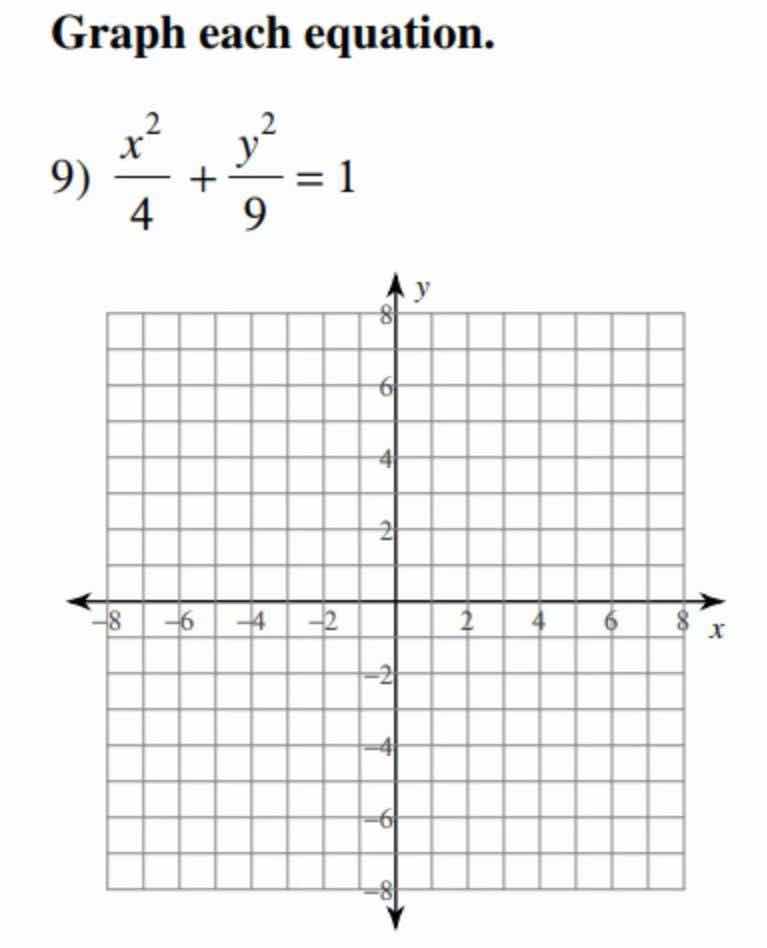
- \\(\dfrac{x^2}{4} + \dfrac{y^2}{9} = 1\\)
graph with x-axis from -8 to 8 and y-axis from -8 to 8, grid lines, and origin at (0,0)
Step1: Identify the conic section
The equation \(\frac{x^{2}}{4}+\frac{y^{2}}{9} = 1\) is in the standard form of an ellipse \(\frac{x^{2}}{b^{2}}+\frac{y^{2}}{a^{2}}=1\) (where \(a>b>0\) and the major axis is along the \(y\)-axis). Here, \(a^{2}=9\) so \(a = 3\) and \(b^{2}=4\) so \(b = 2\).
Step2: Find the vertices and co - vertices
- For the \(y\) - axis (major axis) vertices: When \(x = 0\), we solve for \(y\). Substituting \(x = 0\) into the equation \(\frac{0^{2}}{4}+\frac{y^{2}}{9}=1\), we get \(\frac{y^{2}}{9}=1\), so \(y^{2}=9\) and \(y=\pm3\). So the vertices are \((0, 3)\) and \((0,- 3)\).
- For the \(x\) - axis (minor axis) co - vertices: When \(y = 0\), we solve for \(x\). Substituting \(y = 0\) into the equation \(\frac{x^{2}}{4}+\frac{0^{2}}{9}=1\), we get \(\frac{x^{2}}{4}=1\), so \(x^{2}=4\) and \(x=\pm2\). So the co - vertices are \((2, 0)\) and \((-2, 0)\).
Step3: Plot the points and draw the ellipse
Plot the points \((0,3)\), \((0, - 3)\), \((2,0)\) and \((-2,0)\) on the coordinate plane. Then, draw a smooth curve connecting these points to form the ellipse. The ellipse will be centered at the origin \((0,0)\) since there are no shifts in the \(x\) or \(y\) terms in the equation.

Snap & solve any problem in the app
Get step-by-step solutions on Sovi AI
Photo-based solutions with guided steps
Explore more problems and detailed explanations
To graph \(\frac{x^{2}}{4}+\frac{y^{2}}{9}=1\):
- Recognize it is an ellipse with center at \((0,0)\), major axis along \(y\) - axis with vertices \((0,\pm3)\) and minor axis along \(x\) - axis with co - vertices \((\pm2,0)\).
- Plot the points \((0,3)\), \((0, - 3)\), \((2,0)\), \((-2,0)\) and draw a smooth ellipse through these points. The graph is an ellipse centered at the origin, stretching 3 units up and down along the \(y\) - axis and 2 units left and right along the \(x\) - axis.