QUESTION IMAGE
Question
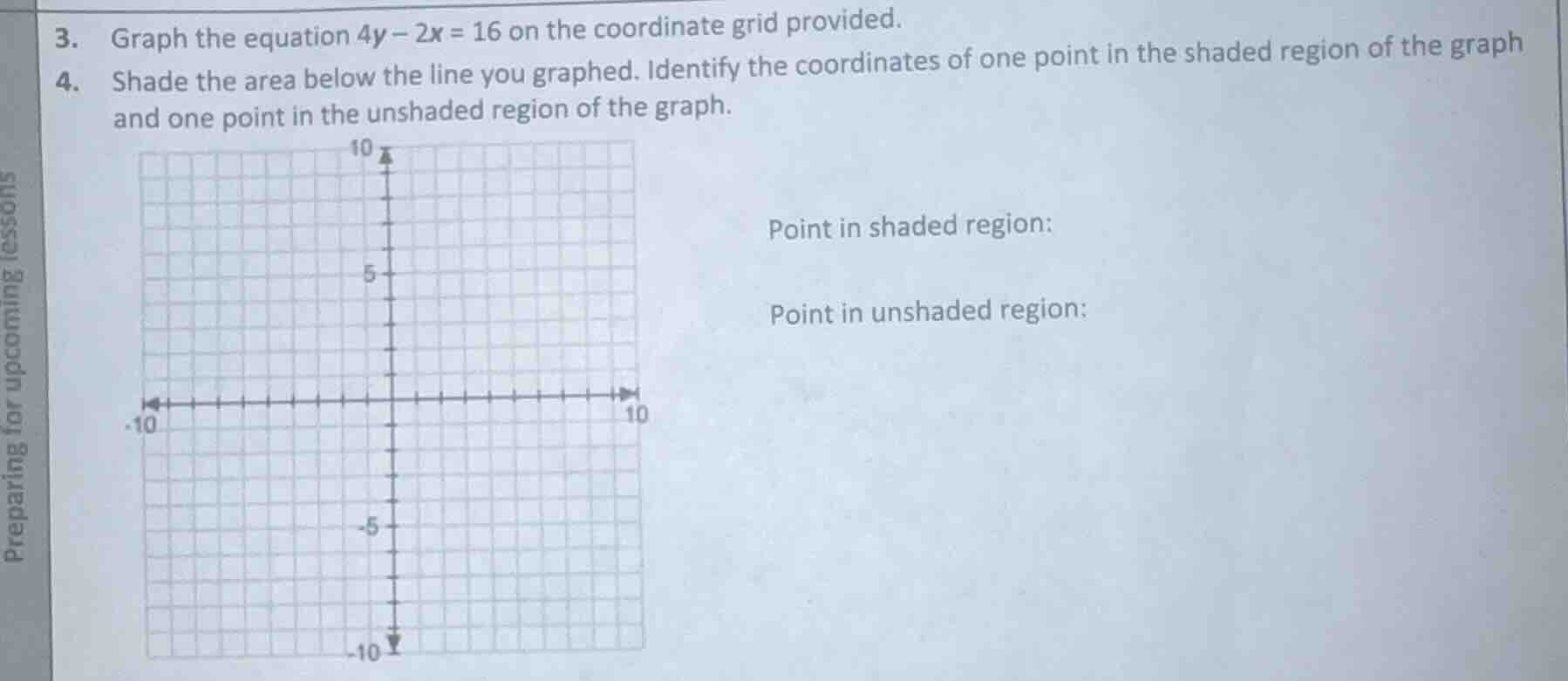
- graph the equation $4y - 2x = 16$ on the coordinate grid provided.
- shade the area below the line you graphed. identify the coordinates of one point in the shaded region of the graph and one point in the unshaded region of the graph.
point in shaded region:
point in unshaded region:
Part 3: Graph the equation \(4y - 2x = 16\)
Step 1: Rewrite in slope - intercept form (\(y=mx + b\))
We start with the equation \(4y-2x = 16\). First, we isolate \(y\). Add \(2x\) to both sides of the equation: \(4y=2x + 16\). Then divide each term by 4: \(y=\frac{2x}{4}+\frac{16}{4}\), which simplifies to \(y=\frac{1}{2}x + 4\).
Step 2: Find the y - intercept and slope
The slope - intercept form of a line is \(y = mx + b\), where \(b\) is the y - intercept and \(m\) is the slope. For the line \(y=\frac{1}{2}x + 4\), the y - intercept \(b = 4\), so the line passes through the point \((0,4)\). The slope \(m=\frac{1}{2}\), which means for every 1 unit we move up (rise) in the y - direction, we move 2 units to the right (run) in the x - direction.
Step 3: Plot the line
- Plot the y - intercept \((0,4)\).
- Using the slope, from the point \((0,4)\), move 2 units to the right (to \(x = 2\)) and 1 unit up (to \(y=5\)) to get the point \((2,5)\). Draw a straight line through the points \((0,4)\) and \((2,5)\) (and other points obtained by using the slope) to graph the line \(y=\frac{1}{2}x + 4\) (or \(4y-2x = 16\)).
Part 4: Identify points in shaded and unshaded regions
The inequality corresponding to the shaded region (below the line) is \(y\leq\frac{1}{2}x + 4\) (since we shade below the line \(y=\frac{1}{2}x + 4\)).
for point in shaded region:
Let's take the point \((0,0)\). Substitute \(x = 0\) and \(y = 0\) into the inequality \(y\leq\frac{1}{2}x + 4\). We get \(0\leq\frac{1}{2}(0)+4\), which simplifies to \(0\leq4\), and this is a true statement. So \((0,0)\) is in the shaded region.
for point in unshaded region:
Let's take the point \((0,5)\). Substitute \(x = 0\) and \(y = 5\) into the inequality \(y\leq\frac{1}{2}x + 4\). We get \(5\leq\frac{1}{2}(0)+4\), which simplifies to \(5\leq4\), and this is a false statement. So \((0,5)\) is in the unshaded region.

Snap & solve any problem in the app
Get step-by-step solutions on Sovi AI
Photo-based solutions with guided steps
Explore more problems and detailed explanations
(for Part 4):
Point in shaded region: \((0,0)\)
Point in unshaded region: \((0,5)\)
(Note: There are other possible points. For example, a point in the shaded region could also be \((2,4)\) (since \(4\leq\frac{1}{2}(2)+4=1 + 4 = 5\), \(4\leq5\) is true) and a point in the unshaded region could be \((2,6)\) (since \(6\leq\frac{1}{2}(2)+4=5\), \(6\leq5\) is false))