QUESTION IMAGE
Question
graph the equation shown below by transforming the given graph of the parent function.
$y = \sqrt{\frac{1}{4}x}$
Step1: Identify the parent function
The parent function of square root functions is \( y = \sqrt{x} \). The given function is \( y=\sqrt{\frac{1}{4}x} \), which can be rewritten as \( y = \sqrt{\frac{1}{4}x}=\sqrt{\frac{1}{4}}\cdot\sqrt{x}=\frac{1}{2}\sqrt{x} \)? Wait, no, actually, the transformation here is a horizontal stretch. Recall that for a function \( y = \sqrt{ax} \) (where \( a>0 \)), if \( 0 < a< 1 \), it is a horizontal stretch of the parent function \( y=\sqrt{x} \) by a factor of \( \frac{1}{a} \).
In our case, the function is \( y=\sqrt{\frac{1}{4}x} \), so \( a = \frac{1}{4} \). The horizontal stretch factor is \( \frac{1}{a}=4 \). That means we take the graph of \( y = \sqrt{x} \) and stretch it horizontally by a factor of 4.
Step2: Analyze the points on the parent graph
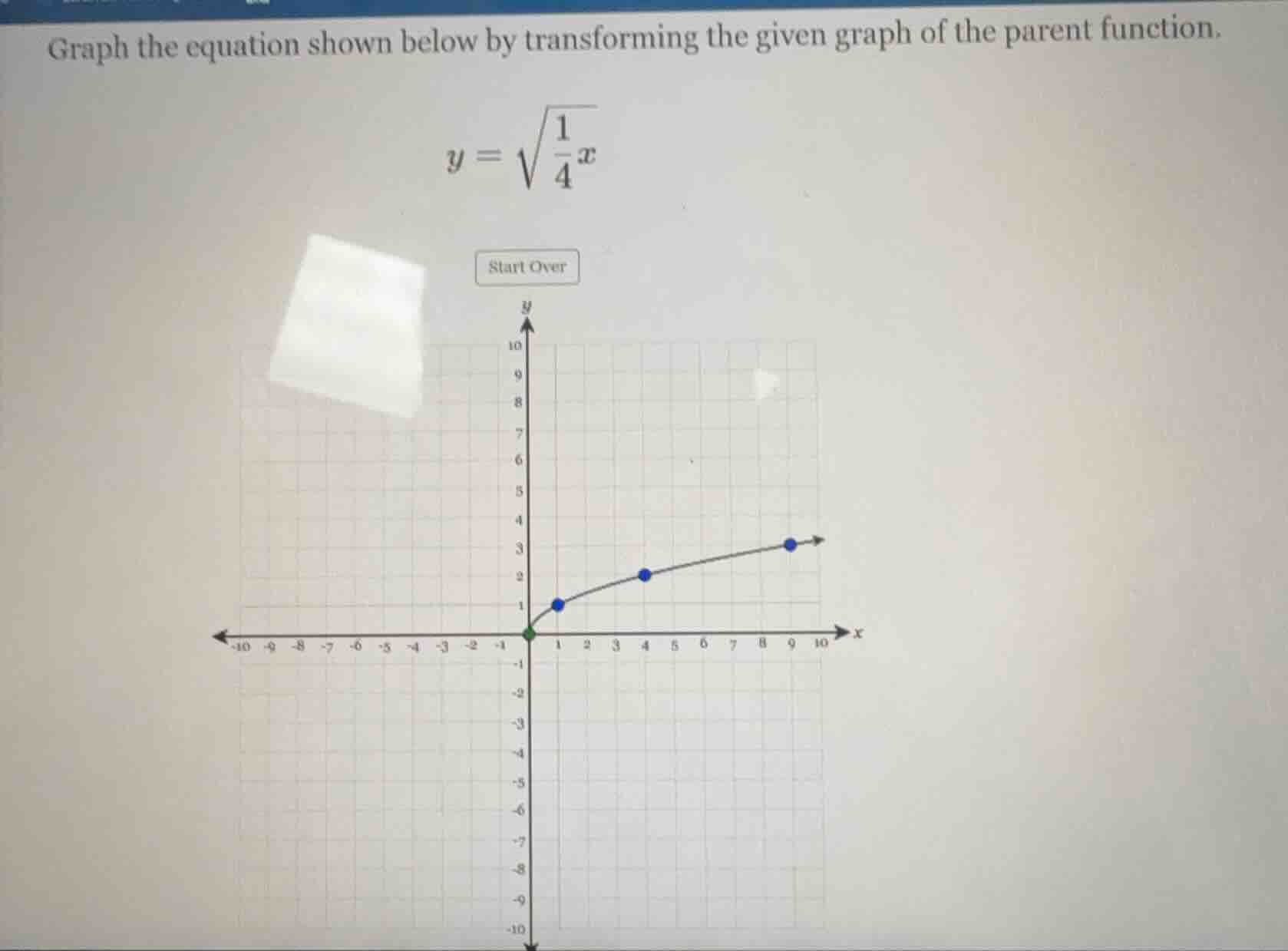
Looking at the given parent graph (the blue curve), let's take the key points. The parent function \( y = \sqrt{x} \) has points like \( (0,0) \), \( (1,1) \), \( (4,2) \), \( (9,3) \) (since \( \sqrt{0}=0 \), \( \sqrt{1}=1 \), \( \sqrt{4}=2 \), \( \sqrt{9}=3 \)).
For the transformed function \( y=\sqrt{\frac{1}{4}x} \), we can find the corresponding points by solving for \( x \) when \( y \) is known, or by using the transformation. Let's use the transformation: if \( (x,y) \) is on \( y = \sqrt{x} \), then for \( y=\sqrt{\frac{1}{4}x'} \) (let \( x' \) be the new x - value), we set \( y=\sqrt{x} \) and \( y=\sqrt{\frac{1}{4}x'} \), so \( \sqrt{x}=\sqrt{\frac{1}{4}x'} \), squaring both sides gives \( x=\frac{1}{4}x' \), so \( x' = 4x \).
So the point \( (0,0) \) on \( y = \sqrt{x} \) stays \( (0,0) \) on \( y=\sqrt{\frac{1}{4}x} \) (since \( 4\times0 = 0 \)).
The point \( (1,1) \) on \( y = \sqrt{x} \) becomes \( (4\times1,1)=(4,1) \) on \( y=\sqrt{\frac{1}{4}x} \) (because when \( x' = 4 \), \( y=\sqrt{\frac{1}{4}\times4}=\sqrt{1}=1 \)).
The point \( (4,2) \) on \( y = \sqrt{x} \) becomes \( (4\times4,2)=(16,2) \)? Wait, no, that can't be right. Wait, maybe I made a mistake in the transformation. Let's re - express the function:
\( y=\sqrt{\frac{1}{4}x}=\sqrt{\frac{x}{4}}=\frac{\sqrt{x}}{2} \)? No, \( \sqrt{\frac{x}{4}}=\frac{\sqrt{x}}{\sqrt{4}}=\frac{\sqrt{x}}{2} \). Wait, now I'm confused. Wait, \( \sqrt{\frac{1}{4}x}=\sqrt{\frac{x}{4}}=\frac{1}{2}\sqrt{x} \). Oh! I see, I messed up the transformation. So it's a vertical compression by a factor of \( \frac{1}{2} \) or a horizontal stretch? Wait, let's check with \( x \) values.
Let's take \( x = 0 \): \( y=\sqrt{\frac{1}{4}\times0}=0 \), same as parent.
\( x = 4 \): \( y=\sqrt{\frac{1}{4}\times4}=\sqrt{1}=1 \)
\( x = 16 \): \( y=\sqrt{\frac{1}{4}\times16}=\sqrt{4}=2 \)
\( x = 36 \): \( y=\sqrt{\frac{1}{4}\times36}=\sqrt{9}=3 \)
Ah! So the correct transformation is: for the parent function \( y = \sqrt{x} \), the transformed function \( y=\sqrt{\frac{1}{4}x} \) has the same \( y \) - value when \( x \) is 4 times larger. So the point \( (1,1) \) on \( y = \sqrt{x} \) (where \( x = 1,y = 1 \)) corresponds to \( x = 4,y = 1 \) on \( y=\sqrt{\frac{1}{4}x} \); the point \( (4,2) \) on \( y = \sqrt{x} \) corresponds to \( x = 16,y = 2 \) on \( y=\sqrt{\frac{1}{4}x} \); the point \( (9,3) \) on \( y = \sqrt{x} \) corresponds to \( x = 36,y = 3 \) on \( y=\sqrt{\frac{1}{4}x} \).
So to graph \( y=\sqrt{\frac{1}{4}x} \), we take the parent graph \( y = \sqrt{x} \) and stretch it horizontally by a factor of 4. That means each x - coordinate of the points on \( y=\sqrt{x} \) is multiplied by 4 to get the corresponding x - coordinate on \( y=\sqrt{\frac{1}{4}x} \), while the y - coordinate…

Snap & solve any problem in the app
Get step-by-step solutions on Sovi AI
Photo-based solutions with guided steps
Explore more problems and detailed explanations
To graph \( y=\sqrt{\frac{1}{4}x} \), we perform a horizontal stretch of the parent function \( y = \sqrt{x} \) by a factor of 4. The key points of the parent function \( y=\sqrt{x} \) (e.g., \((0,0)\), \((1,1)\), \((4,2)\), \((9,3)\)) are transformed to \((0,0)\), \((4,1)\), \((16,2)\), \((36,3)\) on the graph of \( y=\sqrt{\frac{1}{4}x} \). We then plot these transformed points and draw a smooth curve through them, similar in shape to the parent square - root function but stretched horizontally.