QUESTION IMAGE
Question
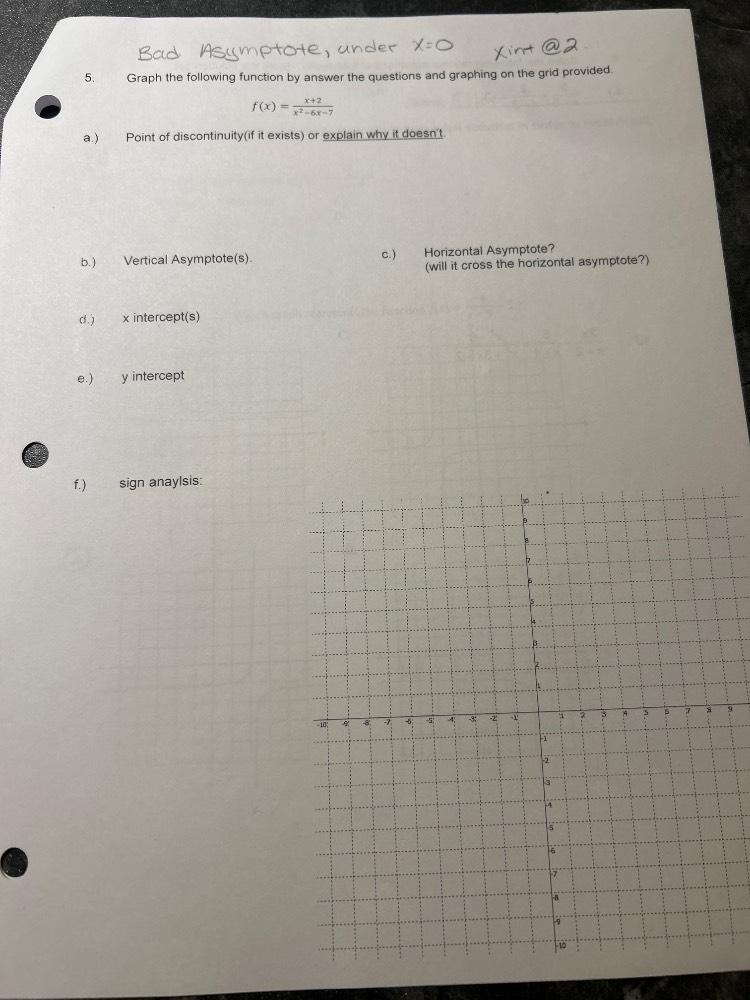
- graph the following function by answer the questions and graphing on the grid provided.
$f(x) = \frac{x + 2}{x^2 - 6x - 7}$
a.) point of discontinuity(if it exists) or explain why it doesnt.
b.) vertical asymptote(s).
c.) horizontal asymptote?
(will it cross the horizontal asymptote?)
d.) x intercept(s)
e.) y intercept
f.) sign analysis:
Part a)
Step1: Factor denominator
Factor \(x^{2}-6x - 7\): \(x^{2}-6x - 7=(x - 7)(x+1)\). The function is \(f(x)=\frac{x + 2}{(x - 7)(x + 1)}\).
Step2: Find discontinuities
Discontinuities occur where denominator is zero: \(x - 7=0\Rightarrow x = 7\); \(x+1=0\Rightarrow x=-1\). No common factors with numerator, so these are vertical asymptotes (no removable discontinuities, so no points of discontinuity that are holes—just asymptotes at \(x=-1\) and \(x = 7\), so no point of discontinuity (hole) exists.
Step1: Recall vertical asymptote rule
Vertical asymptotes occur where denominator is zero (and numerator non - zero).
Step2: Solve denominator \(=0\)
We have denominator \((x - 7)(x + 1)=0\). Solving \(x - 7=0\) gives \(x = 7\), and solving \(x+1=0\) gives \(x=-1\). Numerator at \(x = 7\): \(7 + 2=9
eq0\); at \(x=-1\): \(-1+2 = 1
eq0\).
Step1: Recall horizontal asymptote rules
For a rational function \(f(x)=\frac{ax^{n}+...}{bx^{m}+...}\), if \(n\lt m\), horizontal asymptote is \(y = 0\); if \(n=m\), \(y=\frac{a}{b}\); if \(n\gt m\), no horizontal asymptote.
Step2: Analyze degrees
For \(f(x)=\frac{x + 2}{x^{2}-6x - 7}\), degree of numerator \(n = 1\), degree of denominator \(m = 2\). Since \(n\lt m\), horizontal asymptote is \(y = 0\).
Step3: Check if it crosses horizontal asymptote
To check if \(y = 0\) is crossed, set \(f(x)=0\): \(\frac{x + 2}{x^{2}-6x - 7}=0\). Numerator \(x + 2=0\Rightarrow x=-2\). Denominator at \(x=-2\): \((-2)^{2}-6(-2)-7=4 + 12-7=9
eq0\). So the function crosses the horizontal asymptote at \(x=-2\) (point \((-2,0)\)).

Snap & solve any problem in the app
Get step-by-step solutions on Sovi AI
Photo-based solutions with guided steps
Explore more problems and detailed explanations
No point of discontinuity (hole) exists because the numerator \(x + 2\) and denominator \((x - 7)(x + 1)\) have no common factors. Discontinuities at \(x=-1\) and \(x = 7\) are vertical asymptotes.