QUESTION IMAGE
Question
graph the function.
$y = \frac{9}{2}\sqrt3{x}$
Step 1: Recall the parent function
The parent function of \( y = \frac{9}{2}\sqrt[3]{x} \) is \( y=\sqrt[3]{x} \), which has a domain of all real numbers (\( x\in\mathbb{R} \)) and passes through points like \(( -8, -2 )\), \(( -1, -1 )\), \(( 0, 0 )\), \(( 1, 1 )\), \(( 8, 2 )\).
Step 2: Apply the vertical stretch
The function \( y = \frac{9}{2}\sqrt[3]{x} \) is a vertical stretch of the parent cube - root function by a factor of \( \frac{9}{2}=4.5 \).
For a given \( x \), we calculate \( y \) as follows:
- When \( x = - 8 \):
\( y=\frac{9}{2}\sqrt[3]{-8}=\frac{9}{2}\times(-2)=-9 \)
- When \( x=-1 \):
\( y = \frac{9}{2}\sqrt[3]{-1}=\frac{9}{2}\times(-1)=-4.5 \)
- When \( x = 0 \):
\( y=\frac{9}{2}\sqrt[3]{0}=0 \)
- When \( x = 1 \):
\( y=\frac{9}{2}\sqrt[3]{1}=\frac{9}{2}\times1 = 4.5 \)
- When \( x = 8 \):
\( y=\frac{9}{2}\sqrt[3]{8}=\frac{9}{2}\times2=9 \)
Step 3: Plot the points and draw the graph
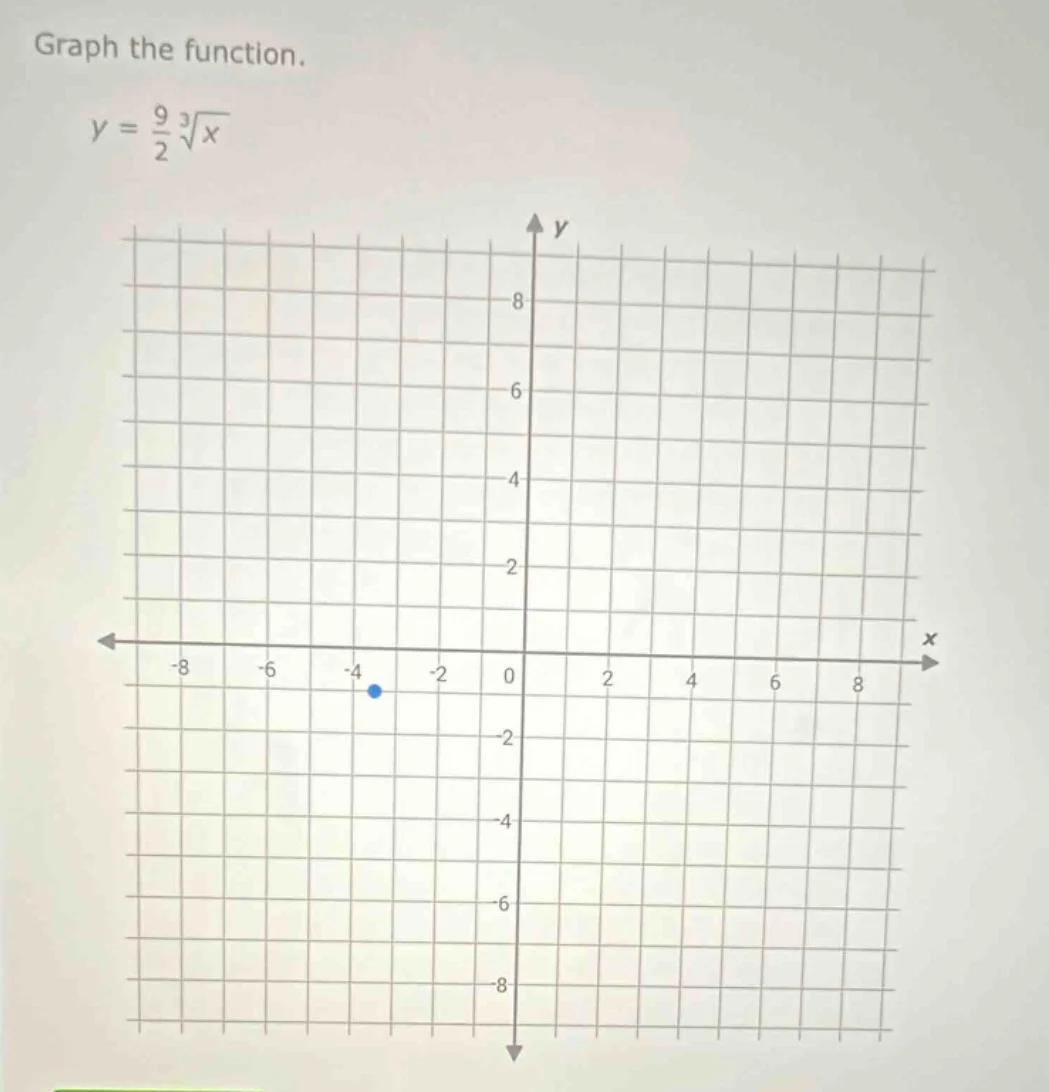
Plot the points \((-8,-9)\), \((-1,-4.5)\), \((0,0)\), \((1,4.5)\), \((8,9)\) on the coordinate plane. Then, draw a smooth curve through these points. The curve should pass through the origin, be symmetric about the origin (since the cube - root function is an odd function), and have a vertical stretch compared to the parent \( y = \sqrt[3]{x} \) function.
(Note: Since we can't draw the graph here in a fully graphical way, but the key steps are to find the key points by substituting values of \( x \) into the function and then connecting them with a smooth curve.)

Snap & solve any problem in the app
Get step-by-step solutions on Sovi AI
Photo-based solutions with guided steps
Explore more problems and detailed explanations
To graph \( y=\frac{9}{2}\sqrt[3]{x} \), follow these steps:
- Identify key points by substituting \( x=-8,-1,0,1,8 \) (and other values if needed) into the function to get \((-8, - 9)\), \((-1,-4.5)\), \((0,0)\), \((1,4.5)\), \((8,9)\).
- Plot these points on the given coordinate grid.
- Draw a smooth, continuous curve through the plotted points. The curve should be a vertically stretched (by a factor of \( \frac{9}{2} \)) version of the parent cube - root function \( y = \sqrt[3]{x} \), passing through the origin and symmetric about the origin.