QUESTION IMAGE
Question
this is the graph of a function $f(x)$.
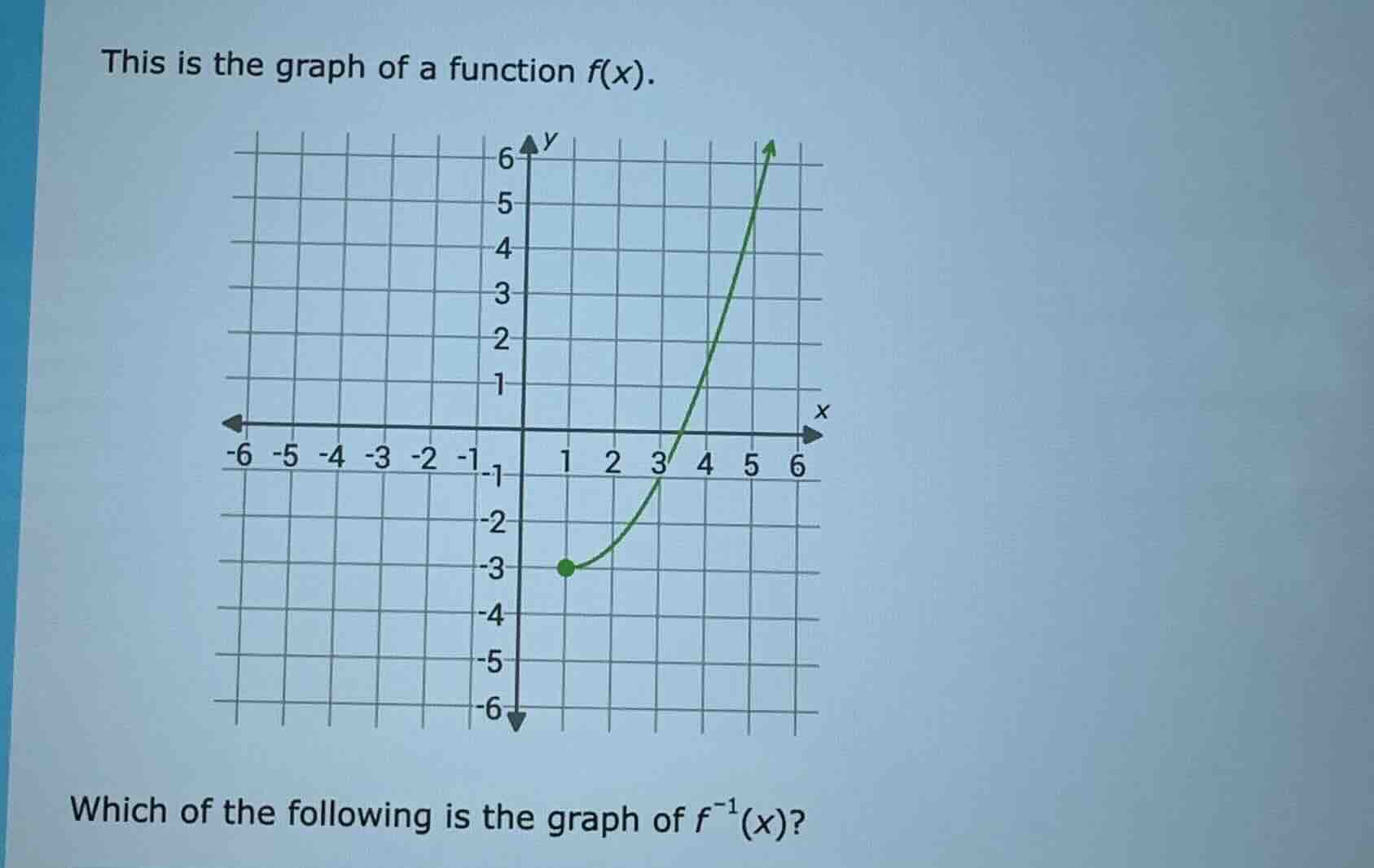
graph of a function with grid, y-axis from -6 to 6, x-axis from -6 to 6, green curve starting at (1, -3) and increasing, crossing x-axis at (3, 0) and going up to (5, 6)
which of the following is the graph of $f^{-1}(x)$?
To determine the graph of \( f^{-1}(x) \), we use the property that the graph of an inverse function \( f^{-1}(x) \) is the reflection of the graph of \( f(x) \) over the line \( y = x \).
Step 1: Identify Key Points on \( f(x) \)
First, find some key points on the graph of \( f(x) \):
- The green dot is at \( (1, -3) \) (since it’s 1 unit right on the \( x \)-axis and 3 units down on the \( y \)-axis).
- The graph crosses the \( x \)-axis at \( (3.5, 0) \) (approximate, but we can also use the reflection property).
Step 2: Reflect Points Over \( y = x \)
To find the corresponding points on \( f^{-1}(x) \), swap the \( x \)- and \( y \)-coordinates of points on \( f(x) \):
- For the point \( (1, -3) \) on \( f(x) \), the reflected point on \( f^{-1}(x) \) is \( (-3, 1) \).
- For the \( x \)-intercept \( (a, 0) \) on \( f(x) \), the reflected point on \( f^{-1}(x) \) is \( (0, a) \).
Step 3: Analyze the Reflection
The graph of \( f(x) \) is a curve starting at \( (1, -3) \) and increasing. When reflected over \( y = x \):
- The domain and range of \( f(x) \) become the range and domain of \( f^{-1}(x) \), respectively.
- The shape of the graph is mirrored over \( y = x \), so if \( f(x) \) is increasing, \( f^{-1}(x) \) will also be increasing (since \( f(x) \) appears to be one-to-one, hence invertible).
Step 4: Match the Reflected Graph
The graph of \( f^{-1}(x) \) must satisfy:
- It passes through \( (-3, 1) \) (reflection of \( (1, -3) \)).
- It is symmetric to \( f(x) \) across \( y = x \).
Without the specific options, we can describe the process:
- Locate key points on \( f(x) \).
- Swap \( x \) and \( y \) to get points on \( f^{-1}(x) \).
- Draw a curve through these reflected points, ensuring symmetry over \( y = x \).
For example, if \( f(x) \) has a point \( (1, -3) \), \( f^{-1}(x) \) has \( (-3, 1) \); if \( f(x) \) crosses \( (3.5, 0) \), \( f^{-1}(x) \) crosses \( (0, 3.5) \). The graph of \( f^{-1}(x) \) will be the reflection of \( f(x) \) over \( y = x \).
To confirm, look for a graph that:
- Contains the point \( (-3, 1) \) (or other reflected key points).
- Is symmetric to \( f(x) \) across \( y = x \).
(Note: Since the options are not provided here, the key is to apply the reflection over \( y = x \) to identify the correct graph.)

Snap & solve any problem in the app
Get step-by-step solutions on Sovi AI
Photo-based solutions with guided steps
Explore more problems and detailed explanations
To determine the graph of \( f^{-1}(x) \), we use the property that the graph of an inverse function \( f^{-1}(x) \) is the reflection of the graph of \( f(x) \) over the line \( y = x \).
Step 1: Identify Key Points on \( f(x) \)
First, find some key points on the graph of \( f(x) \):
- The green dot is at \( (1, -3) \) (since it’s 1 unit right on the \( x \)-axis and 3 units down on the \( y \)-axis).
- The graph crosses the \( x \)-axis at \( (3.5, 0) \) (approximate, but we can also use the reflection property).
Step 2: Reflect Points Over \( y = x \)
To find the corresponding points on \( f^{-1}(x) \), swap the \( x \)- and \( y \)-coordinates of points on \( f(x) \):
- For the point \( (1, -3) \) on \( f(x) \), the reflected point on \( f^{-1}(x) \) is \( (-3, 1) \).
- For the \( x \)-intercept \( (a, 0) \) on \( f(x) \), the reflected point on \( f^{-1}(x) \) is \( (0, a) \).
Step 3: Analyze the Reflection
The graph of \( f(x) \) is a curve starting at \( (1, -3) \) and increasing. When reflected over \( y = x \):
- The domain and range of \( f(x) \) become the range and domain of \( f^{-1}(x) \), respectively.
- The shape of the graph is mirrored over \( y = x \), so if \( f(x) \) is increasing, \( f^{-1}(x) \) will also be increasing (since \( f(x) \) appears to be one-to-one, hence invertible).
Step 4: Match the Reflected Graph
The graph of \( f^{-1}(x) \) must satisfy:
- It passes through \( (-3, 1) \) (reflection of \( (1, -3) \)).
- It is symmetric to \( f(x) \) across \( y = x \).
Without the specific options, we can describe the process:
- Locate key points on \( f(x) \).
- Swap \( x \) and \( y \) to get points on \( f^{-1}(x) \).
- Draw a curve through these reflected points, ensuring symmetry over \( y = x \).
For example, if \( f(x) \) has a point \( (1, -3) \), \( f^{-1}(x) \) has \( (-3, 1) \); if \( f(x) \) crosses \( (3.5, 0) \), \( f^{-1}(x) \) crosses \( (0, 3.5) \). The graph of \( f^{-1}(x) \) will be the reflection of \( f(x) \) over \( y = x \).
To confirm, look for a graph that:
- Contains the point \( (-3, 1) \) (or other reflected key points).
- Is symmetric to \( f(x) \) across \( y = x \).
(Note: Since the options are not provided here, the key is to apply the reflection over \( y = x \) to identify the correct graph.)