QUESTION IMAGE
Question
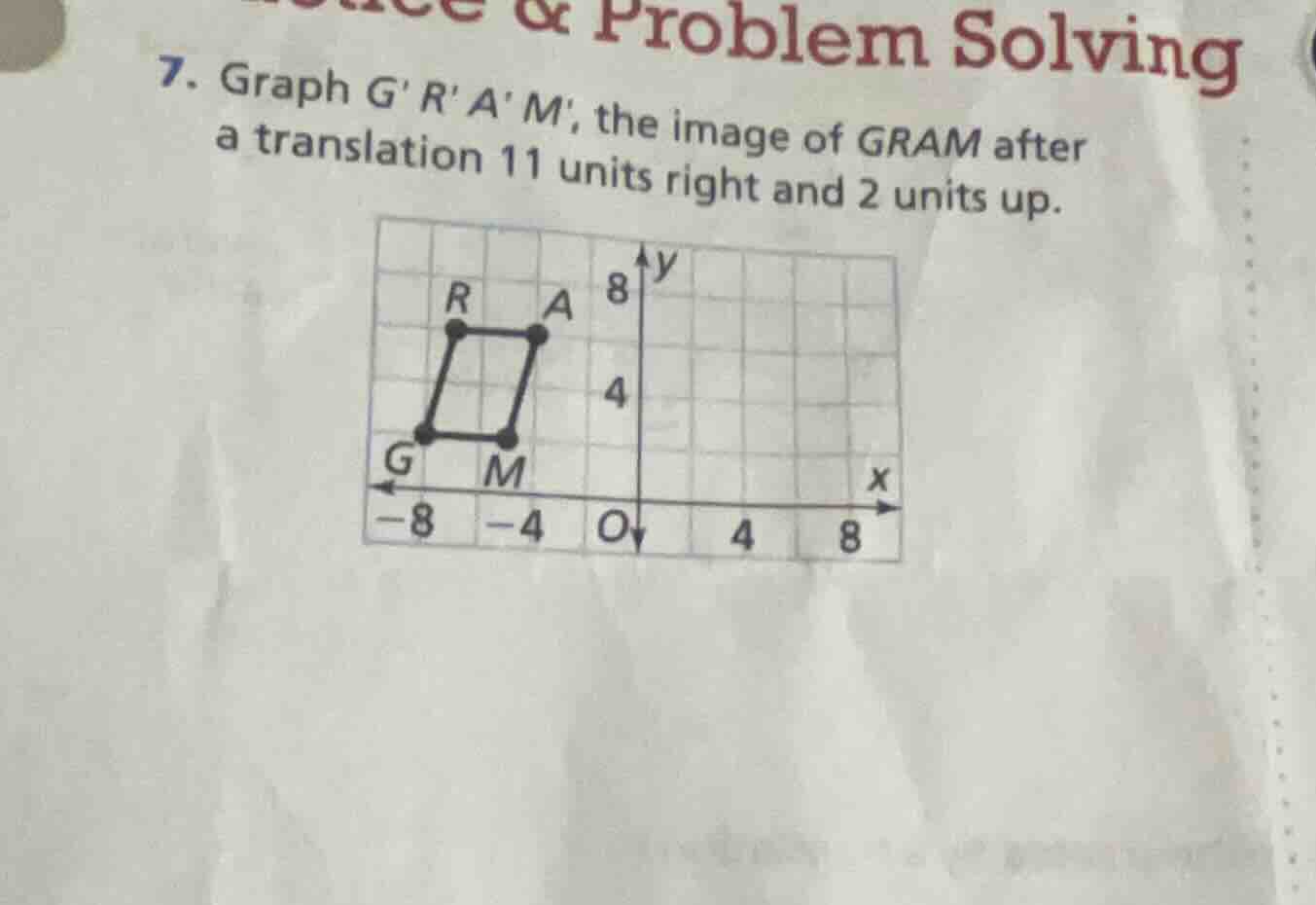
- graph g r a m; the image of gram after a translation 11 units right and 2 units up.
Step1: Find coordinates of original points
From the graph:
- \( G(-8, 1) \) (assuming y - coordinate of G is 1 as it's on the grid line, similarly:
- \( R(-7, 6) \) (approximate, but let's get exact from grid: Wait, looking at the grid, G is at (-8, 1)? Wait, no, let's check the grid. The x - axis: -8, -4, 0, 4, 8. The y - axis: 0, 4, 8. Let's find exact coordinates:
- \( G(-8, 1) \)? Wait, no, the square: G, M, A, R. Let's see: G is at (-8, 1)? Wait, M is at (-4, 1), G is at (-8, 1), R is at (-7, 6)? Wait, no, maybe better: Let's take G: x=-8, y = 1 (since it's on the horizontal line near y=1). M: x=-4, y = 1. A: x=-4, y = 6? Wait, no, R is at (-7, 6), A at (-4, 6). Yes, that makes a rectangle. So:
- \( G(-8, 1) \)
- \( R(-7, 6) \)
- \( A(-4, 6) \)
- \( M(-4, 1) \)
Step2: Apply translation (x + 11, y + 2)
For a translation 11 units right (add 11 to x - coordinate) and 2 units up (add 2 to y - coordinate):
- For \( G(-8, 1) \): \( G'(-8 + 11, 1+2)=(3, 3) \)
- For \( R(-7, 6) \): \( R'(-7 + 11, 6 + 2)=(4, 8) \)
- For \( A(-4, 6) \): \( A'(-4+11, 6 + 2)=(7, 8) \)
- For \( M(-4, 1) \): \( M'(-4 + 11, 1+2)=(7, 3) \)
Step3: Graph the new points
Plot \( G'(3, 3) \), \( R'(4, 8) \), \( A'(7, 8) \), \( M'(7, 3) \) and connect them to form the translated figure.
(Note: The key is to find original coordinates, apply translation rule \((x,y)\to(x + 11,y + 2)\) and then graph the new points.)

Snap & solve any problem in the app
Get step-by-step solutions on Sovi AI
Photo-based solutions with guided steps
Explore more problems and detailed explanations
To graph \( G'R'A'M' \), first find the coordinates of the original vertices \( G, R, A, M \) from the graph: \( G(-8,1) \), \( R(-7,6) \), \( A(-4,6) \), \( M(-4,1) \). Apply the translation \((x,y)\to(x + 11,y + 2)\) to get the new coordinates: \( G'(3,3) \), \( R'(4,8) \), \( A'(7,8) \), \( M'(7,3) \). Then plot these points on the coordinate plane and connect them in order to form the translated quadrilateral.