QUESTION IMAGE
Question
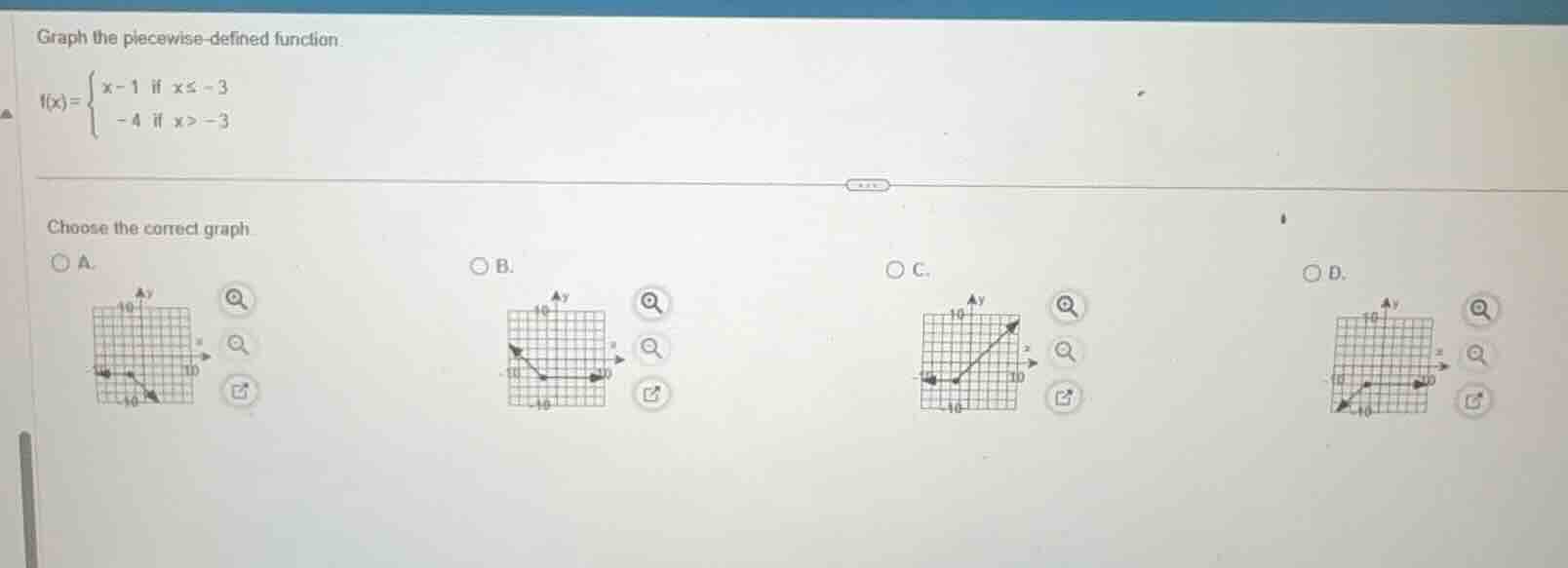
graph the piecewise - defined function.
$f(x)=\begin{cases}x - 1&\text{if }xleq - 3\\-4&\text{if }x > - 3end{cases}$
choose the correct graph
\\(\bigcirc\\) a.
\\(\bigcirc\\) b.
\\(\bigcirc\\) c.
\\(\bigcirc\\) d.
Step1: Analyze the first piece \( f(x) = x - 1 \) for \( x \leq -3 \)
This is a linear function with slope \( 1 \) and y-intercept \( -1 \). We can find a point on this line by plugging \( x = -3 \): \( f(-3)=-3 - 1=-4 \). So the point \( (-3, -4) \) is on this part, and since the slope is positive, as \( x \) decreases (because \( x \leq -3 \)), \( y \) decreases.
Step2: Analyze the second piece \( f(x)=-4 \) for \( x > -3 \)
This is a horizontal line \( y = -4 \) for all \( x \) values greater than \( -3 \). At \( x=-3 \), the first piece gives \( y=-4 \), and the second piece starts at \( x > -3 \), so there is a closed dot at \( (-3, -4) \) for the first piece and an open dot? Wait, no: for \( x \leq -3 \), the first piece includes \( x=-3 \), so the point \( (-3, -4) \) is included there. For \( x > -3 \), the second piece is \( y=-4 \), so the graph should have a line with slope 1 (from \( f(x)=x - 1 \)) for \( x \leq -3 \) (passing through \( (-3, -4) \) and decreasing as \( x \) goes left), and a horizontal line \( y=-4 \) for \( x > -3 \).
Now let's check the options:
- Option A: The line for \( x \leq -3 \) has negative slope (correct, since \( f(x)=x - 1 \) has slope 1? Wait no, slope of \( x - 1 \) is 1, positive. Wait, I made a mistake: \( f(x)=x - 1 \) has slope 1, so as \( x \) increases, \( y \) increases. But for \( x \leq -3 \), so when \( x=-3 \), \( y=-4 \); when \( x=-4 \), \( y=-5 \), etc. So the line for \( x \leq -3 \) should have positive slope, going from \( (-3, -4) \) down to the left (since \( x \) is less than -3, so moving left from \( x=-3 \), \( x \) decreases, \( y = x - 1 \) decreases, so the line goes from \( (-3, -4) \) with slope 1 (so for each unit left, \( y \) decreases by 1). Then for \( x > -3 \), it's a horizontal line \( y=-4 \).
Wait let's re-express:
For \( f(x)=x - 1 \), when \( x=-3 \), \( y=-4 \); \( x=-4 \), \( y=-5 \); \( x=-5 \), \( y=-6 \), etc. So the line has slope 1, so it's a line with slope 1, passing through \( (-3, -4) \), and for \( x \leq -3 \), we plot that. Then for \( x > -3 \), \( y=-4 \), so a horizontal line at \( y=-4 \) starting from \( x > -3 \) (so open dot at \( (-3, -4) \)? No, wait: the first piece is \( x \leq -3 \), so \( x=-3 \) is included in the first piece, so the point \( (-3, -4) \) is on the first piece. The second piece is \( x > -3 \), so at \( x=-3 \), the second piece does not include \( x=-3 \), but the first piece does. Wait, no: the function is defined as \( x \leq -3 \) for the first piece, so \( x=-3 \) is in the first piece, and \( x > -3 \) for the second. So the graph should have a closed dot at \( (-3, -4) \) for the first piece, and then a horizontal line \( y=-4 \) for \( x > -3 \).
Wait, let's recast:
- First piece: \( f(x)=x - 1 \), \( x \leq -3 \). So this is a linear function with slope 1, so it's a line going up to the right (since slope is positive). But since \( x \leq -3 \), the domain for this piece is \( x \leq -3 \), so we take the part of the line \( y = x - 1 \) where \( x \leq -3 \). So when \( x=-3 \), \( y=-4 \); when \( x=-4 \), \( y=-5 \); when \( x=-5 \), \( y=-6 \), etc. So the line segment (or ray) for \( x \leq -3 \) starts at \( (-3, -4) \) and goes to the left (decreasing \( x \)) with slope 1 (so decreasing \( y \)).
Second piece: \( y=-4 \) for \( x > -3 \), so a horizontal line starting just to the right of \( x=-3 \) (open dot at \( (-3, -4) \) for the second piece? No, the first piece includes \( x=-3 \), so the first piece has a closed dot at \( (-3, -4) \), and the second piece has an open d…

Snap & solve any problem in the app
Get step-by-step solutions on Sovi AI
Photo-based solutions with guided steps
Explore more problems and detailed explanations
B