QUESTION IMAGE
Question
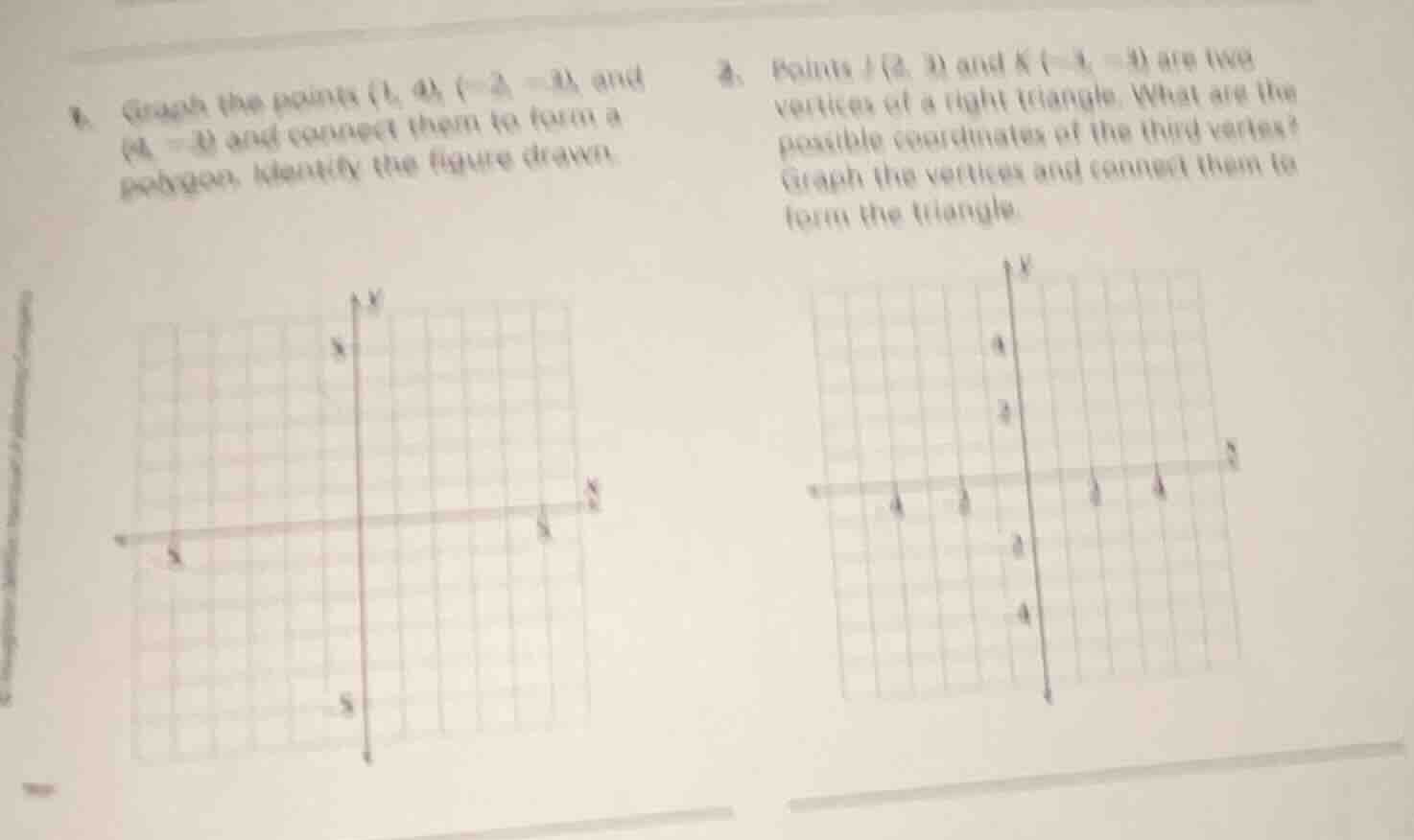
- graph the points (1, 4), (-2, -3), and (4, -3) and connect them to form a polygon. identify the figure drawn.
- points j (2, 3) and k (-3, -3) are two vertices of a right triangle. what are the possible coordinates of the third vertex? graph the vertices and connect them to form the triangle.
Problem 1
Step1: Plot given points
Plot $(1, 4)$, $(-2, -3)$, $(4, -3)$ on the coordinate plane.
Step2: Connect the points
Draw line segments between each pair of points.
Step3: Identify the polygon
Compare the side lengths and angles:
- Distance between $(-2, -3)$ and $(4, -3)$: $\sqrt{(4 - (-2))^2 + (-3 - (-3))^2} = 6$
- Distance between $(1, 4)$ and $(-2, -3)$: $\sqrt{(-2 - 1)^2 + (-3 - 4)^2} = \sqrt{9 + 49} = \sqrt{58}$
- Distance between $(1, 4)$ and $(4, -3)$: $\sqrt{(4 - 1)^2 + (-3 - 4)^2} = \sqrt{9 + 49} = \sqrt{58}$
Two sides are equal, and the base is horizontal.
Step1: Analyze right triangle conditions
For points $J(2, 3)$ and $K(-3, -3)$ to form a right triangle, the right angle can be at $J$, at $K$, or at the third vertex $L(x,y)$.
Case 1: Right angle at $J$
The line $JL$ is perpendicular to $JK$. Slope of $JK$ is $\frac{-3 - 3}{-3 - 2} = \frac{6}{5}$, so slope of $JL$ is $-\frac{5}{6}$. Also, $JL$ can be vertical/horizontal: if we take horizontal line from $J$: $(2, -3)$; vertical line from $J$: $(2, -3)$ does not work, instead $(-3, 3)$ (vertical from $K$ perpendicular to $JK$ at $J$? No, correct coordinates: right angle at $J$: $L(2, -3)$ (vertical line from $J$ meets horizontal from $K$)
Case 2: Right angle at $K$
Right angle at $K$: $L(-3, 3)$ (vertical line from $K$ meets horizontal from $J$)
Case 3: Right angle at $L$
Use perpendicular slope condition: $\frac{y-3}{x-2} \times \frac{y+3}{x+3} = -1$. Simplify: $(y^2 - 9) = -(x^2 - 2x + 3x -6) \implies x^2 + y^2 -x -6 =0$. Integer solutions include $(2, -3)$ and $(-3, 3)$, plus other points like $(-3, 3)$, $(2, -3)$, and also $( -2, 2)$ (non-integer also exist, but common integer coordinates are $(2, -3)$ and $(-3, 3)$)
Step2: Graph the points
Plot $J(2,3)$, $K(-3,-3)$, and the third vertex, then connect them.

Snap & solve any problem in the app
Get step-by-step solutions on Sovi AI
Photo-based solutions with guided steps
Explore more problems and detailed explanations
The polygon is an isosceles triangle.
---