QUESTION IMAGE
Question
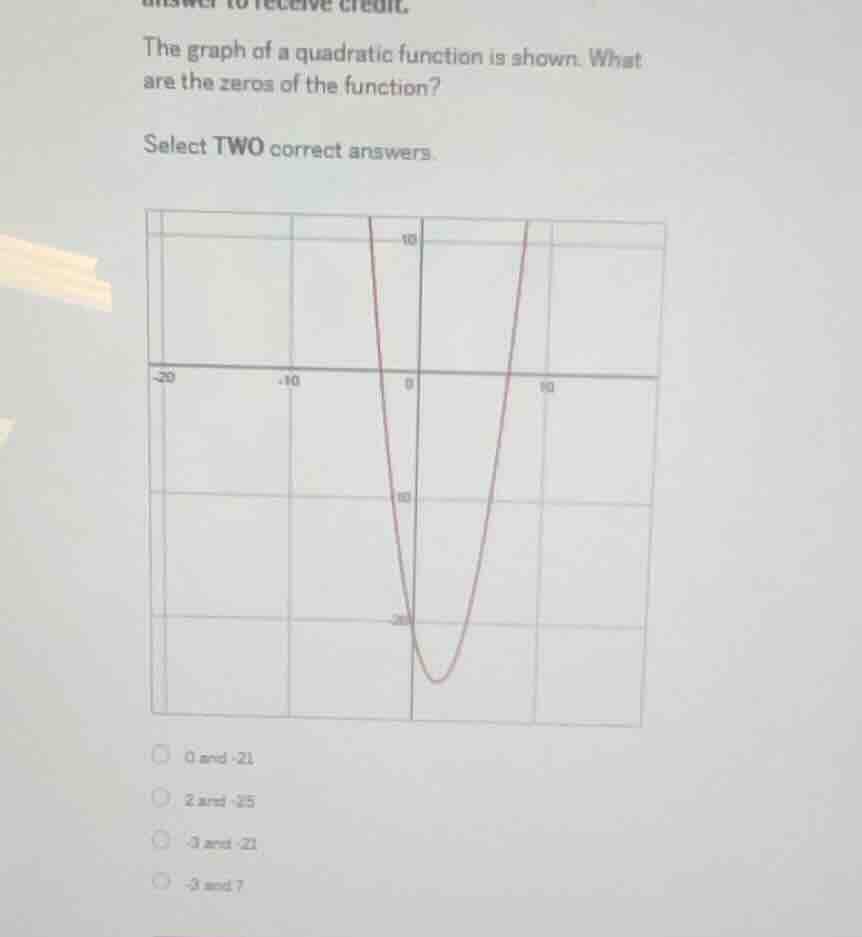
the graph of a quadratic function is shown. what are the zeros of the function? select two correct answers. options: 0 and -21, 2 and -25, -3 and -21, -3 and 7
Step1: Understand zeros of quadratic function
The zeros of a quadratic function are the x - intercepts, i.e., the values of \(x\) where the graph of the quadratic function crosses the \(x\) - axis (\(y = 0\)).
Step2: Analyze the graph and options
Looking at the graph (a parabola opening upwards), we need to find the \(x\) - values where it intersects the \(x\) - axis. Let's check the options:
- Option 1: \(0\) and \(- 21\): The graph does not seem to cross at \(0\) and \(-21\) from the given grid (with \(x\) values around \(- 20,-10,0,10\)).
- Option 2: \(2\) and \(-25\): The \(x\) - axis grid has values like \(-20,-10,0,10\), \(-25\) is not in the range of the visible grid for intersection.
- Option 3: \(-3\) and \(-21\): \(-21\) is not in the range of the visible \(x\) - axis for intersection.
- Option 4: \(-3\) and \(7\): These values are reasonable as \(x\) - intercepts for a parabola that is between \(x=-10\) to \(x = 10\) (from the grid). Also, for a quadratic function \(y=ax^{2}+bx + c\), the roots (zeros) are the \(x\) - intercepts. If we assume the parabola intersects the \(x\) - axis at \(x=-3\) and \(x = 7\), these are valid x - intercepts.

Snap & solve any problem in the app
Get step-by-step solutions on Sovi AI
Photo-based solutions with guided steps
Explore more problems and detailed explanations
D. \(-3\) and \(7\) (assuming the last option is D, if the options are labeled as A: \(0\) and \(-21\), B: \(2\) and \(-25\), C: \(-3\) and \(-21\), D: \(-3\) and \(7\))