QUESTION IMAGE
Question
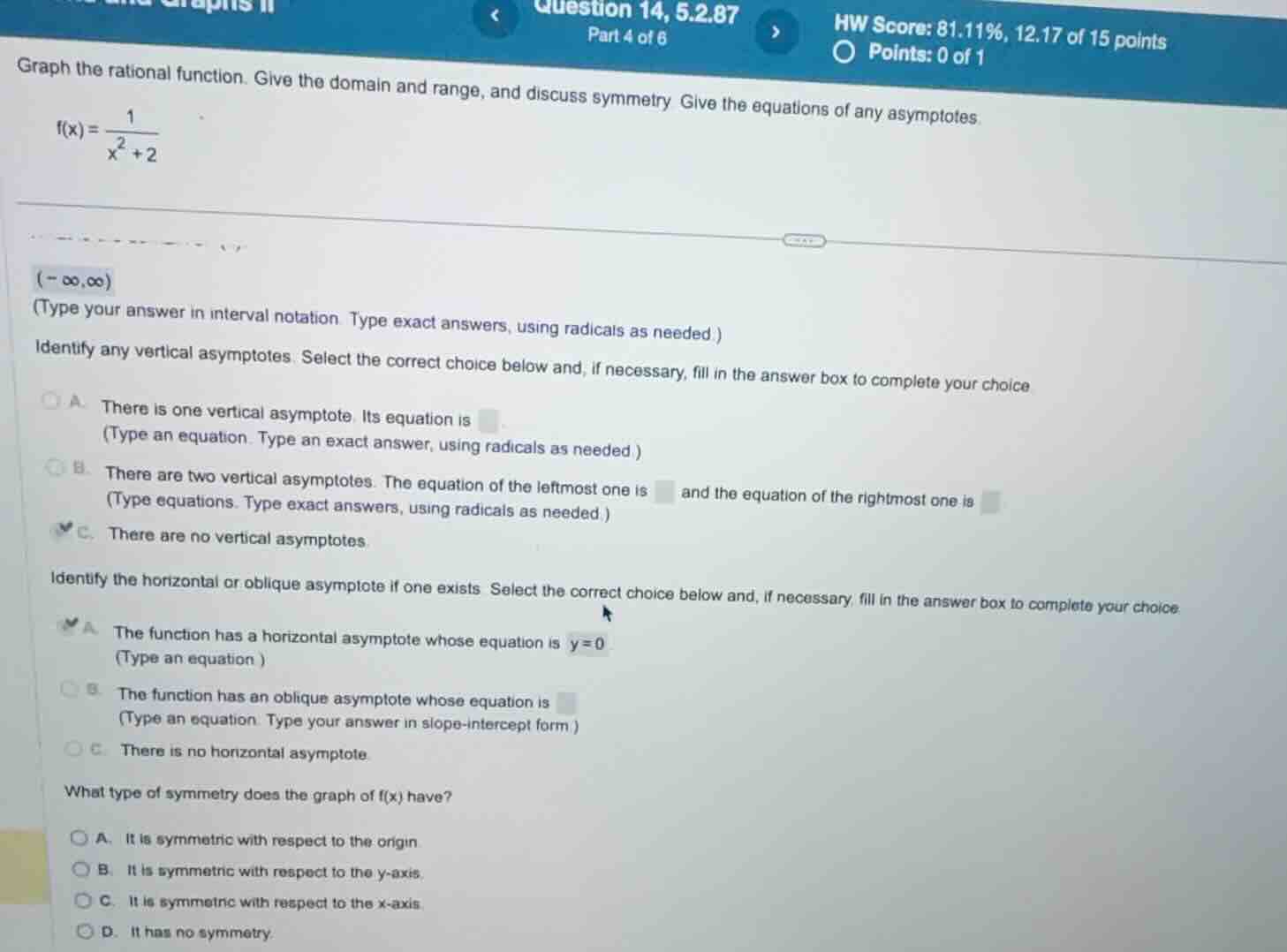
graph the rational function. give the domain and range, and discuss symmetry. give the equations of any asymptotes.\\( f(x) = \frac{1}{x^2 + 2} \\)\\( (-infty, infty) \\)\\( \text{(type your answer in interval notation. type exact answers, using radicals as needed.)} \\)\\( \text{identify any vertical asymptotes. select the correct choice below and, if necessary, fill in the answer box to complete your choice.} \\)\\( \text{a. there is one vertical asymptote. its equation is } \\)\\( \text{(type an equation. type an exact answer, using radicals as needed.)} \\)\\( \text{b. there are two vertical asymptotes. the equation of the leftmost one is } \\)\\( \text{and the equation of the rightmost one is } \\)\\( \text{(type equations. type exact answers, using radicals as needed.)} \\)\\( \text{c. there are no vertical asymptotes.} \\)\\( \text{identify the horizontal or oblique asymptote if one exists. select the correct choice below and, if necessary, fill in the answer box to complete your choice.} \\)\\( \text{a. the function has a horizontal asymptote whose equation is } y = 0 \\)\\( \text{(type an equation.)} \\)\\( \text{b. the function has an oblique asymptote whose equation is } \\)\\( \text{(type an equation. type your answer in slope - intercept form.)} \\)\\( \text{c. there is no horizontal asymptote.} \\)\\( \text{what type of symmetry does the graph of } f(x) \text{ have?} \\)\\( \text{a. it is symmetric with respect to the origin.} \\)\\( \text{b. it is symmetric with respect to the } y \text{-axis.} \\)\\( \text{c. it is symmetric with respect to the } x \text{-axis.} \\)\\( \text{d. it has no symmetry.}
For the vertical asymptotes:
Step1: Recall vertical asymptote condition
Vertical asymptotes occur where the denominator is zero (and numerator non - zero). For \(f(x)=\frac{1}{x^{2}+2}\), set denominator \(x^{2}+2 = 0\).
Step2: Solve the equation \(x^{2}+2=0\)
\(x^{2}=- 2\). Since the square of a real number \(x\) is always non - negative (\(x^{2}\geq0\) for all real \(x\)), there are no real solutions. So, there are no vertical asymptotes.
For the horizontal asymptote:
Step1: Recall horizontal asymptote rules for rational functions
For a rational function \(f(x)=\frac{N(x)}{D(x)}\), where the degree of \(N(x)\) is \(n\) and the degree of \(D(x)\) is \(m\). If \(n\lt m\), the horizontal asymptote is \(y = 0\).
Step2: Analyze degrees of numerator and denominator
In \(f(x)=\frac{1}{x^{2}+2}\), the degree of the numerator \(N(x) = 1\) (degree of a constant is 0? Wait, no. The numerator is \(1=1x^{0}\), so degree \(n = 0\). The denominator \(D(x)=x^{2}+2\) has degree \(m = 2\). Since \(n=0\lt m = 2\), the horizontal asymptote is \(y=0\).
For the symmetry:
To check symmetry, we use the definitions. A function is symmetric about the \(y\) - axis if \(f(-x)=f(x)\), symmetric about the origin if \(f(-x)=-f(x)\), and symmetric about the \(x\) - axis if \(f(x)=f(-x)\) and \(f(x)=-f(x)\) (which is only true for \(f(x) = 0\) in most cases).
Step1: Compute \(f(-x)\)
For \(f(x)=\frac{1}{x^{2}+2}\), \(f(-x)=\frac{1}{(-x)^{2}+2}=\frac{1}{x^{2}+2}\).
Step2: Compare \(f(-x)\) and \(f(x)\)
Since \(f(-x)=\frac{1}{x^{2}+2}=f(x)\), the function is symmetric about the \(y\) - axis.

Snap & solve any problem in the app
Get step-by-step solutions on Sovi AI
Photo-based solutions with guided steps
Explore more problems and detailed explanations
s:
- Vertical Asymptotes: C. There are no vertical asymptotes.
- Horizontal Asymptote: A. The function has a horizontal asymptote whose equation is \(y = 0\)
- Symmetry: B. It is symmetric with respect to the \(y\) - axis.