QUESTION IMAGE
Question
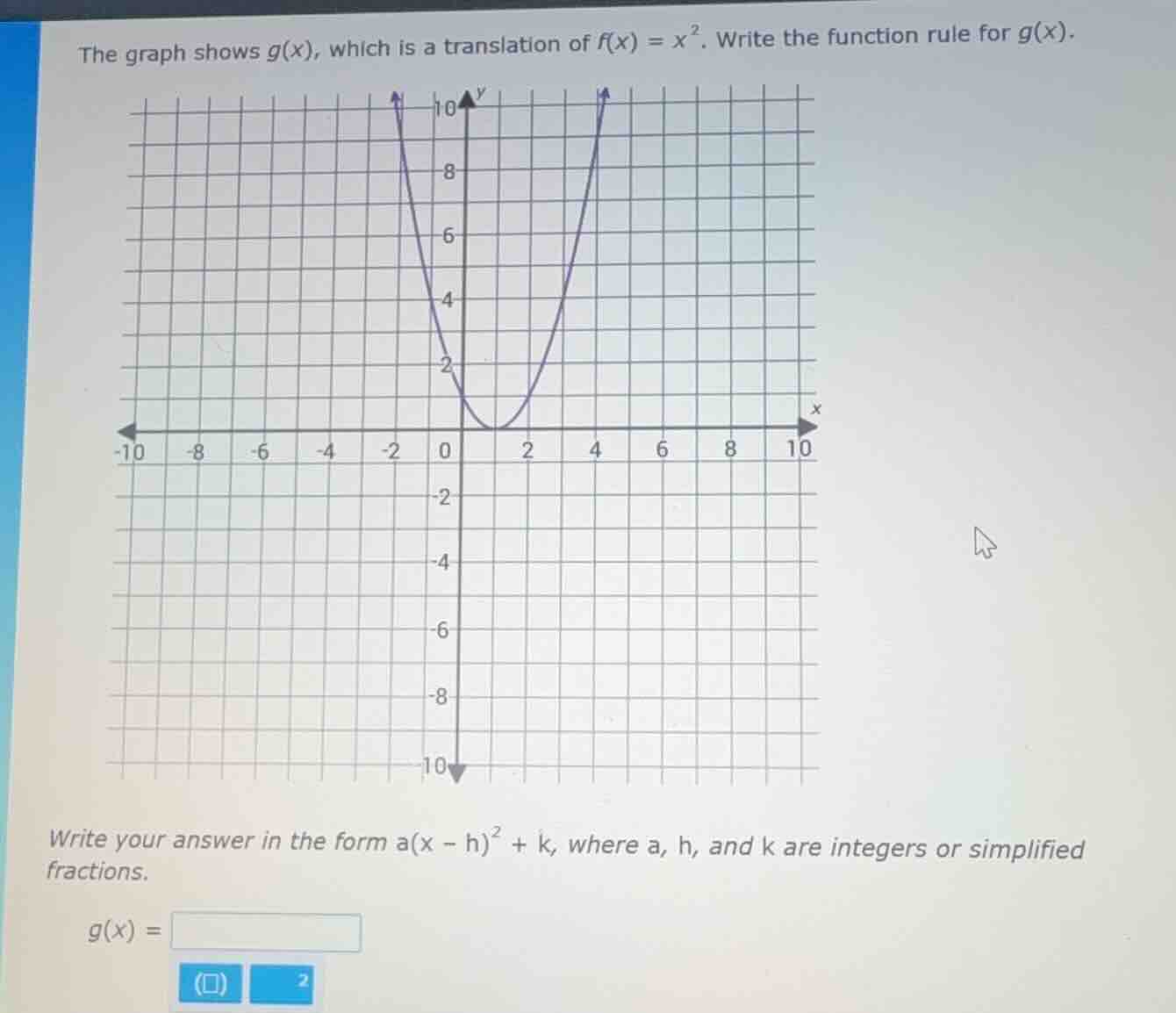
the graph shows g(x), which is a translation of f(x) = x². write the function rule for g(x).
write your answer in the form a(x - h)² + k, where a, h, and k are integers or simplified fractions.
g(x) =
Step1: Identify the vertex of \( g(x) \)
The parent function \( f(x) = x^2 \) has its vertex at \( (0, 0) \). From the graph of \( g(x) \), the vertex is also at \( (0, 0) \)? Wait, no, looking at the graph, the vertex of \( g(x) \) – wait, actually, the graph of \( g(x) \) seems to have the same vertex as \( f(x) \)? Wait, no, maybe I made a mistake. Wait, the standard form of a quadratic function after translation is \( g(x) = a(x - h)^2 + k \), where \( (h, k) \) is the vertex. For \( f(x) = x^2 \), \( a = 1 \), \( h = 0 \), \( k = 0 \). Now, looking at the graph of \( g(x) \), does it have the same vertex? Wait, the graph of \( g(x) \) – wait, maybe the vertex is still \( (0, 0) \), but is there a vertical stretch or compression? Wait, no, the problem says it's a translation. Wait, translation means shifting, not stretching. Wait, maybe I misread the graph. Wait, the graph of \( g(x) \) – let's check a point. For \( f(x) = x^2 \), when \( x = 1 \), \( f(1) = 1 \). For \( g(x) \), when \( x = 1 \), what's the \( y \)-value? Wait, the graph shows that at \( x = 1 \), \( y = 1 \)? Wait, no, maybe the vertex is at \( (0, 0) \), and since it's a translation, maybe \( a = 1 \), \( h = 0 \), \( k = 0 \)? No, that can't be. Wait, maybe the graph is actually \( g(x) = (x - 0)^2 + 0 \), but that's the same as \( f(x) \). That doesn't make sense. Wait, maybe the graph is shifted? Wait, no, the vertex is at \( (0, 0) \). Wait, maybe the problem is that the graph is \( g(x) = x^2 \), but that's the same as \( f(x) \). That can't be. Wait, maybe I made a mistake. Wait, let's re-examine the graph. The graph of \( g(x) \) – the parabola opens upwards, vertex at \( (0, 0) \), same as \( f(x) \). So maybe the translation is 0, so \( g(x) = (x - 0)^2 + 0 = x^2 \). But that seems odd. Wait, maybe the graph is actually shifted? Wait, no, the coordinates: the grid is from -10 to 10 on both axes. Wait, maybe the vertex is at \( (0, 0) \), so \( h = 0 \), \( k = 0 \), and \( a = 1 \). So \( g(x) = 1(x - 0)^2 + 0 = x^2 \). But that's the same as \( f(x) \). Maybe the problem has a typo, or I misread the graph. Wait, maybe the vertex is at \( (0, 0) \), so the function is \( g(x) = (x - 0)^2 + 0 = x^2 \). But that seems strange. Alternatively, maybe the vertex is at \( (0, 0) \), so \( g(x) = (x - 0)^2 + 0 = x^2 \).
Wait, maybe I made a mistake. Let's check again. The problem says "a translation of \( f(x) = x^2 \)". Translation means horizontal or vertical shift. So if there's no shift, then \( g(x) = x^2 \). So in the form \( a(x - h)^2 + k \), \( a = 1 \), \( h = 0 \), \( k = 0 \). So \( g(x) = 1(x - 0)^2 + 0 = x^2 \).
Step2: Write the function rule
Since the vertex \( (h, k) \) is \( (0, 0) \) and the vertical stretch factor \( a \) is 1 (because it's a translation, not a stretch), the function rule for \( g(x) \) is \( g(x) = (x - 0)^2 + 0 \), which simplifies to \( g(x) = x^2 \).

Snap & solve any problem in the app
Get step-by-step solutions on Sovi AI
Photo-based solutions with guided steps
Explore more problems and detailed explanations
\( g(x) = (x - 0)^2 + 0 \) (or simplified as \( g(x) = x^2 \))