QUESTION IMAGE
Question
graphing inequalities
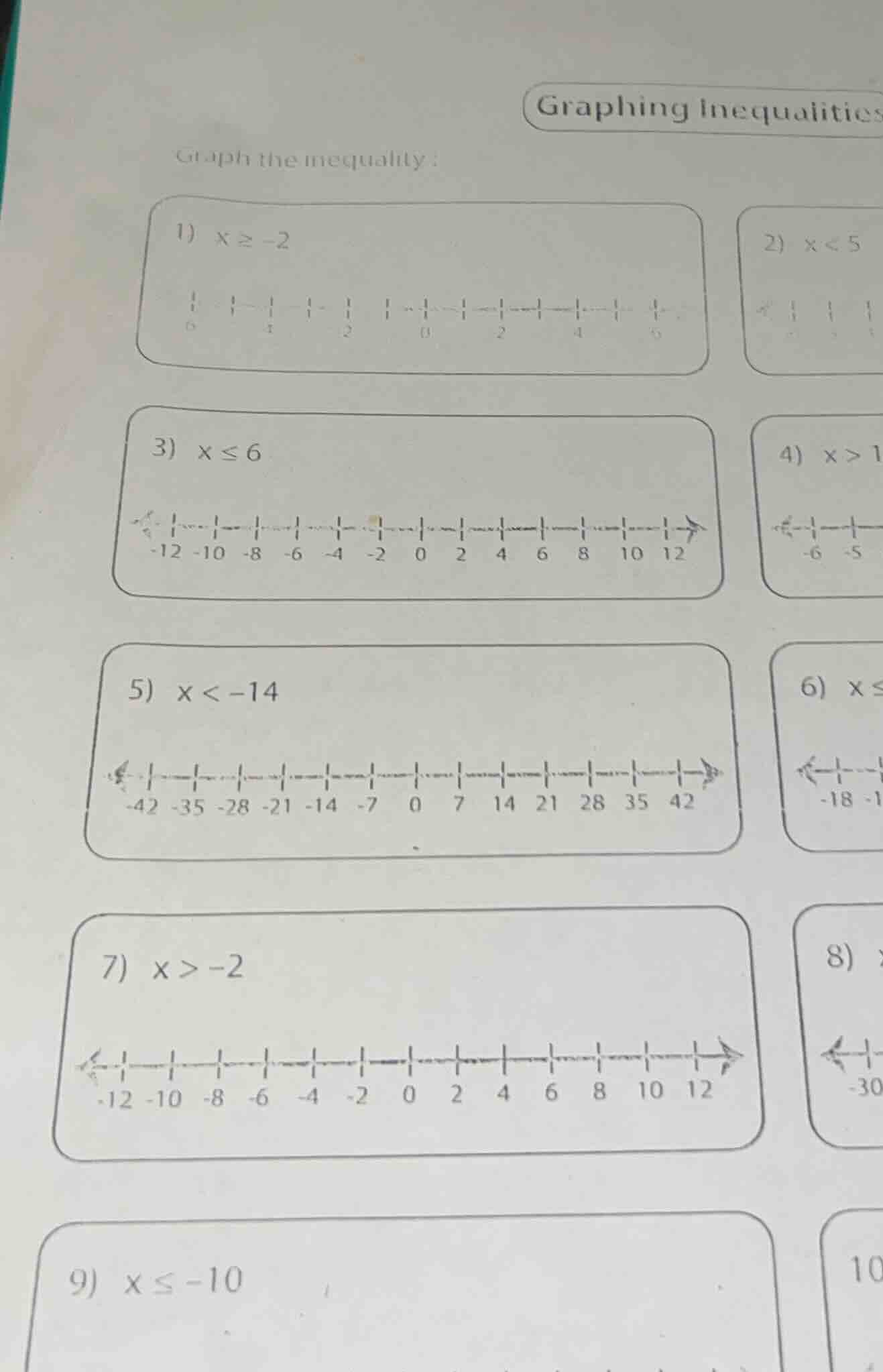
graph the inequality:
- ( x geq -2 )
- ( x < 5 )
- ( x leq 6 )
- ( x > 1 )
- ( x < -14 )
- ( x leq ) (partially visible)
- ( x > -2 )
- (partially visible)
- ( x leq -10 )
- (partially visible)
Let's take problem 1: \( x \geq -2 \) as an example to show the graphing steps.
Step1: Identify the critical point
The inequality is \( x \geq -2 \), so the critical point is \( x = -2 \).
Step2: Determine the type of dot
Since the inequality is "greater than or equal to", we use a closed (filled) dot at \( x = -2 \) to indicate that -2 is included in the solution set.
Step3: Determine the direction of the line
For \( x \geq -2 \), the solutions are all numbers greater than or equal to -2, so we draw a line to the right of the closed dot at \( x = -2 \) on the number line.
For problem 2: \( x < 5 \)
Step1: Identify the critical point
The critical point is \( x = 5 \).
Step2: Determine the type of dot
Since the inequality is "less than" (not "less than or equal to"), we use an open (unfilled) dot at \( x = 5 \) to indicate that 5 is not included in the solution set.
Step3: Determine the direction of the line
For \( x < 5 \), the solutions are all numbers less than 5, so we draw a line to the left of the open dot at \( x = 5 \) on the number line.
For problem 3: \( x \leq 6 \)
Step1: Identify the critical point
The critical point is \( x = 6 \).
Step2: Determine the type of dot
Since the inequality is "less than or equal to", we use a closed dot at \( x = 6 \).
Step3: Determine the direction of the line
For \( x \leq 6 \), the solutions are all numbers less than or equal to 6, so we draw a line to the left of the closed dot at \( x = 6 \) on the number line (the given number line has marks from -12 to 12, so we shade left from 6).
For problem 4: \( x > 1 \) (assuming the number line has appropriate marks)
Step1: Identify the critical point
The critical point is \( x = 1 \).
Step2: Determine the type of dot
Since the inequality is "greater than", we use an open dot at \( x = 1 \).
Step3: Determine the direction of the line
For \( x > 1 \), the solutions are all numbers greater than 1, so we draw a line to the right of the open dot at \( x = 1 \).
For problem 5: \( x < -14 \)
Step1: Identify the critical point
The critical point is \( x = -14 \).
Step2: Determine the type of dot
Since the inequality is "less than", we use an open dot at \( x = -14 \).
Step3: Determine the direction of the line
For \( x < -14 \), the solutions are all numbers less than -14, so we draw a line to the left of the open dot at \( x = -14 \) on the number line (marks from -42 to 42, so shade left from -14).
For problem 6: (assuming it's \( x \leq \) some number, say if it's \( x \leq -15 \) with number line from -18 etc.)
Step1: Identify the critical point
Suppose the critical point is \( x = -15 \) (depending on the actual problem, but following the pattern).
Step2: Determine the type of dot
Closed dot if "less than or equal to".
Step3: Determine the direction of the line
Draw line to the left of the closed dot.
For problem 7: \( x > -2 \)
Step1: Identify the critical point
The critical point is \( x = -2 \).
Step2: Determine the type of dot
Open dot (since it's "greater than", not "greater than or equal to").
Step3: Determine the direction of the line
Draw a line to the right of the open dot at \( x = -2 \) on the number line (marks from -12 to 12, so shade right from -2).
For problem 8: (assuming it's a similar inequality, say \( x < -30 \) with number line from -30 etc.)
Step1: Identify the critical point
Critical point at \( x = -30 \).
Step2: Determine the type of dot
Open dot (if "less than").
Step3: Determine the direction of the line
Draw line to the left of the open dot.
For problem 9: \( x \leq -10 \)
Step1: Identify the critical point
The critica…

Snap & solve any problem in the app
Get step-by-step solutions on Sovi AI
Photo-based solutions with guided steps
Explore more problems and detailed explanations
The graphs are drawn by:
- For \( x \geq -2 \): Closed dot at -2, line to the right.
- For \( x < 5 \): Open dot at 5, line to the left.
- For \( x \leq 6 \): Closed dot at 6, line to the left.
- For \( x > 1 \): Open dot at 1, line to the right.
- For \( x < -14 \): Open dot at -14, line to the left.
- (Depends on the full inequality) Follow critical point, dot type, direction.
- For \( x > -2 \): Open dot at -2, line to the right.
- (Depends on the full inequality) Follow critical point, dot type, direction.
- For \( x \leq -10 \): Closed dot at -10, line to the left.
- (Depends on the full inequality) Follow critical point, dot type, direction.