QUESTION IMAGE
Question
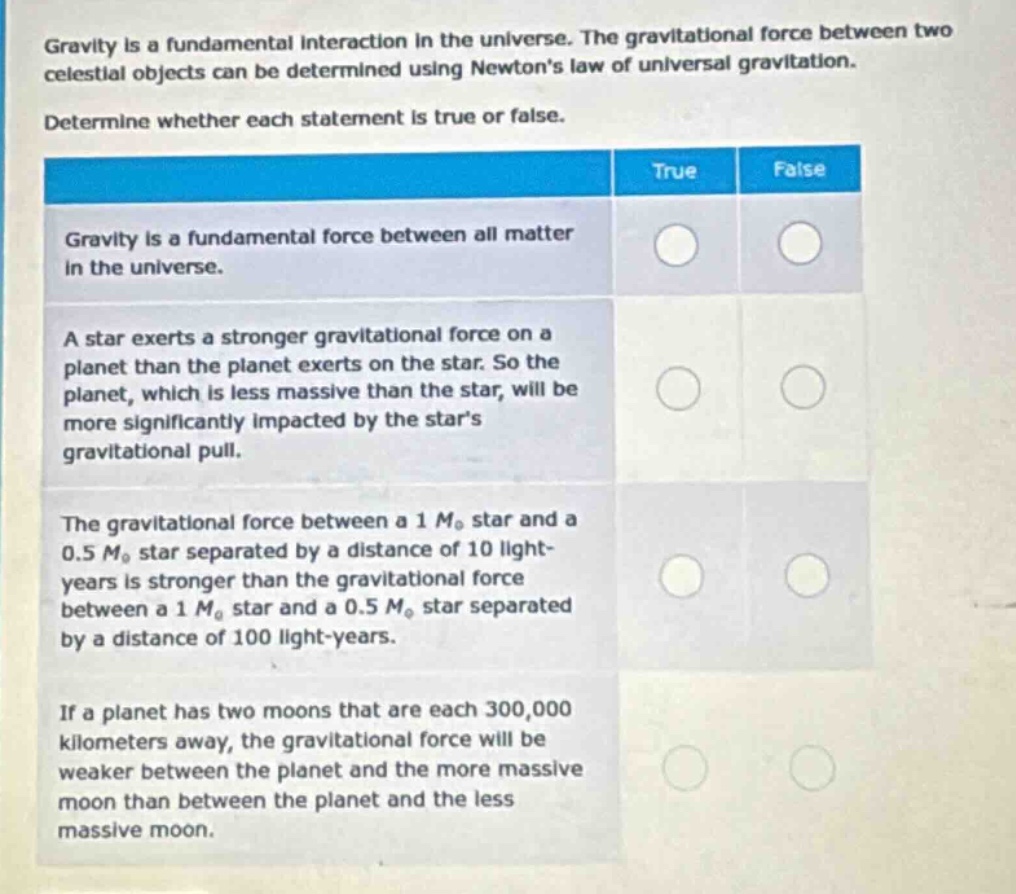
gravity is a fundamental interaction in the universe. the gravitational force between two celestial objects can be determined using newtons law of universal gravitation.
determine whether each statement is true or false.
| true | false | |
|---|---|---|
| a star exerts a stronger gravitational force on a planet than the planet exerts on the star. so the planet, which is less massive than the star, will be more significantly impacted by the star’s gravitational pull. | ○ | ○ |
| the gravitational force between a 1 $m_\odot$ star and a 0.5 $m_\odot$ star separated by a distance of 10 light - years is stronger than the gravitational force between a 1 $m_\odot$ star and a 0.5 $m_\odot$ star separated by a distance of 100 light - years. | ○ | ○ |
| if a planet has two moons that are each 300,000 kilometers away, the gravitational force will be weaker between the planet and the more massive moon than between the planet and the less massive moon. | ○ | ○ |
To determine the truth value of each statement, we analyze them using Newton’s law of universal gravitation, \( F = G\frac{m_1m_2}{r^2} \), where \( F \) is the gravitational force, \( G \) is the gravitational constant, \( m_1 \) and \( m_2 \) are the masses of the two objects, and \( r \) is the distance between their centers.
Statement 1: "Gravity is a fundamental force between all matter in the universe."
Gravity is one of the four fundamental forces (along with electromagnetism, weak nuclear force, and strong nuclear force) and acts between all objects with mass (all matter) in the universe.
Statement 2: "A star exerts a stronger gravitational force on a planet than the planet exerts on the star... the planet will be more significantly impacted..."
By Newton’s third law, the gravitational force exerted by the star on the planet is equal in magnitude to the force exerted by the planet on the star. The planet’s acceleration (impact) is larger because \( a = \frac{F}{m} \), and the planet has less mass (\( m \)) than the star. However, the statement incorrectly claims the star exerts a stronger force (it is equal).
Statement 3: "The gravitational force between a \( 1\ M_\odot \) star and a \( 0.5\ M_\odot \) star separated by 10 light - years is stronger than... separated by 100 light - years."
From \( F = G\frac{m_1m_2}{r^2} \), force is inversely proportional to the square of the distance (\( r \)). For the same masses (\( m_1 = 1\ M_\odot \), \( m_2 = 0.5\ M_\odot \)), a smaller distance (\( r = 10 \) light - years) gives a larger force than a larger distance (\( r = 100 \) light - years) because \( r^2 \) is smaller for 10 light - years.
Statement 4: "If a planet has two moons... the gravitational force will be weaker between the planet and the more massive moon..."
From \( F = G\frac{m_1m_2}{r^2} \), force is directly proportional to the product of the masses (\( m_1 \) = planet’s mass, \( m_2 \) = moon’s mass) and inversely proportional to \( r^2 \). For the same distance (\( r = 300,000 \) km), a more massive moon (\( m_2 \) larger) should result in a stronger force, not weaker.

Snap & solve any problem in the app
Get step-by-step solutions on Sovi AI
Photo-based solutions with guided steps
Explore more problems and detailed explanations
s:
- Gravity is a fundamental force between all matter in the universe: True
- A star exerts a stronger gravitational force on a planet...: False
- The gravitational force between a \( 1\ M_\odot \) star and a \( 0.5\ M_\odot \) star...: True
- If a planet has two moons...: False