QUESTION IMAGE
Question
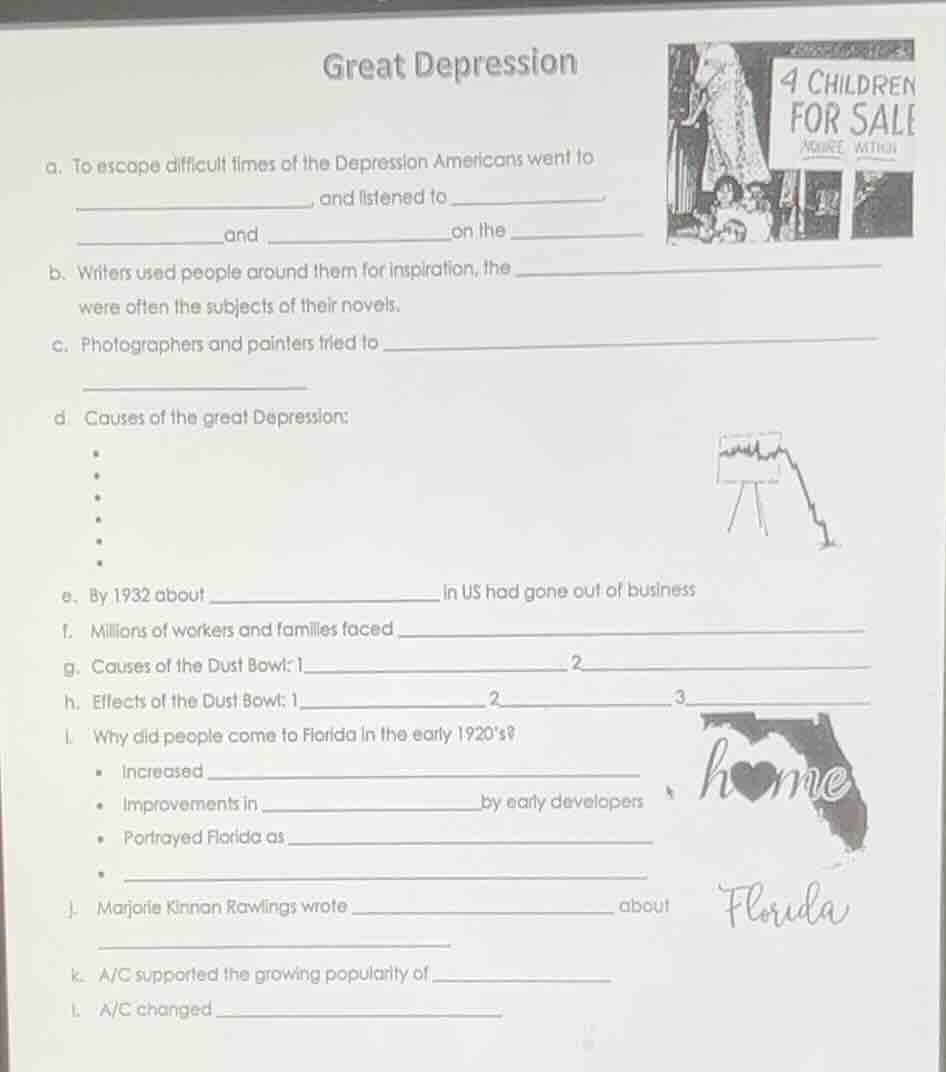
great depression
a. to escape difficult times of the depression americans went to _____________, and listened to ___________, ___________and ___________on the _____________
b. writers used people around them for inspiration, the _______________ were often the subjects of their novels.
c. photographers and painters tried to _______________
d. causes of the great depression:
e. by 1932 about _______________ in us had gone out of business
f. millions of workers and families faced _______________
g. causes of the dust bowl: 1_______________ 2
h. effects of the dust bowl: 1_____________ 2_____________3
i. why did people come to florida in the early 1920s?
- increased _______________
- improvements in _______________by early developers
- portrayed florida as _______________
- _______________
j. marjorie kinnan rawlings wrote _____________ about _____________
k. a/c supported the growing popularity of _______________
l. a/c changed _______________
a. During the Great Depression, Americans sought cheap entertainment; movie theaters (nickelodeons) offered escape, and radio broadcasts featured comedy, music, and dramas.
b. Writers focused on the experiences of working-class and struggling ordinary people, who were hard-hit by the Depression.
c. Visual artists aimed to document and depict the harsh realities and human suffering of the Depression era.
d. Key causes include the 1929 stock market crash, overproduction in industry/agriculture, bank failures, unequal wealth distribution, high tariffs reducing global trade, and lack of government economic oversight.
e. By 1932, roughly 100,000 U.S. businesses had collapsed due to the economic crisis.
f. Workers and families faced widespread unemployment, homelessness, hunger, and extreme poverty.
g. Dust Bowl causes: 1) Intensive, unsustainable farming practices that removed native grasslands; 2) Severe, prolonged drought in the Great Plains.
h. Dust Bowl effects: 1) Massive dust storms destroyed farmland and crops; 2) Thousands of farmers (Okies) migrated west for work; 3) Severe respiratory health issues for residents.
i. Early 1920s Florida boom drivers: 1) Increased tourism and demand for real estate; 2) Improvements in transportation (railroads, roads) by developers; 3) Portrayal as a warm, tropical paradise for retirement/vacation; 4) Easy access to credit for land purchases.
j. Marjorie Kinnan Rawlings wrote The Yearling, a novel about rural Florida life.
k. Air conditioning (A/C) supported the growing popularity of Florida as a place to live and vacation by mitigating its hot climate.
l. A/C changed patterns of settlement and economic growth, allowing widespread development in warm, humid regions like the American South.

Snap & solve any problem in the app
Get step-by-step solutions on Sovi AI
Photo-based solutions with guided steps
Explore more problems and detailed explanations
a. movie theaters; comedy shows; musical performances; radio
b. working class and unemployed people
c. capture the harsh realities of the Depression
d. - 1929 Stock Market Crash
- Overproduction in agriculture and industry
- Widespread bank failures
- Unequal distribution of wealth
- High protective tariffs reducing global trade
- Lack of government economic regulation
e. 100,000 businesses
f. unemployment, homelessness, and extreme poverty
g. 1) Unsustainable farming practices that removed native grasses; 2) Severe, prolonged drought
h. 1) Destruction of farmland and crops via dust storms; 2) Mass migration of farmers to the West; 3) Chronic respiratory health problems for local residents
i. - tourism and real estate demand
- transportation (roads and railroads)
- a warm, idyllic tropical paradise
- easy access to installment credit for land
j. The Yearling; rural Florida life
k. Florida as a residential and vacation destination
l. patterns of settlement and economic development in warm, humid regions