QUESTION IMAGE
Question
guided notes lesson 8 - 3: aa similarity
i can prove triangle similarity using angle - angle. (ma.912.gr.1.2)
i can solve problems involving similarity in triangles. (ma.912.gr.1.6)
learn:
postulate 8.1: angle - angle (aa) similarity
if two angles of one triangle are congruent to two angles of another triangle, then the triangles are similar.
example: if $\angle a\cong\angle y$ and $\angle b\cong\angle z$, then $\triangle abc\cong\triangle yzx$.
when solving for unknown quantities in similar triangles, solving proportions will be utilized. see below for a review from algebra 1.
$\frac{x}{9}=\frac{2x - 3}{24}$
$24(x)=9(2x - 3)$ cross multiply
$24x = 18x-27$ distribute
$6x=-27$ subtract 18x from both sides
$x = - 4.5$ divide both sides by 6
practice solving proportions:
- $\frac{t}{0.3}=\frac{17}{0.9}$
- $\frac{x}{3}=\frac{3x + 2}{6}$
- $\frac{5}{7k + 4}=\frac{2}{2k-3}$
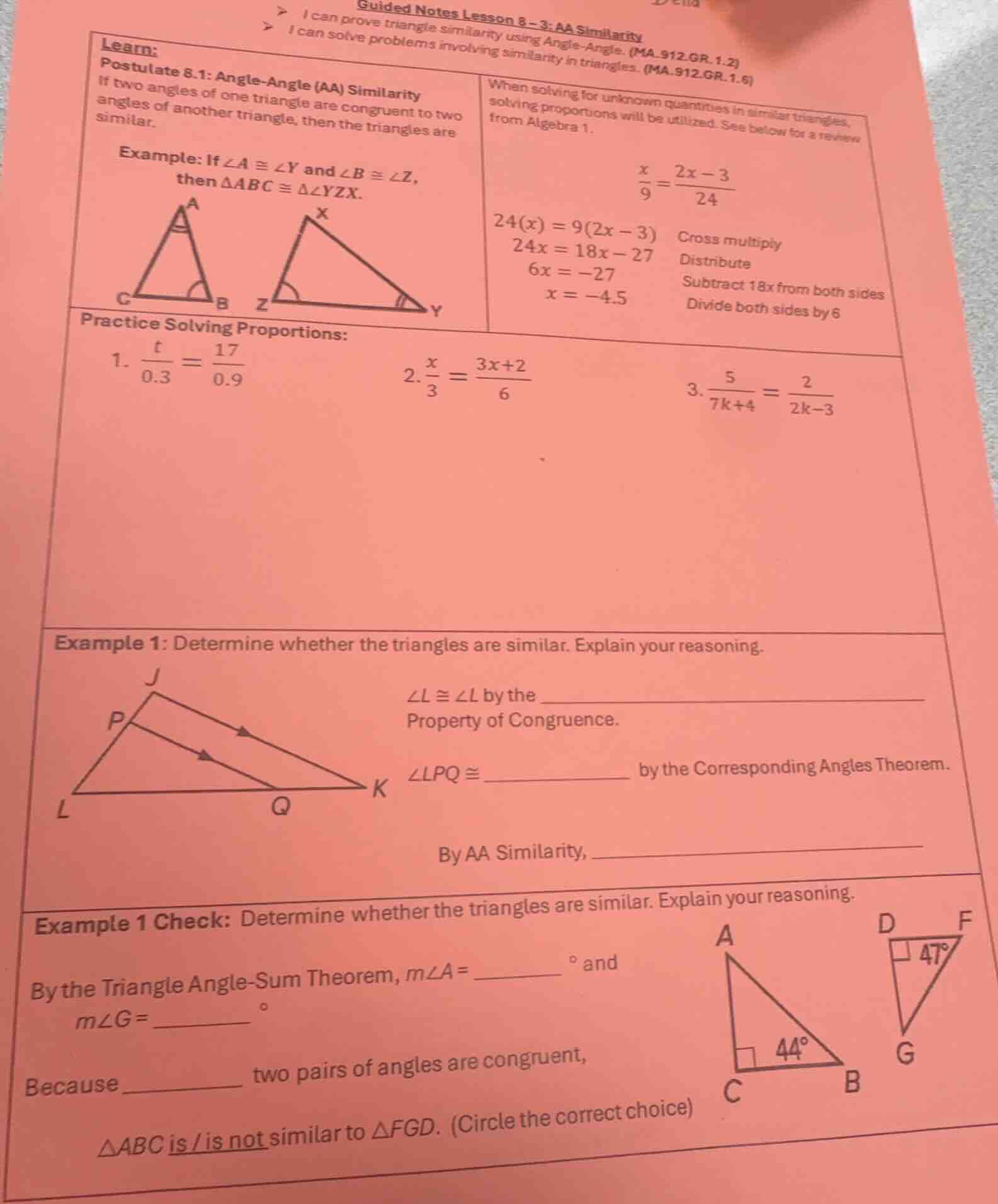
example 1: determine whether the triangles are similar. explain your reasoning.
$\angle l\cong\angle l$ by the \underline{\qquad} property of congruence.
$\angle lpq\cong\underline{\qquad}$ by the corresponding angles theorem.
by aa similarity, \underline{\qquad}
example 1 check: determine whether the triangles are similar. explain your reasoning.
by the triangle angle - sum theorem, $m\angle a = \underline{\qquad}^\circ$ and $m\angle g=\underline{\qquad}^\circ$
because \underline{\qquad} two pairs of angles are congruent,
$\triangle abc$ is / is not similar to $\triangle fgd$. (circle the correct choice)
Practice Solving Proportions
Step1: Cross multiply to eliminate fractions
$\frac{t}{0.3} = \frac{17}{0.9} \\
0.9t = 0.3 \times 17$
Step2: Calculate right-hand side value
$0.9t = 5.1$
Step3: Isolate t by dividing by 0.9
$t = \frac{5.1}{0.9}$
Step4: Simplify the fraction
$t = \frac{17}{3} \approx 5.67$
---
Step1: Cross multiply to eliminate fractions
$\frac{x}{3} = \frac{3x+2}{6} \\
6x = 3(3x+2)$
Step2: Distribute the right-hand side
$6x = 9x + 6$
Step3: Isolate x terms
$6x - 9x = 6 \\
-3x = 6$
Step4: Solve for x
$x = \frac{6}{-3} = -2$
---
Step1: Cross multiply to eliminate fractions
$\frac{5}{7k+4} = \frac{2}{2k-3} \\
5(2k-3) = 2(7k+4)$
Step2: Distribute both sides
$10k - 15 = 14k + 8$
Step3: Isolate k terms
$10k - 14k = 8 + 15 \\
-4k = 23$
Step4: Solve for k
$k = -\frac{23}{4} = -5.75$
- The shared angle $\angle L$ is congruent to itself via the Reflexive Property of Congruence.
- Segments $PQ$ and $JK$ are parallel, so corresponding angles $\angle LPQ$ and $\angle LJK$ are congruent by the Corresponding Angles Theorem.
- With two pairs of congruent angles, the triangles satisfy AA Similarity.
Step1: Calculate $m\angle A$ using Triangle Angle-Sum Theorem
For $\triangle ABC$:
$m\angle A + 90^\circ + 44^\circ = 180^\circ \\
m\angle A = 180^\circ - 134^\circ = 46^\circ$
Step2: Calculate $m\angle G$ using Triangle Angle-Sum Theorem
For $\triangle FGD$:
$m\angle G + 90^\circ + 47^\circ = 180^\circ \\
m\angle G = 180^\circ - 137^\circ = 43^\circ$
Step3: Compare angle pairs
Only the right angles are congruent; the other angle pairs do not match, so there are not two pairs of congruent angles.

Snap & solve any problem in the app
Get step-by-step solutions on Sovi AI
Photo-based solutions with guided steps
Explore more problems and detailed explanations
- $t = \frac{17}{3}$
- $x = -2$
- $k = -\frac{23}{4}$
---