QUESTION IMAGE
Question
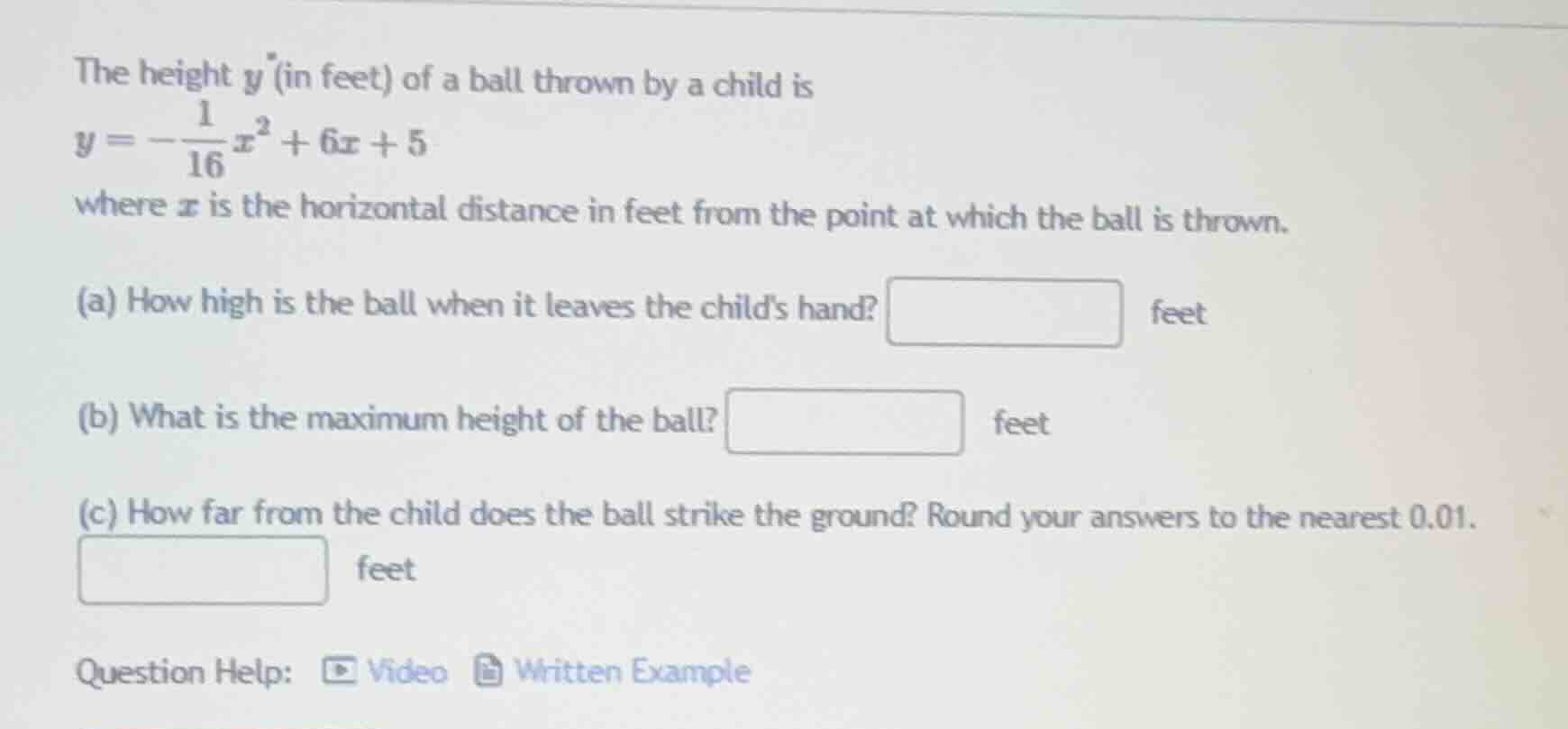
the height ( y ) (in feet) of a ball thrown by a child is ( y = -\frac{1}{16}x^2 + 6x + 5 ) where ( x ) is the horizontal distance in feet from the point at which the ball is thrown. (a) how high is the ball when it leaves the childs hand? (square) feet (b) what is the maximum height of the ball? (square) feet (c) how far from the child does the ball strike the ground? round your answers to the nearest 0.01. (square) feet question help: video written example
Part (a)
Step1: Substitute \( x = 0 \) (ball leaves hand, horizontal distance 0) into the equation.
\( y = -\frac{1}{16}(0)^2 + 6(0) + 5 \)
Step2: Simplify the expression.
\( y = 0 + 0 + 5 = 5 \)
The given equation is a quadratic \( y = ax^2 + bx + c \) with \( a = -\frac{1}{16} \), \( b = 6 \), \( c = 5 \). The x-coordinate of the vertex (where maximum occurs) is \( x = -\frac{b}{2a} \).
Step1: Calculate the x-coordinate of the vertex.
\( x = -\frac{6}{2 \times (-\frac{1}{16})} = -\frac{6}{-\frac{1}{8}} = 6 \times 8 = 48 \)
Step2: Substitute \( x = 48 \) into the height equation.
\( y = -\frac{1}{16}(48)^2 + 6(48) + 5 \)
Step3: Simplify the expression.
First, \( (48)^2 = 2304 \), so \( -\frac{1}{16} \times 2304 = -144 \). Then \( 6 \times 48 = 288 \). So \( y = -144 + 288 + 5 = 149 \)
The ball strikes the ground when \( y = 0 \), so solve \( -\frac{1}{16}x^2 + 6x + 5 = 0 \). Multiply both sides by -16 to eliminate the fraction: \( x^2 - 96x - 80 = 0 \). Use the quadratic formula \( x = \frac{-b \pm \sqrt{b^2 - 4ac}}{2a} \) where \( a = 1 \), \( b = -96 \), \( c = -80 \).
Step1: Calculate the discriminant \( D = b^2 - 4ac \).
\( D = (-96)^2 - 4(1)(-80) = 9216 + 320 = 9536 \)
Step2: Find the square root of the discriminant.
\( \sqrt{9536} \approx 97.65 \) (rounded to two decimal places)
Step3: Apply the quadratic formula (we take the positive root since distance can't be negative).
\( x = \frac{96 + 97.65}{2} = \frac{193.65}{2} \approx 96.83 \) (the other root is negative, so we discard it)

Snap & solve any problem in the app
Get step-by-step solutions on Sovi AI
Photo-based solutions with guided steps
Explore more problems and detailed explanations
5