QUESTION IMAGE
Question
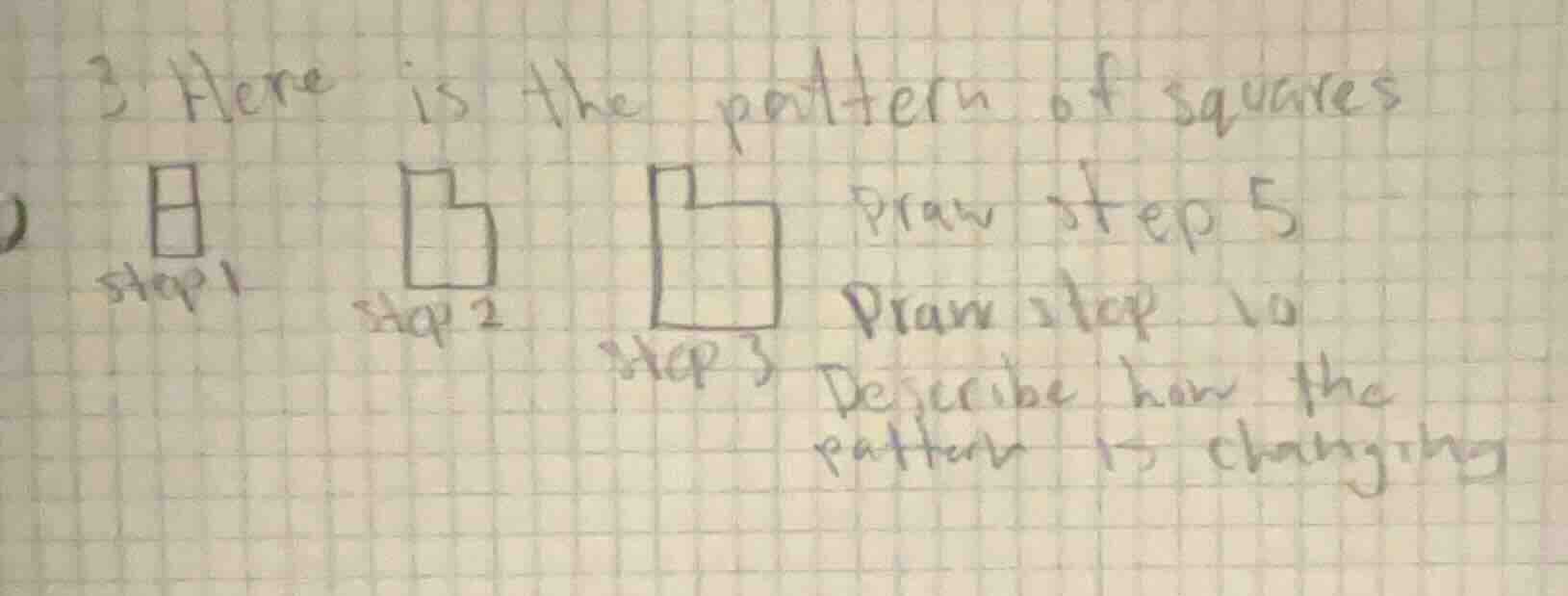
- here is the pattern of squares
step1 step2 step3
draw step 5
draw step 10
describe how the pattern is changing
Analyzing the Pattern of Squares
Step 1: Identify the Pattern in Steps 1–3
- Step 1: A 2×1 vertical rectangle (2 squares stacked vertically).
- Step 2: A 2×2 square missing the top - right square (3 squares: 2×2 = 4, 4 - 1 = 3).
- Step 3: A 3×2 rectangle? Wait, no—looking at the shape, Step 3 seems to be a 3×2 - like shape but actually, let's count the squares. Step 1: 2 squares. Step 2: 3 squares. Step 3: 4 squares? Wait, no, maybe the pattern is that each step adds one square to the "base" or expands the shape. Wait, another way: Step 1: 2 squares (1 column, 2 rows). Step 2: 3 squares (2 columns, 2 rows, missing 1). Step 3: 4 squares (3 columns, 2 rows? No, maybe horizontal expansion. Let's re - examine:
- Step 1: Vertical 2 - square column (height 2, width 1).
- Step 2: Width 2, height 2, with a square missing at the top - right (so 2×2 - 1 = 3 squares).
- Step 3: Width 3, height 2, with a square missing at the top - right of the original 2×2 part? Wait, no, maybe each step increases the width by 1 square at the bottom - right and keeps the top - left 2 - square column.
Let's list the number of squares:
- Step 1: 2 squares.
- Step 2: 3 squares (2 + 1).
- Step 3: 4 squares (3 + 1).
Ah, so the number of squares follows \( n = \text{step number}+ 1 \)? Wait, Step 1: 2 = 1 + 1? No, 1+1 = 2, Step 2: 2 + 1 = 3, Step 3: 3 + 1 = 4. Yes! So the number of squares in step \( k \) is \( k + 1 \).
Step 2: Determine Step 5
If the number of squares in step \( k \) is \( k + 1 \), then:
- Step 1: \( 1 + 1 = 2 \) squares.
- Step 2: \( 2 + 1 = 3 \) squares.
- Step 3: \( 3 + 1 = 4 \) squares.
- Step 4: \( 4 + 1 = 5 \) squares.
- Step 5: \( 5 + 1 = 6 \) squares.
Now, the shape: The original top - left has a 2 - square vertical column (height 2, width 1). Then, to the right of this column, each step adds a square at the bottom - right (so the width increases by 1 each step, with the bottom row being longer than the top row by 1 square? Wait, Step 1: Top row: 1 square, Bottom row: 1 square (vertical stack). Step 2: Top row: 1 square, Bottom row: 2 squares (so a "step" at the bottom - right). Step 3: Top row: 1 square, Bottom row: 3 squares. Wait, that makes more sense!
- Step 1:
- Top row: 1 square (column 1).
- Bottom row: 1 square (column 1).
- Step 2:
- Top row: 1 square (column 1).
- Bottom row: 2 squares (columns 1 and 2).
- Step 3:
- Top row: 1 square (column 1).
- Bottom row: 3 squares (columns 1, 2, 3).
Yes, this fits the square count:
- Step 1: \( 1 + 1 = 2 \) squares.
- Step 2: \( 1 + 2 = 3 \) squares.
- Step 3: \( 1 + 3 = 4 \) squares.
So the pattern for the rows:
- Top row: Always 1 square (in column 1, height 2? Wait, no, the initial shape in Step 1 is two squares stacked vertically, so top and bottom in column 1. Then Step 2: Top square in column 1, bottom squares in columns 1 and 2. Step 3: Top square in column 1, bottom squares in columns 1, 2, 3.
So to draw Step 5:
- Top row: 1 square (column 1, same as Steps 1–3).
- Bottom row: 5 squares (columns 1, 2, 3, 4, 5).
Step 3: Describe the Pattern Change
- Number of Squares: In step \( k \), the number of squares is \( k + 1 \) (since Step 1: \( 1+1 = 2 \), Step 2: \( 2 + 1=3 \), Step 3: \( 3 + 1 = 4 \), etc.).
- Shape Change: The top - left has a vertical 2 - square column (top and bottom in column 1). The bottom row expands horizontally by 1 square per step (from column 1 in Step 1 to column \( k \) in Step \( k \) for the bottom row), while the top row remains a single square in column 1.
Drawing Step 5
- Draw a vertical s…

Snap & solve any problem in the app
Get step-by-step solutions on Sovi AI
Photo-based solutions with guided steps
Explore more problems and detailed explanations
Analyzing the Pattern of Squares
Step 1: Identify the Pattern in Steps 1–3
- Step 1: A 2×1 vertical rectangle (2 squares stacked vertically).
- Step 2: A 2×2 square missing the top - right square (3 squares: 2×2 = 4, 4 - 1 = 3).
- Step 3: A 3×2 rectangle? Wait, no—looking at the shape, Step 3 seems to be a 3×2 - like shape but actually, let's count the squares. Step 1: 2 squares. Step 2: 3 squares. Step 3: 4 squares? Wait, no, maybe the pattern is that each step adds one square to the "base" or expands the shape. Wait, another way: Step 1: 2 squares (1 column, 2 rows). Step 2: 3 squares (2 columns, 2 rows, missing 1). Step 3: 4 squares (3 columns, 2 rows? No, maybe horizontal expansion. Let's re - examine:
- Step 1: Vertical 2 - square column (height 2, width 1).
- Step 2: Width 2, height 2, with a square missing at the top - right (so 2×2 - 1 = 3 squares).
- Step 3: Width 3, height 2, with a square missing at the top - right of the original 2×2 part? Wait, no, maybe each step increases the width by 1 square at the bottom - right and keeps the top - left 2 - square column.
Let's list the number of squares:
- Step 1: 2 squares.
- Step 2: 3 squares (2 + 1).
- Step 3: 4 squares (3 + 1).
Ah, so the number of squares follows \( n = \text{step number}+ 1 \)? Wait, Step 1: 2 = 1 + 1? No, 1+1 = 2, Step 2: 2 + 1 = 3, Step 3: 3 + 1 = 4. Yes! So the number of squares in step \( k \) is \( k + 1 \).
Step 2: Determine Step 5
If the number of squares in step \( k \) is \( k + 1 \), then:
- Step 1: \( 1 + 1 = 2 \) squares.
- Step 2: \( 2 + 1 = 3 \) squares.
- Step 3: \( 3 + 1 = 4 \) squares.
- Step 4: \( 4 + 1 = 5 \) squares.
- Step 5: \( 5 + 1 = 6 \) squares.
Now, the shape: The original top - left has a 2 - square vertical column (height 2, width 1). Then, to the right of this column, each step adds a square at the bottom - right (so the width increases by 1 each step, with the bottom row being longer than the top row by 1 square? Wait, Step 1: Top row: 1 square, Bottom row: 1 square (vertical stack). Step 2: Top row: 1 square, Bottom row: 2 squares (so a "step" at the bottom - right). Step 3: Top row: 1 square, Bottom row: 3 squares. Wait, that makes more sense!
- Step 1:
- Top row: 1 square (column 1).
- Bottom row: 1 square (column 1).
- Step 2:
- Top row: 1 square (column 1).
- Bottom row: 2 squares (columns 1 and 2).
- Step 3:
- Top row: 1 square (column 1).
- Bottom row: 3 squares (columns 1, 2, 3).
Yes, this fits the square count:
- Step 1: \( 1 + 1 = 2 \) squares.
- Step 2: \( 1 + 2 = 3 \) squares.
- Step 3: \( 1 + 3 = 4 \) squares.
So the pattern for the rows:
- Top row: Always 1 square (in column 1, height 2? Wait, no, the initial shape in Step 1 is two squares stacked vertically, so top and bottom in column 1. Then Step 2: Top square in column 1, bottom squares in columns 1 and 2. Step 3: Top square in column 1, bottom squares in columns 1, 2, 3.
So to draw Step 5:
- Top row: 1 square (column 1, same as Steps 1–3).
- Bottom row: 5 squares (columns 1, 2, 3, 4, 5).
Step 3: Describe the Pattern Change
- Number of Squares: In step \( k \), the number of squares is \( k + 1 \) (since Step 1: \( 1+1 = 2 \), Step 2: \( 2 + 1=3 \), Step 3: \( 3 + 1 = 4 \), etc.).
- Shape Change: The top - left has a vertical 2 - square column (top and bottom in column 1). The bottom row expands horizontally by 1 square per step (from column 1 in Step 1 to column \( k \) in Step \( k \) for the bottom row), while the top row remains a single square in column 1.
Drawing Step 5
- Draw a vertical stack of 2 squares in column 1 (top and bottom).
- In the bottom row, add squares to the right of column 1 until there are 5 squares in the bottom row (columns 1–5). The top row remains with only 1 square (in column 1).
Drawing Step 10
Using the same pattern:
- Top row: 1 square (column 1).
- Bottom row: 10 squares (columns 1–10).
- Number of squares: \( 1+10 = 11 \) squares.
To draw Step 10:
- Draw the top - left vertical 2 - square column (column 1, top and bottom).
- In the bottom row, draw 10 squares (columns 1–10). The top row has only 1 square (column 1).
Final Description of the Pattern
- The pattern has a fixed vertical 2 - square column (top and bottom) in the left - most column.
- The bottom row expands horizontally by 1 square per step (so in step \( k \), the bottom row has \( k \) squares, and the total number of squares is \( k + 1 \)).
- The top row remains with 1 square (in the left - most column) throughout the steps.