QUESTION IMAGE
Question
- historical and cultural context
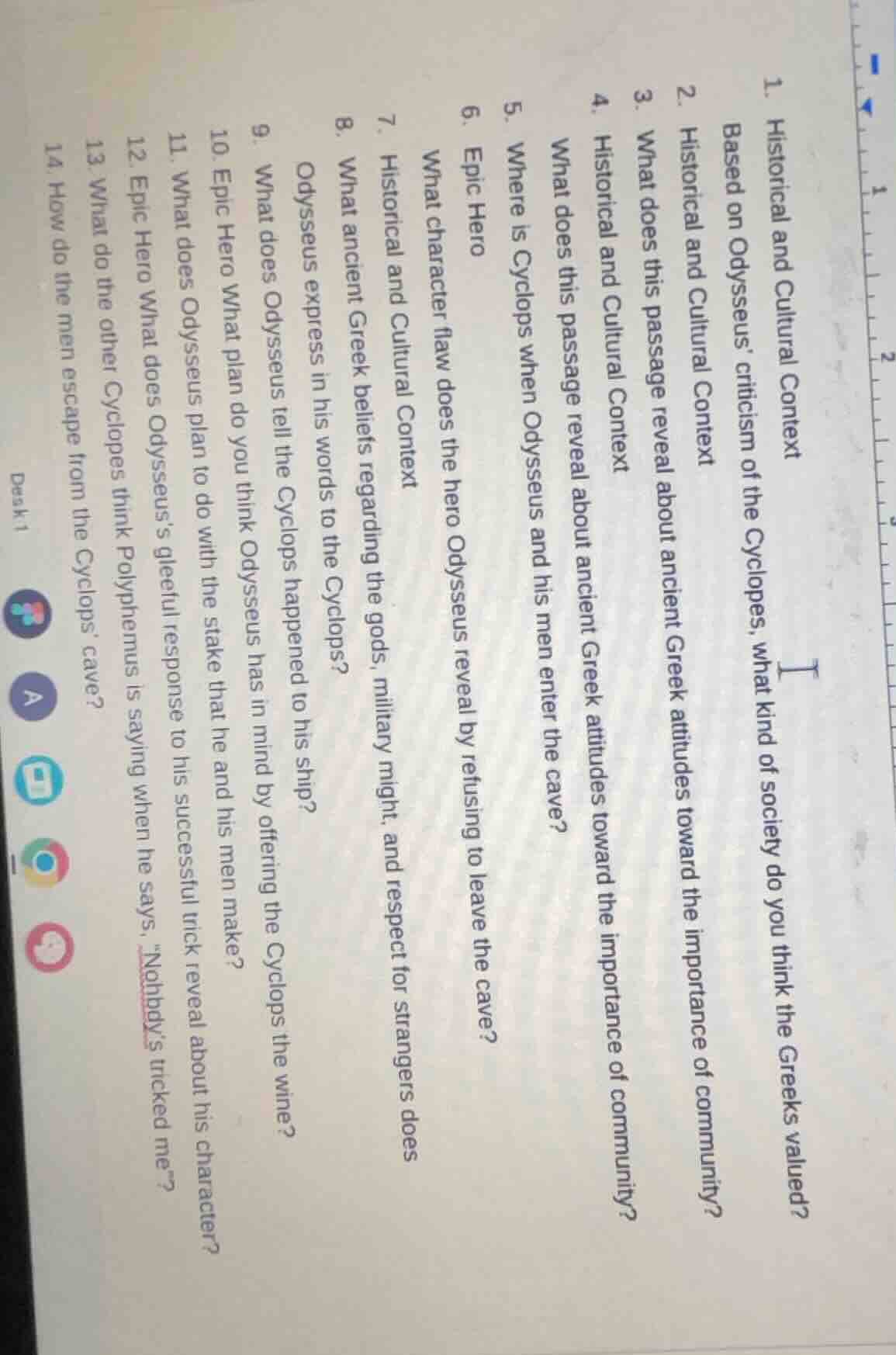
based on odysseus’ criticism of the cyclopes, what kind of society do you think the greeks valued?
- historical and cultural context
what does this passage reveal about ancient greek attitudes toward the importance of community?
- historical and cultural context
what does this passage reveal about ancient greek attitudes toward the importance of community?
- historical and cultural context
what does this passage reveal about ancient greek attitudes toward the importance of community?
- where is cyclops when odysseus and his men enter the cave?
- epic hero
what character flaw does the hero odysseus reveal by refusing to leave the cave?
- historical and cultural context
what ancient greek beliefs regarding the gods, military might, and respect for strangers does
odysseus express in his words to the cyclops?
- what ancient greek beliefs regarding the gods, military might, and respect for strangers does
odysseus express in his words to the cyclops?
- what does odysseus tell the cyclops happened to his ship?
- epic hero what plan do you think odysseus has in mind by offering the cyclops the wine?
- what does odysseus plan to do with the stake that he and his men make?
- epic hero what does odysseus’s gleeful response to his successful trick reveal about his character?
- what do the other cyclopes think polyphemus is saying when he says, “nobody’s tricked me”?
- how do the men escape from the cyclops’ cave?
- Odysseus criticizes the Cyclopes for being lawless, isolated, and not following the rules of hospitality (xenia). This shows Greeks valued structured, community-focused societies with shared laws and respect for guests/strangers.
- The passage reveals Greeks valued community, collective order, and the sacred custom of xenia (hospitality to strangers), as they condemn the Cyclopes' rejection of these norms.
- It reinforces that Greeks saw community, mutual support, and adherence to social codes (like xenia) as foundational to a civilized society, contrasting with the Cyclopes' solitary, lawless ways.
- It shows Greeks viewed community, shared governance, and respect for guests as core to civilization, framing the Cyclopes' lack of these as barbaric.
- Polyphemus, the Cyclops, is in his cave on the island of Sicily (or the fictional island of the Cyclopes) when Odysseus and his men enter.
- Odysseus' refusal to leave reveals his excessive pride (hubris) and curiosity, which are character flaws that put his men in danger.
- By offering wine, Odysseus plans to get the Cyclopes drunk, blind him, and escape the cave.
- When Odysseus tells the Cyclops his ship was destroyed, he is lying to protect his remaining ships and crew from the Cyclops' wrath.
- Odysseus expresses that Greeks believe the gods enforce the law of xenia (hospitality), and that the Cyclopes' rejection of this will lead to divine punishment; he also frames military strategy and cleverness as virtues, and respect for strangers as a moral obligation.
- Odysseus and his men heat the stake in a fire, then use it to blind Polyphemus.
- Odysseus' gleeful response reveals his pride (hubris) and desire for glory, even when it endangers his crew.
- The other Cyclopes think Polyphemus is saying "Nobody tricked me," so they believe he is ill or cursed, not attacked, and leave him alone.
- Odysseus and his men tie themselves under the bellies of Polyphemus' sheep; when the Cyclops lets the sheep out to graze, he feels their backs but does not check underneath, allowing the men to escape.

Snap & solve any problem in the app
Get step-by-step solutions on Sovi AI
Photo-based solutions with guided steps
Explore more problems and detailed explanations
- The Greeks valued structured, community-focused societies with shared laws and the sacred custom of hospitality (xenia).
- They valued community, collective order, and the sacred custom of hospitality (xenia).
- They saw community, mutual support, and social codes like hospitality as foundational to civilization.
- They viewed community, shared governance, and respect for guests as core to a civilized society.
- Polyphemus is in his cave on the Cyclopes' island (near Sicily).
- It reveals his hubris (excessive pride) and reckless curiosity.
- He plans to get the Cyclops drunk to blind him and escape.
- He is lying to protect his ships and crew.
- He expresses belief in divine enforcement of hospitality, military cleverness as virtue, and respect for strangers as a moral duty.
- They will heat the stake to blind Polyphemus.
- It reveals his hubris and craving for glory.
- They think he is ill/cursed, not attacked, so they leave him.
- They hide under Polyphemus' sheep to sneak out.