QUESTION IMAGE
Question
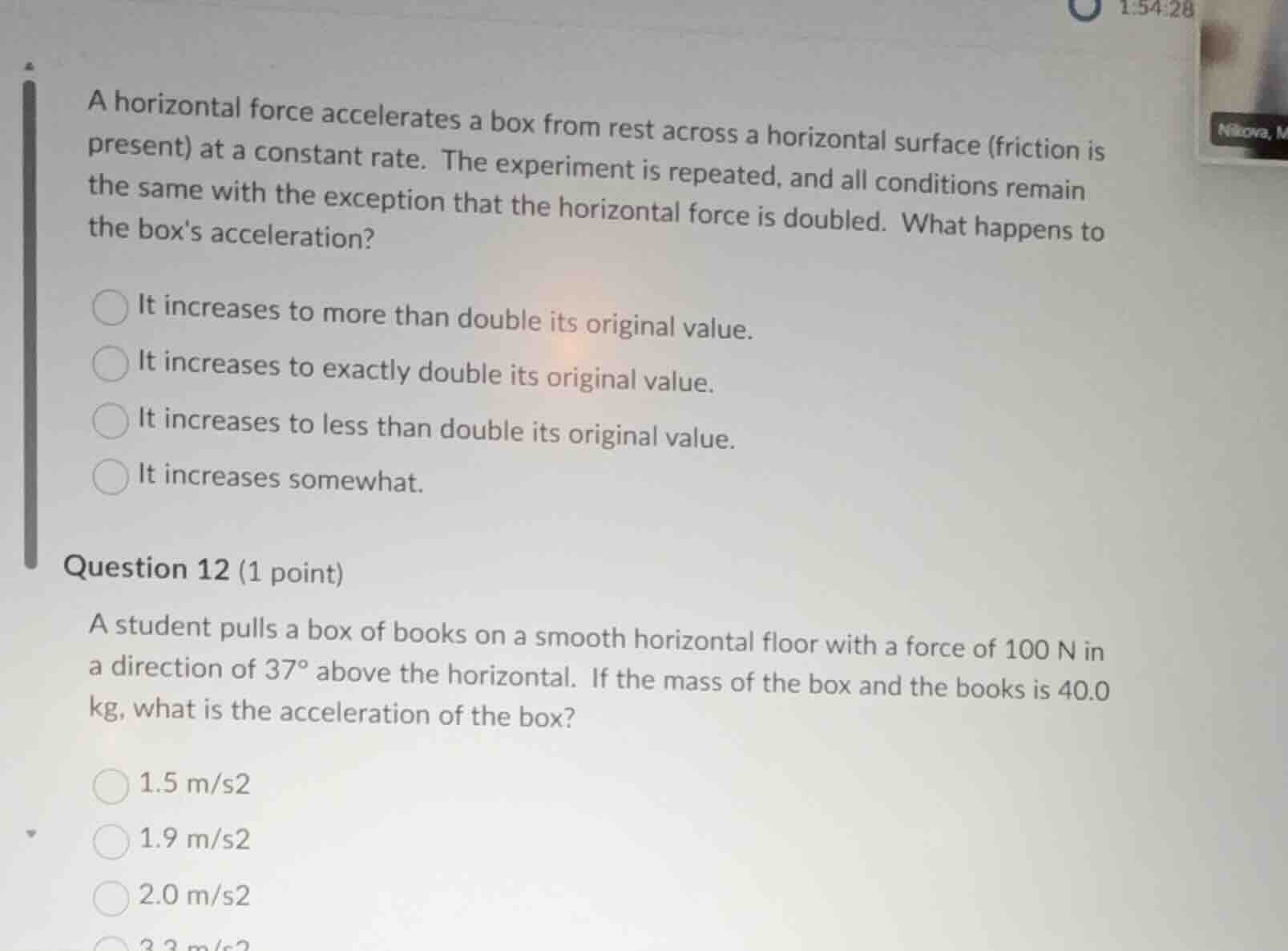
a horizontal force accelerates a box from rest across a horizontal surface (friction is present) at a constant rate. the experiment is repeated, and all conditions remain the same with the exception that the horizontal force is doubled. what happens to the boxs acceleration?
it increases to more than double its original value.
it increases to exactly double its original value.
it increases to less than double its original value.
it increases somewhat.
question 12 (1 point)
a student pulls a box of books on a smooth horizontal floor with a force of 100 n in a direction of 37° above the horizontal. if the mass of the box and the books is 40.0 kg, what is the acceleration of the box?
1.5 m/s2
1.9 m/s2
2.0 m/s2
First Question (About Force and Acceleration with Friction)
Step1: Recall Newton's Second Law
Newton's second law is \( F_{net} = ma \), where \( F_{net} \) is the net force, \( m \) is mass, and \( a \) is acceleration. Initially, let the applied force be \( F_1 \), friction be \( f \), so \( F_{net1}=F_1 - f= m a_1 \).
Step2: Analyze the Second Case
When the force is doubled, \( F_2 = 2F_1 \). The friction \( f=\mu N \), and since normal force \( N = mg \) (horizontal surface, no vertical force change), friction remains \( f \). So \( F_{net2}=2F_1 - f \).
Step3: Compare Accelerations
From first case, \( F_1= m a_1 + f \). Substitute into second net force: \( F_{net2}=2(m a_1 + f)-f = 2m a_1 + f \). Then \( a_2=\frac{2m a_1 + f}{m}=2a_1+\frac{f}{m} \). Since \( \frac{f}{m}>0 \), \( a_2 > 2a_1 \).
Step1: Resolve the Force Horizontally
The applied force is \( F = 100\ N \) at \( 37^\circ \) above horizontal. The horizontal component is \( F_x = F\cos(37^\circ) \). \( \cos(37^\circ)\approx0.8 \), so \( F_x = 100\times0.8 = 80\ N \).
Step2: Apply Newton's Second Law
Since the surface is smooth, there's no friction. So net force \( F_{net}=F_x = ma \). Mass \( m = 40.0\ kg \). Solve for \( a \): \( a=\frac{F_x}{m}=\frac{80}{40}=2.0\ m/s^2 \)? Wait, no, wait: Wait, \( \cos(37^\circ) \) is approximately 0.8? Wait, actually, in some approximations, \( \cos(37^\circ)\approx0.8 \), but let's check again. Wait, maybe I made a mistake. Wait, no, the problem says "smooth" floor, so friction is zero. Wait, but let's recalculate: \( F_x = 100\cos(37^\circ) \). If \( \cos(37^\circ)\approx0.8 \), then \( F_x = 80\ N \). Then \( a = F_x/m = 80/40 = 2.0\ m/s^2 \)? But wait, maybe the options have 2.0? Wait, the options include 2.0 m/s². Wait, but let's check the calculation again. Wait, \( F = 100\ N \), angle \( 37^\circ \), mass 40 kg. Horizontal component: \( F\cos\theta = 100\times\cos(37^\circ) \). \( \cos(37^\circ) \) is approximately 0.8 (since \( \sin(37^\circ)\approx0.6 \), \( \cos(37^\circ)\approx0.8 \) for 3-4-5 triangle approximation). So \( F_x = 80\ N \). Then \( a = F_x/m = 80/40 = 2.0\ m/s^2 \). Wait, but maybe the question has a typo? Wait, no, the options include 2.0 m/s². Wait, but let's check the steps again.
Step1: Horizontal Component
\( F_{horizontal} = F \cos(\theta) = 100 \times \cos(37^\circ) \). Using \( \cos(37^\circ) \approx 0.8 \), so \( F_{horizontal} = 80\ N \).
Step2: Newton's Second Law
Since no friction (smooth floor), net force is horizontal component. \( F_{net} = F_{horizontal} = ma \). So \( a = \frac{F_{horizontal}}{m} = \frac{80}{40} = 2.0\ m/s^2 \).

Snap & solve any problem in the app
Get step-by-step solutions on Sovi AI
Photo-based solutions with guided steps
Explore more problems and detailed explanations
It increases to more than double its original value.