QUESTION IMAGE
Question
how americans see the future of space exploration, 50 years after the first moon landing
by courtney johnson
before you read, take note of text features, genre characteristics, and text structure.
highlight examples of text features in yellow and evidence of text structures in pink.
use sticky notes to record notes about genre characteristics.
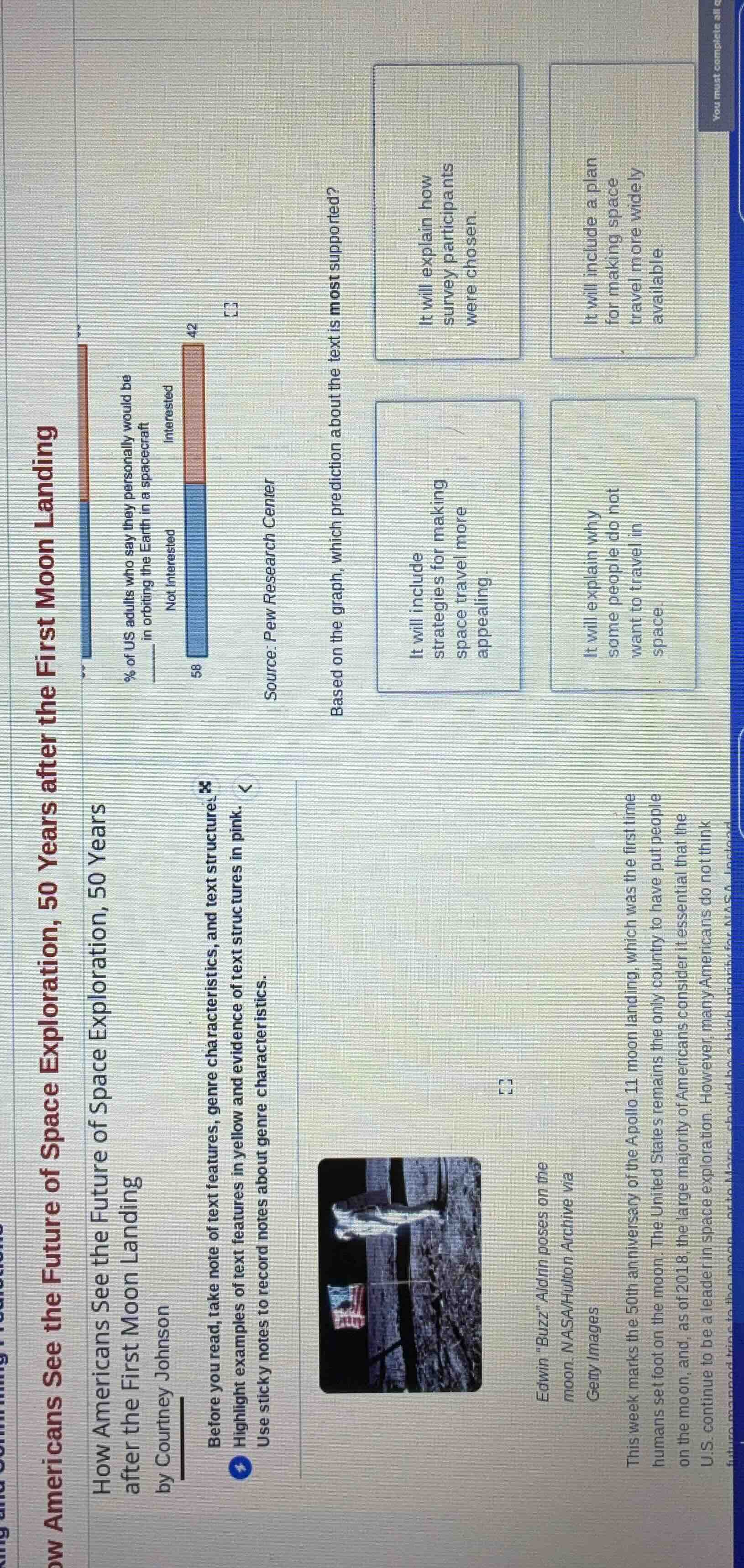
edwin \buzz\ aldrin poses on the moon. nasa/hulton archive via getty images
this week marks the 50th anniversary of the apollo 11 moon landing, which was the first time humans set foot on the moon. the united states remains the only country to have put people on the moon, and, as of 2018, the large majority of americans consider it essential that the u.s. continue to be a leader in space exploration. however, many americans do not think
% of us adults who say they personally would be in orbiting the earth in a spacecraft
not interested 58
interested 42
source: pew research center
based on the graph, which prediction about the text is most supported?
it will include strategies for making space travel more appealing.
it will explain how survey participants were chosen.
it will explain why some people do not want to travel in space.
it will include a plan for making space travel more widely available.
To solve this, we analyze the graph and the text's likely content:
- The graph shows US adults’ interest in space travel (orbiting Earth in a spacecraft).
- The text is about Americans’ views on space exploration 50 years after the first moon landing.
Now, evaluate the predictions:
- "It will explain how survey participants were chosen": The graph/text focus on opinions, not survey methodology. Eliminate.
- "It will include strategies for making space travel more appealing": The graph is about interest, not strategies. Eliminate.
- "It will include a plan for making space travel more widely available": The graph/text focus on public opinion, not policy plans. Eliminate.
- "It will explain why some people do not want to travel in space": The graph shows 58% are “Not Interested” in orbiting Earth. The text’s theme (public views on space exploration) supports explaining why some lack interest.
The graph shows 58% of US adults are not interested in orbiting Earth in a spacecraft, and the text explores Americans’ views on space exploration. The prediction "It will explain why some people do not want to travel in space" aligns with analyzing public interest (or lack thereof) in space travel, matching the graph’s data and the text’s theme. Other options (survey methodology, strategies, or plans) do not align with the graph/text focus.

Snap & solve any problem in the app
Get step-by-step solutions on Sovi AI
Photo-based solutions with guided steps
Explore more problems and detailed explanations
It will explain why some people do not want to travel in space.