QUESTION IMAGE
Question
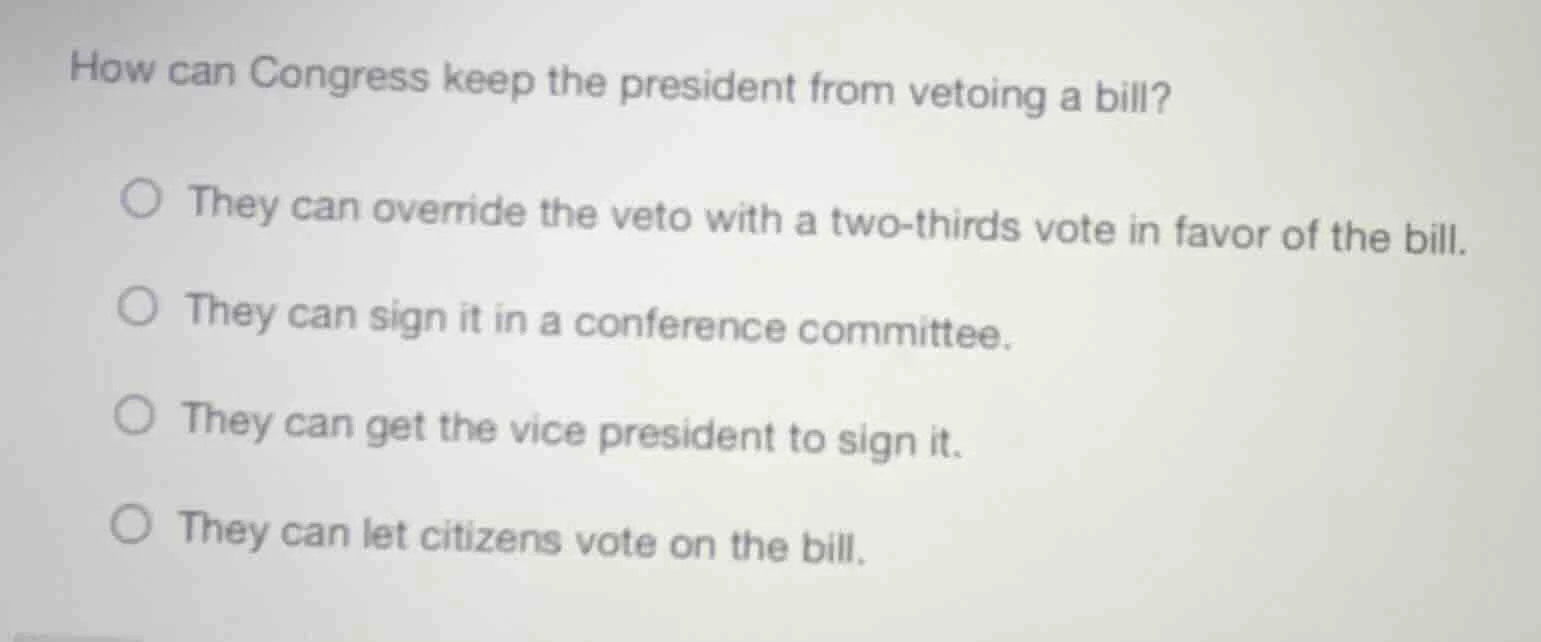
how can congress keep the president from vetoing a bill?
○ they can override the veto with a two - thirds vote in favor of the bill.
○ they can sign it in a conference committee.
○ they can get the vice president to sign it.
○ they can let citizens vote on the bill.
Brief Explanations
To determine the correct answer, we analyze each option:
- Option 1: In the U.S. legislative process, Congress (both the House of Representatives and the Senate) can override a presidential veto with a two - thirds majority vote in both chambers. This is a key part of the system of checks and balances.
- Option 2: Signing a bill is not the role of a conference committee. A conference committee is used to reconcile differences between House and Senate versions of a bill.
- Option 3: The vice - president does not have the authority to sign a bill in place of the president. The president is the one with the power to sign or veto bills.
- Option 4: In the U.S. federal system, citizens do not directly vote on bills in the way described. Bills go through the legislative process in Congress and are then signed or vetoed by the president.

Snap & solve any problem in the app
Get step-by-step solutions on Sovi AI
Photo-based solutions with guided steps
Explore more problems and detailed explanations
A. They can override the veto with a two - thirds vote in favor of the bill.