QUESTION IMAGE
Question
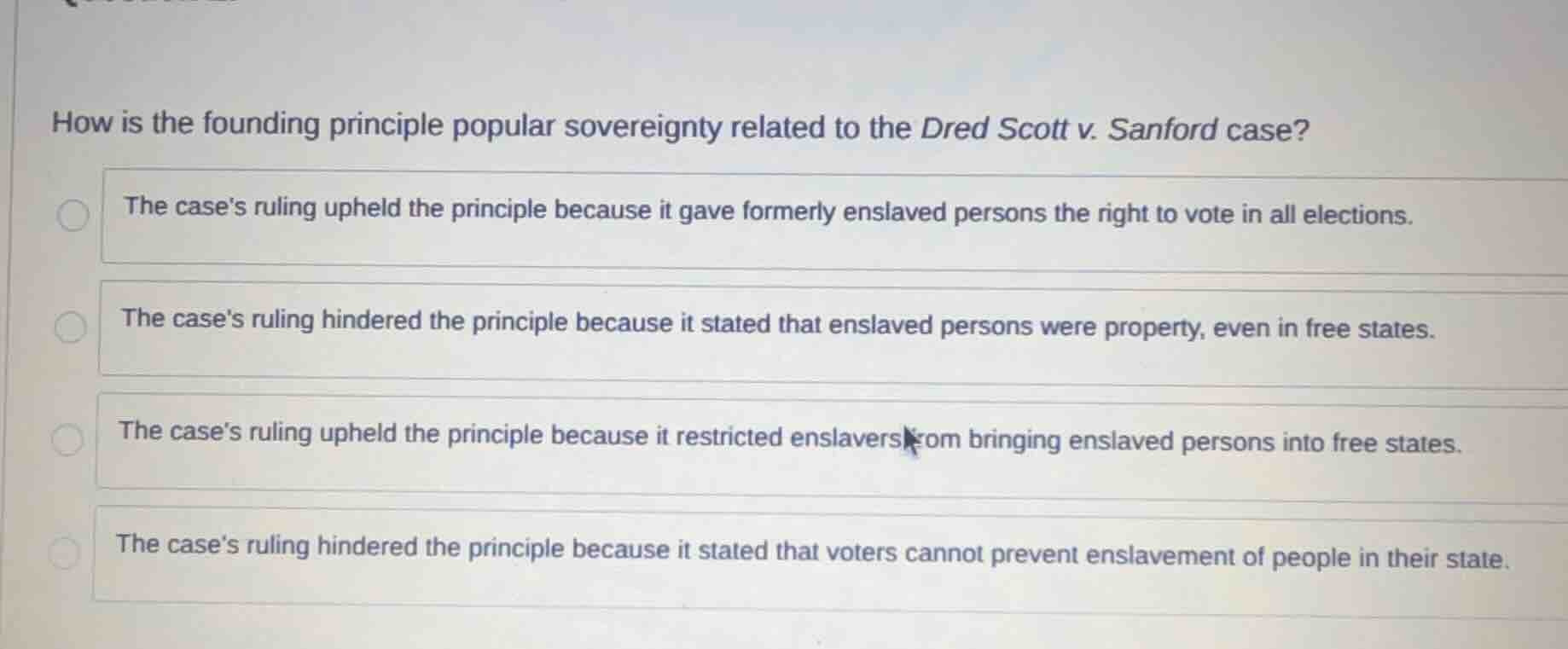
how is the founding principle popular sovereignty related to the dred scott v. sanford case?
the cases ruling upheld the principle because it gave formerly enslaved persons the right to vote in all elections.
the cases ruling hindered the principle because it stated that enslaved persons were property, even in free states.
the cases ruling upheld the principle because it restricted enslavers from bringing enslaved persons into free states.
the cases ruling hindered the principle because it stated that voters cannot prevent enslavement of people in their state.
Popular sovereignty is the principle that the authority of a state and its government are created and sustained by the consent of its people, through their elected representatives, meaning voters can set policy for their region. In Dred Scott v. Sanford, the Supreme Court ruled that Congress (and by extension, state voters) could not prohibit slavery in U.S. territories, directly undermining popular sovereignty by stripping voters of the power to ban slavery in their state/territory. The other options are incorrect: the ruling did not give enslaved people voting rights, it did not restrict enslavers from bringing enslaved people to free states, and while it declared enslaved people property, the direct blow to popular sovereignty is removing voter power over slavery.

Snap & solve any problem in the app
Get step-by-step solutions on Sovi AI
Photo-based solutions with guided steps
Explore more problems and detailed explanations
D. The case's ruling hindered the principle because it stated that voters cannot prevent enslavement of people in their state.