QUESTION IMAGE
Question
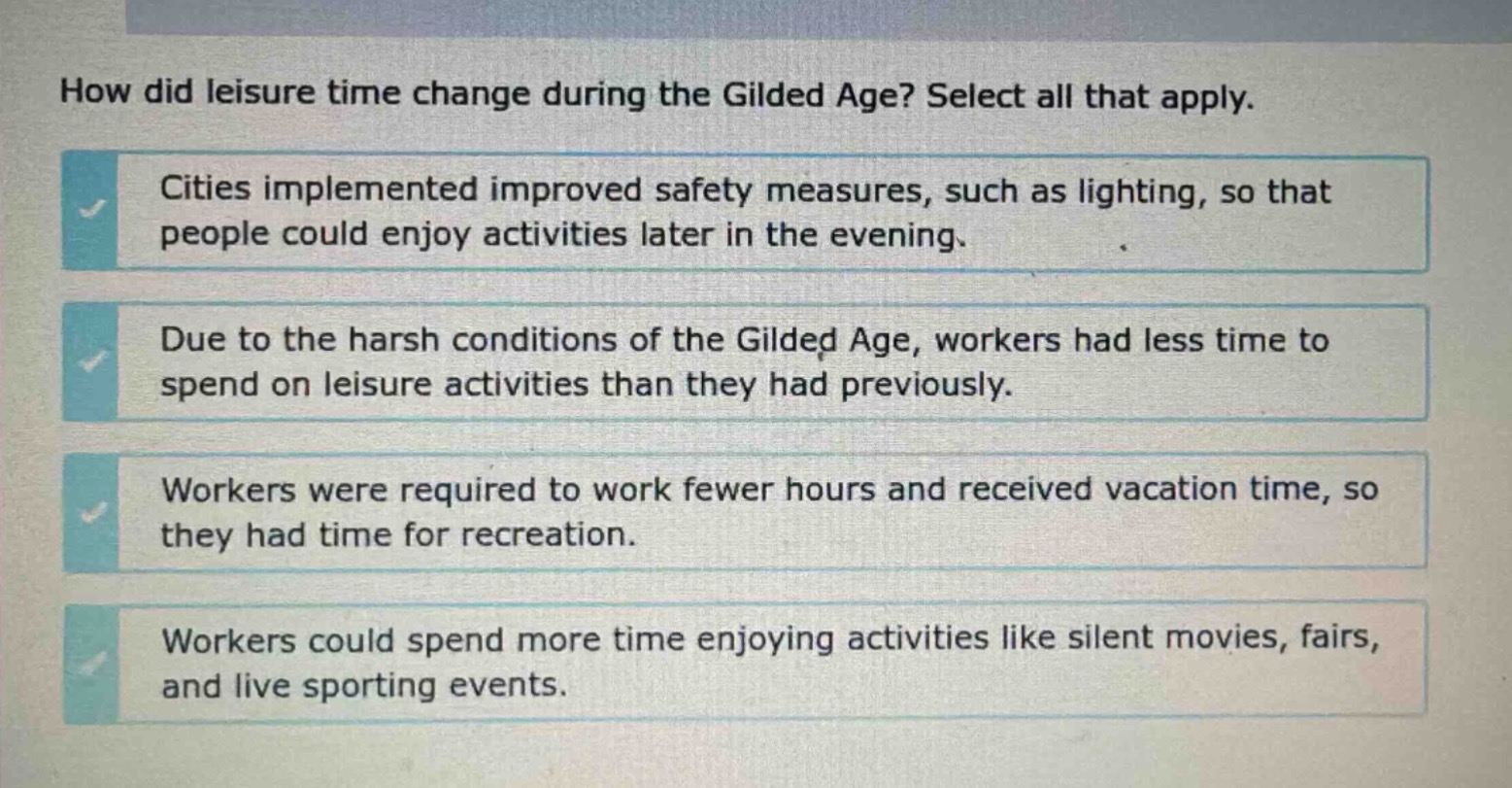
how did leisure time change during the gilded age? select all that apply. cities implemented improved safety measures, such as lighting, so that people could enjoy activities later in the evening. due to the harsh conditions of the gilded age, workers had less time to spend on leisure activities than they had previously. workers were required to work fewer hours and received vacation time, so they had time for recreation. workers could spend more time enjoying activities like silent movies, fairs, and live sporting events.
To determine the correct answers, we analyze each option based on Gilded Age (late 19th century) leisure and work context:
- First option: Cities improved safety (e.g., electric lighting) allowing evening leisure. This is accurate as urban infrastructure supported nighttime activities.
- Second option: Harsh Gilded Age conditions (long hours, poor labor laws) actually reduced leisure time? No—this is incorrect. In reality, labor movements and changing norms later (but during Gilded Age, workers often had long hours, but the option’s claim is misleading. Wait, re - evaluating: The Gilded Age had harsh labor conditions initially, but over time, reforms (like shorter hours) emerged. However, the option says “workers had less time” than previously. If “previously” was before industrialization (more agrarian, flexible hours), maybe? But this is less clear. However, the other options:
- Third option: Workers being required to work fewer hours and get vacation time. During the Gilded Age, labor unions and reforms started pushing for shorter hours (e.g., 8 - hour day movement), so this is accurate as a change over the period.
- Fourth option: New leisure activities (silent movies, fairs, sports) became popular as cities grew and entertainment industries developed. So workers could engage in these, which is accurate.
Wait, but the second option: If “previously” was a time with more leisure (e.g., pre - industrial, when work was more seasonal), then harsh industrial conditions could reduce leisure. But historically, the Gilded Age saw both harsh conditions and the start of labor reforms. However, the question is about “how leisure time changed”. Let's re - check:
- Cities implemented improved safety measures...: Correct. Better lighting made evenings safer for leisure.
- Due to harsh conditions... workers had less time...: This is incorrect. While early Gilded Age had long hours, over time, labor movements led to shorter hours (so leisure increased). Also, “previously” is ambiguous. If “previously” was before industrialization, maybe, but the Gilded Age was industrial. This option is misleading and incorrect.
- Workers were required to work fewer hours...: Correct. Labor reforms (e.g., 8 - hour day) and emerging vacation practices (though limited) were changes during the Gilded Age.
- Workers could spend more time... silent movies...: Correct. New entertainment forms (silent films, public events) emerged, and with more leisure time (from shorter hours), workers could participate.
Wait, but the original image shows all options checked, but that's wrong. Let's correct:
The correct answers are the first, third, and fourth options. The second option is incorrect because while early Gilded Age had long hours, the trend was towards more leisure (shorter hours, new entertainment) as reforms happened. So:
- Correct options:
- A. Cities implemented improved safety measures, such as lighting, so that people could enjoy activities later in the evening.
- C. Workers were required to work fewer hours and received vacation time, so they had time for recreation.
- D. Workers could spend more time enjoying activities like silent movies, fairs, and live sporting events.
The second option is incorrect because the Gilded Age saw a shift towards more leisure (due to shorter hours, new entertainment) despite initial harsh conditions. So the correct answers are the first, third, and fourth options.

Snap & solve any problem in the app
Get step-by-step solutions on Sovi AI
Photo-based solutions with guided steps
Explore more problems and detailed explanations
A. Cities implemented improved safety measures, such as lighting, so that people could enjoy activities later in the evening.
C. Workers were required to work fewer hours and received vacation time, so they had time for recreation.
D. Workers could spend more time enjoying activities like silent movies, fairs, and live sporting events.