QUESTION IMAGE
Question
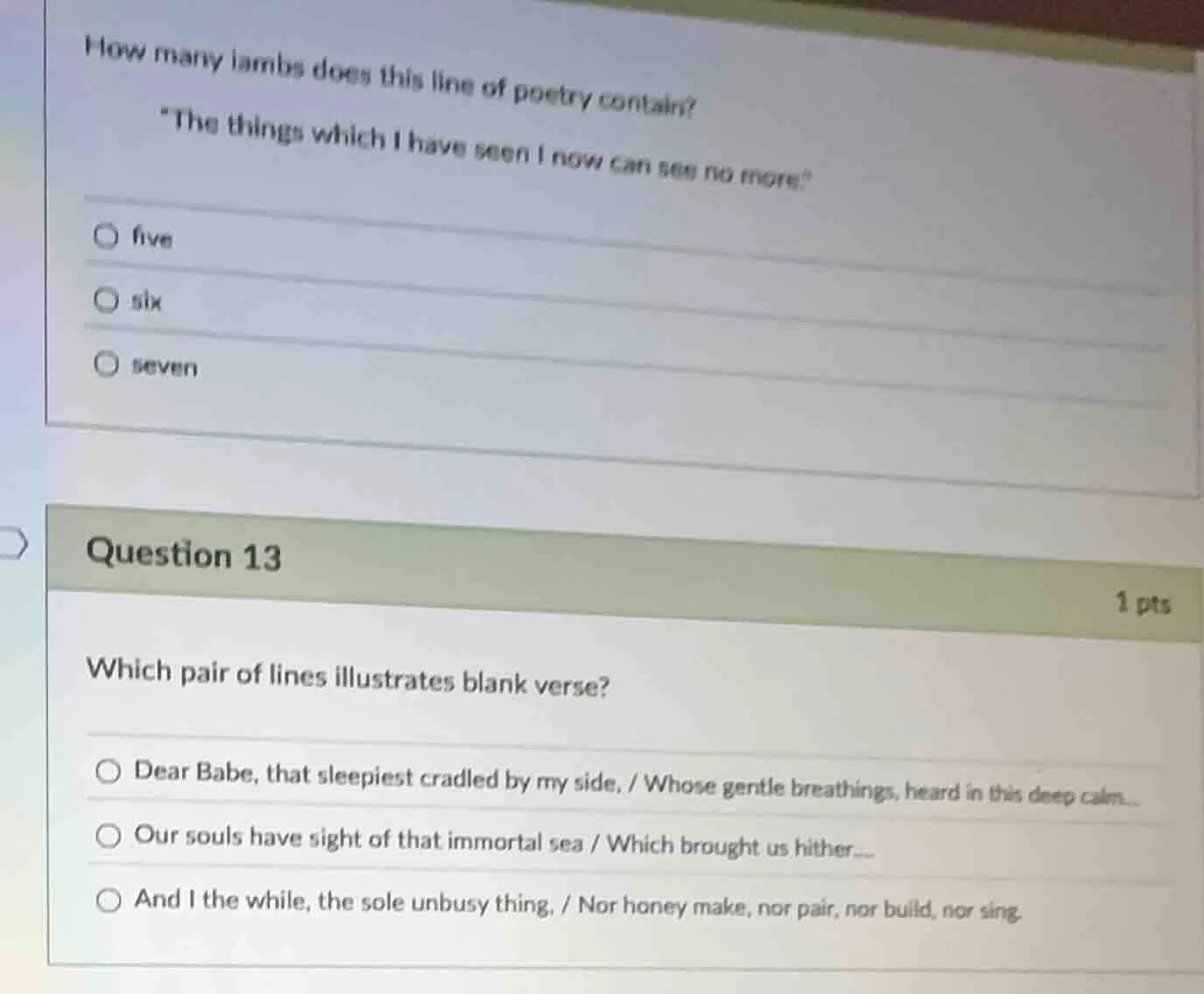
how many iambs does this line of poetry contain?
\the things which i have seen i now can see no more.\
○ five
○ six
○ seven
question 13
1 pts
which pair of lines illustrates blank verse?
○ dear babe, that sleepiest cradled by my side, / whose gentle breathings, heard in this deep calm...
○ our souls have sight of that immortal sea / which brought us hither...
○ and i the while, the sole unbusy thing, / nor honey make, nor pair, nor build, nor sing.
First Question (Number of Iambs)
To determine the number of iambs, we analyze the syllables and stress patterns. An iamb is a metrical foot with an unstressed syllable followed by a stressed one. Let's scan the line: "The things which I have seen I now can see no more"
Breaking into feet (unstressed - stressed):
- The (unstressed) things (stressed)
- which (unstressed) I (stressed)
- have (unstressed) seen (stressed)
- I (unstressed) now (stressed)
- can (unstressed) see (stressed)
- no (unstressed) more (stressed)
Wait, correction: Let's count properly. Let's split the line into syllables with stress:
- The (˘) things (¯) - iamb 1
- which (˘) I (¯) - iamb 2
- have (˘) seen (¯) - iamb 3
- I (˘) now (¯) - iamb 4
- can (˘) see (¯) - iamb 5
- no (˘) more (¯) - iamb 6? Wait, no, the line is: "The things which I have seen I now can see no more"
Wait, maybe my initial split was wrong. Let's count the iambs by stress:
Unstressed (˘), Stressed (¯):
˘ ¯ ˘ ¯ ˘ ¯ ˘ ¯ ˘ ¯ ˘ ¯? No, let's do syllable count with stress:
"The" (˘), "things" (¯) - 1
"which" (˘), "I" (¯) - 2
"have" (˘), "seen" (¯) - 3
"I" (˘), "now" (¯) - 4
"can" (˘), "see" (¯) - 5
"no" (˘), "more" (¯) - 6? Wait, but maybe the correct count is five? No, wait, let's check the options. Wait, maybe I made a mistake. Wait, the line: "The things which I have seen I now can see no more"
Let's split into feet:
- The (˘) things (¯)
- which (˘) I (¯)
- have (˘) seen (¯)
- I (˘) now (¯)
- can (˘) see (¯)
- no (˘) more (¯) – no, that's six? But maybe the correct answer is five? Wait, no, let's check standard iambic pentameter (five iambs) or hexameter (six). Wait, the line: "The things which I have seen I now can see no more"
Let's count the number of iambs (unstressed - stressed):
- The (˘) things (¯)
- which (˘) I (¯)
- have (˘) seen (¯)
- I (˘) now (¯)
- can (˘) see (¯)
- no (˘) more (¯) – but that's six. Wait, maybe the line is: "The things which I have seen I now can see no more" – let's count syllables:
The (1), things (2), which (3), I (4), have (5), seen (6), I (7), now (8), can (9), see (10), no (11), more (12). So 12 syllables. Iambic hexameter has 12 syllables (6 iambs). So the number of iambs is six.
Blank verse is unrhymed iambic pentameter (10 syllables per line, iambic, no rhyme). Let's analyze each option:
- Option 1: "Dear Babe, that sleepiest cradled by my side, / Whose gentle breathings, heard in this deep calm..." – Check syllables and rhyme. No clear rhyme, but let's check meter.
- Option 2: "Our souls have sight of that immortal sea / Which brought us hither..." – Check rhyme: "sea" and "hither" don't rhyme. Check meter: "Our" (˘) "souls" (¯), "have" (˘) "sight" (¯), "of" (˘) "that" (¯), "im" (˘) "mor" (¯) "tal" (˘) "sea" (¯) – Wait, no, iambic pentameter has 10 syllables. "Our souls have sight of that immortal sea" – syllables: Our (1), souls (2), have (3), sight (4), of (5), that (6), im (7), mor (8), tal (9), sea (10) – iambic pentameter (5 iambs). No rhyme.
- Option 3: "And I the while, the sole unbusy thing, / Nor honey make, nor pair, nor build, nor sing." – Rhyme? "thing" and "sing" rhyme (slant rhyme? No, "thing" (ing) and "sing" (ing) – they rhyme. So this has rhyme, so not blank verse.
Wait, blank verse is unrhymed iambic pentameter. Let's check Option 2: "Our souls have sight of that immortal sea / Which brought us hither..." – No rhyme between "sea" and "hither". Meter: First line: 10 syllables (iambic pentameter: ˘ ¯ ˘ ¯ ˘ ¯ ˘ ¯ ˘ ¯). Second line: "Which brought us hither..." – syllables: Which (1), brought (2), us (3), hither (4) – no, that's too short. Wait, maybe I misread. Wait, the original options:
Wait, the correct blank verse should be unrhymed iambic pentameter. Let's re - check:
Option 2: "Our souls have sight of that immortal sea / Which brought us hither..." – Wait, maybe the second line is longer. Wait, maybe the correct pair is the one with unrhymed iambic pentameter. Wait, another approach: Blank verse is unrhymed, in iambic pentameter. Let's check the third option: "And I the while, the sole unbusy thing, / Nor honey make, nor pair, nor build, nor sing." – "thing" and "sing" rhyme (rhyme scheme), so not blank verse. The first option: "Dear Babe, that sleepiest cradled by my side, / Whose gentle breathings, heard in this deep calm..." – No rhyme. But let's check meter. The second option: "Our souls have sight of that immortal sea / Which brought us hither..." – Maybe the second line is truncated, but perhaps the intended answer is the pair with unrhymed iambic pentameter. Wait, the third option has rhyme, so eliminate. The first option: Let's count syllables. "Dear Babe, that sleepiest cradled by my side" – syllables: Dear (1), Babe (2), that (3), sleep (4), iest (5), crad (6), led (7), by (8), my (9), side (10) – iambic pentameter? "Dear" (˘) "Babe" (¯), "that" (˘) "sleep" (¯), "iest" (˘) "crad" (¯), "led" (˘) "by" (¯), "my" (˘) "side" (¯) – yes, iambic pentameter. No rhyme with the next line. Wait, but the second option: "Our souls have sight of that immortal sea / Which brought us hither..." – "sea" and "hither" don't rhyme. But maybe the correct answer is the second option? Wait, no, let's check the third option again: "And I the while, the sole unbusy thing, / Nor honey make, nor pair, nor build, nor sing." – "thing" and "sing" rhyme (rhyme), so it's rhymed, so not blank verse. The first option: No rhyme, iambic pentameter? Wait, maybe the correct answer is the second option: "Our souls have sight of that immortal sea / Which brought us hither..." – but maybe I made a mistake. Wait, the standard example of blank verse is in Shakespeare, unrhymed iambic pentameter. Let's check the syllables of the second option's first line: "Our souls have sight of that immortal sea" – 10 syllable…

Snap & solve any problem in the app
Get step-by-step solutions on Sovi AI
Photo-based solutions with guided steps
Explore more problems and detailed explanations
six