QUESTION IMAGE
Question
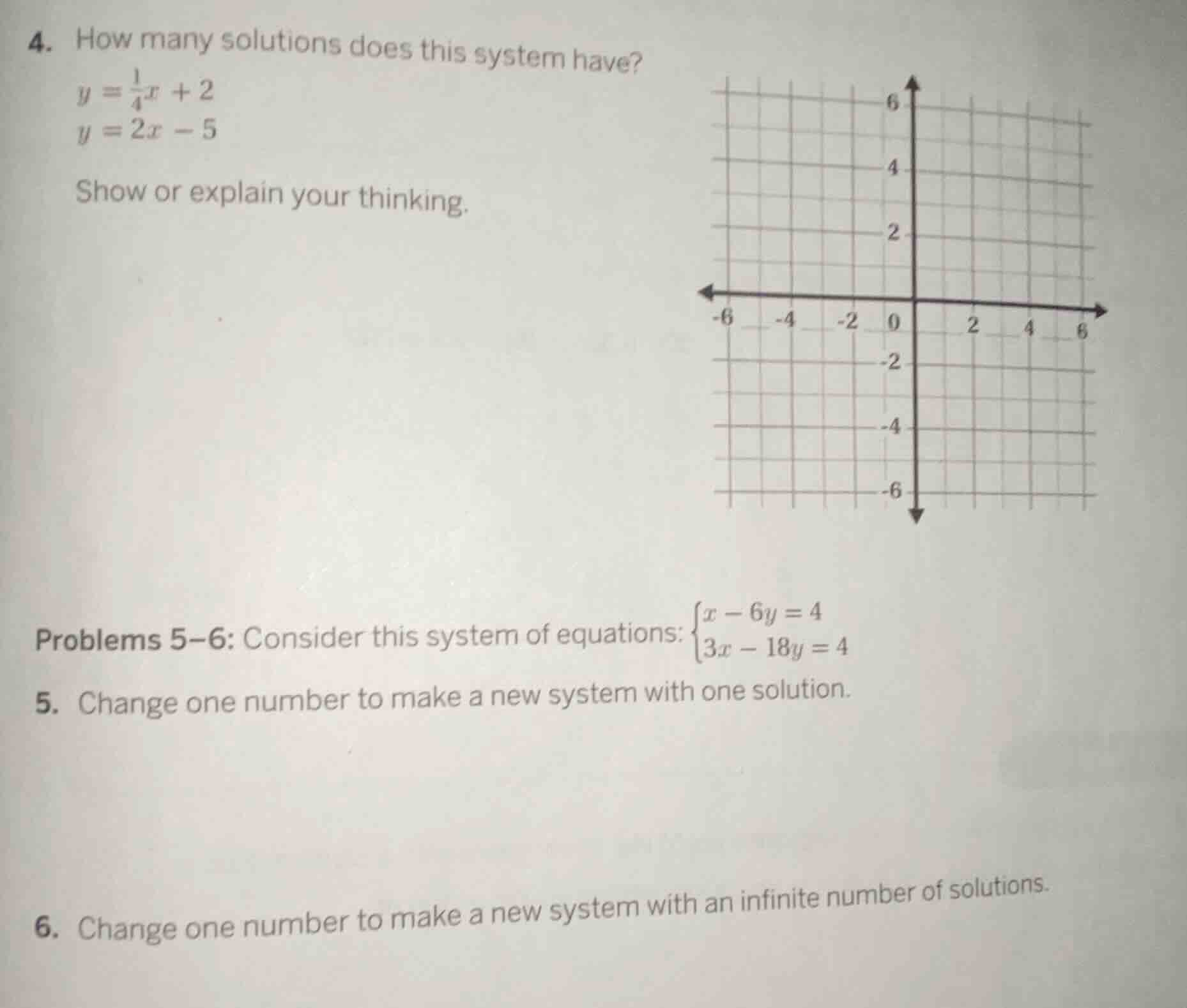
- how many solutions does this system have?$y = \frac{1}{4}x + 2$$y = 2x - 5$show or explain your thinking.problems 5-6: consider this system of equations: $\
$5. change one number to make a new system with one solution.6. change one number to make a new system with an infinite number of solutions.
For Problem 4:
Step1: Set equations equal
Since $y=y$, equate the two expressions:
$\frac{1}{4}x + 2 = 2x - 5$
Step2: Isolate x terms
Subtract $\frac{1}{4}x$ and add 5 to both sides:
$2 + 5 = 2x - \frac{1}{4}x$
Step3: Simplify both sides
Calculate constants and combine like terms:
$7 = \frac{8}{4}x - \frac{1}{4}x = \frac{7}{4}x$
Step4: Solve for x
Multiply both sides by $\frac{4}{7}$:
$x = 7 \times \frac{4}{7} = 4$
Step5: Find y value
Substitute $x=4$ into $y=2x-5$:
$y = 2(4) - 5 = 8 - 5 = 3$
A linear system has one solution if the lines are not parallel (different slopes) or not identical. The original system has equations that are parallel ($x-6y=4$ can be rewritten as $y=\frac{1}{6}x-\frac{2}{3}$; $3x-18y=4$ becomes $y=\frac{1}{6}x-\frac{2}{9}$). To get one solution, change the coefficient of $x$ or $y$ in one equation to make the slopes different.
A linear system has infinite solutions if the two equations are scalar multiples of each other (they represent the same line). The first equation multiplied by 3 is $3x-18y=12$, but the original second equation is $3x-18y=4$. Changing the constant term of the second equation to 12 makes the equations identical.

Snap & solve any problem in the app
Get step-by-step solutions on Sovi AI
Photo-based solutions with guided steps
Explore more problems and detailed explanations
This system has 1 unique solution: $(4, 3)$
---