QUESTION IMAGE
Question
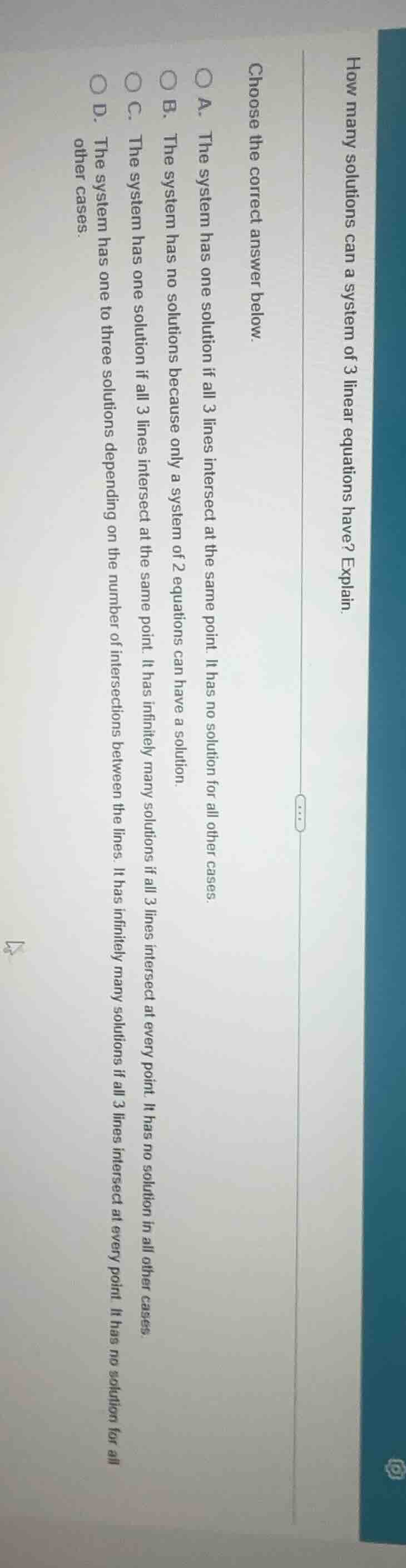
how many solutions can a system of 3 linear equations have? explain.
choose the correct answer below.
a. the system has one solution if all 3 lines intersect at the same point. it has no solution for all other cases.
b. the system has no solutions because only a system of 2 equations can have a solution.
c. the system has one solution if all 3 lines intersect at the same point. it has infinitely many solutions if all 3 lines intersect at every point. it has no solution in all other cases.
d. the system has one to three solutions depending on the number of intersections between the lines. it has infinitely many solutions if all 3 lines intersect at every point. it has no solution for all other cases.
To determine the number of solutions for a system of 3 linear equations, we analyze the intersection of the lines (each equation represents a line in 2D or a plane in 3D, but for the context of linear equations in two variables, we consider lines).
- If all 3 lines intersect at the same single point, the system has one solution (the coordinates of that point satisfy all three equations).
- If all 3 lines are coincident (intersect at every point, meaning they are the same line), the system has infinitely many solutions (every point on the line satisfies all three equations).
- In all other cases (e.g., lines are parallel, or two lines intersect but the third doesn't pass through that intersection point, or two lines are parallel and the third is not, etc.), the system has no solution because there is no point that lies on all three lines.
Now let's analyze each option:
- Option A: Incorrect. It incorrectly states the system has no solution for all other cases, but there's also the case of infinitely many solutions (when all lines are the same).
- Option B: Incorrect. The question is about a system of 3 equations, not 2. The reasoning about a 2 - equation system is irrelevant.
- Option C: Correct. It accounts for the three possible cases: one solution (all lines intersect at a single common point), infinitely many solutions (all lines are the same, intersecting at every point), and no solution (in all other cases where there's no common point for all three lines).
- Option D: Incorrect. The description of the number of solutions is muddled and does not correctly represent the possible solution sets for a system of three linear equations.

Snap & solve any problem in the app
Get step-by-step solutions on Sovi AI
Photo-based solutions with guided steps
Explore more problems and detailed explanations
C. The system has one solution if all 3 lines intersect at the same point. It has infinitely many solutions if all 3 lines intersect at every point. It has no solution in all other cases.