QUESTION IMAGE
Question
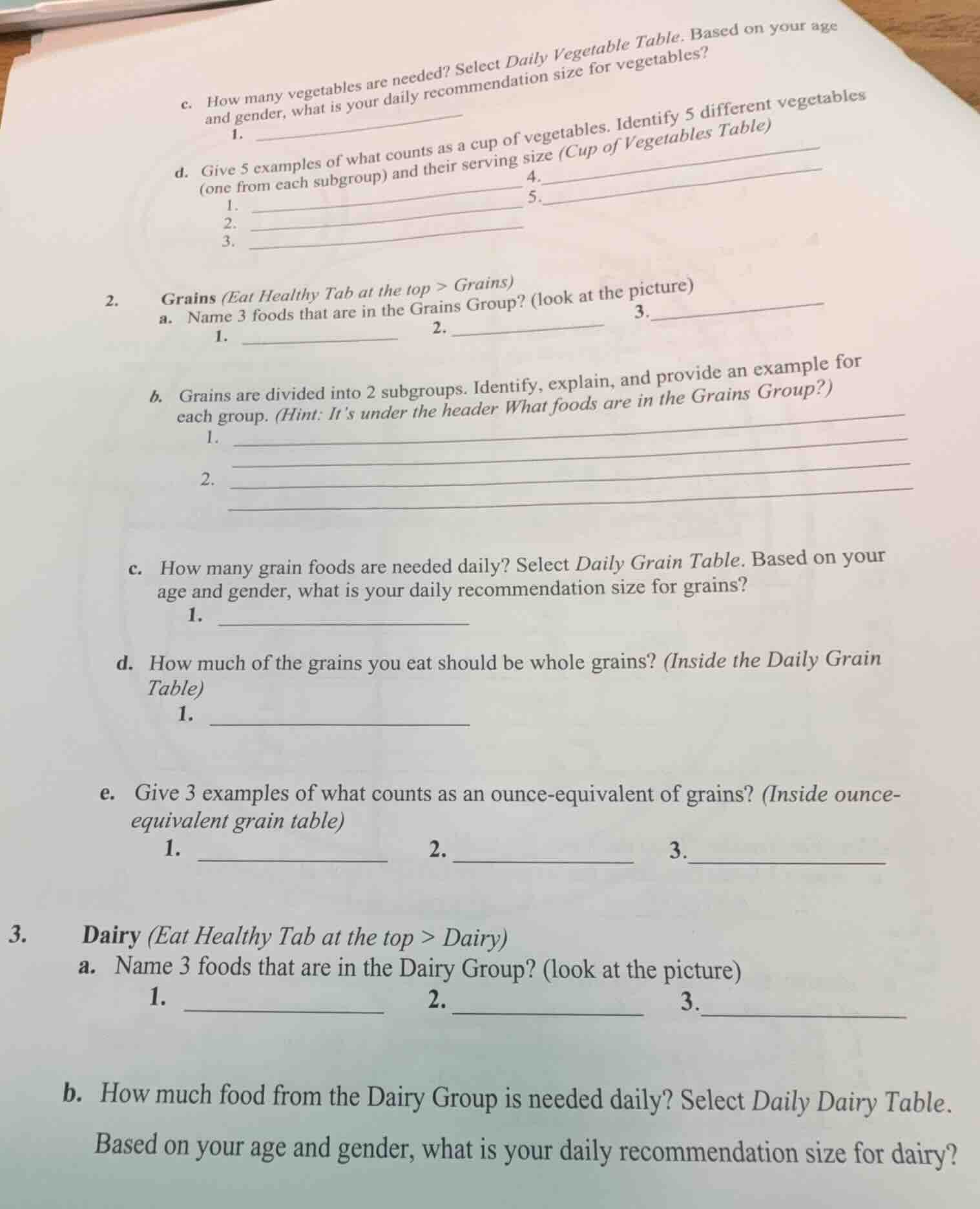
c. how many vegetables are needed? select daily vegetable table. based on your age and gender, what is your daily recommendation size for vegetables?
1.
d. give 5 examples of what counts as a cup of vegetables. identify 5 different vegetables (one from each subgroup) and their serving size (cup of vegetables table)
1.
2.
3.
4.
5.
- grains (eat healthy tab at the top > grains)
a. name 3 foods that are in the grains group? (look at the picture)
1.
2.
3.
b. grains are divided into 2 subgroups. identify, explain, and provide an example for each group. (hint: its under the header what foods are in the grains group?)
1.
2.
c. how many grain foods are needed daily? select daily grain table. based on your age and gender, what is your daily recommendation size for grains?
1.
d. how much of the grains you eat should be whole grains? (inside the daily grain table)
1.
e. give 3 examples of what counts as an ounce - equivalent of grains? (inside ounce - equivalent grain table)
1.
2.
3.
- dairy (eat healthy tab at the top > dairy)
a. name 3 foods that are in the dairy group? (look at the picture)
1.
2.
3.
b. how much food from the dairy group is needed daily? select daily dairy table. based on your age and gender, what is your daily recommendation size for dairy?
To answer these questions, we need to refer to the relevant dietary guidelines (e.g., from sources like the USDA's MyPlate or similar "Eat Healthy" resources). Here are sample answers based on typical dietary recommendations:
Section 2: Grains
2a. Name 3 foods in the Grains Group
- Bread (e.g., whole - wheat bread)
- Rice (e.g., brown rice)
- Pasta (e.g., whole - wheat pasta)
2b. Grains subgroups
- Whole Grains: These are grains that contain the entire grain kernel (bran, germ, and endosperm). Example: Oatmeal (made from whole oats).
- Refined Grains: These have been processed to remove the bran and germ, so they have less fiber and nutrients. Example: White bread (made from refined wheat flour).
2c. Daily grain recommendation (example for a 14 - 18 - year - old female)
- Daily grain foods needed: Around 6 ounce - equivalents. (This varies by age, gender, and activity level. For a 14 - 18 - year - old female, the recommendation is often 6 ounce - equivalents per day.)
2d. Whole grains proportion
- At least half of the grains eaten should be whole grains.
2e. Ounce - equivalent of grains examples
- 1 slice of bread
- 1/2 cup of cooked rice
- 1 cup of ready - to - eat cereal
Section 3: Dairy
3a. Name 3 foods in the Dairy Group
- Milk (e.g., low - fat milk)
- Yogurt (e.g., plain Greek yogurt)
- Cheese (e.g., cheddar cheese)
3b. Daily dairy recommendation (example for a 14 - 18 - year - old female)
- Daily dairy recommendation: 3 cups per day. (This is a common recommendation for this age and gender group, but it can vary.)
Section c (Vegetables, from the first part)
c. Daily vegetable recommendation (example for a 14 - 18 - year - old female)
- Daily vegetable foods needed: Around 2.5 cups. (The recommendation varies by age, gender, and activity level.)
d. Cup of vegetables examples (one from each subgroup: dark green, red/orange, legumes, starchy, other)
- Dark green: 1 cup of raw spinach
- Red/orange: 1 cup of chopped carrots
- Legumes: 1 cup of cooked black beans
- Starchy: 1 cup of cooked corn
- Other: 1 cup of raw cucumber
Please note that these answers are based on general dietary guidelines. For the most accurate answers, you should refer to the specific "Eat Healthy" resources or tables mentioned in the questions (like the Daily Vegetable Table, Daily Grain Table, etc.) and input your actual age and gender to get personalized recommendations.

Snap & solve any problem in the app
Get step-by-step solutions on Sovi AI
Photo-based solutions with guided steps
Explore more problems and detailed explanations
To answer these questions, we need to refer to the relevant dietary guidelines (e.g., from sources like the USDA's MyPlate or similar "Eat Healthy" resources). Here are sample answers based on typical dietary recommendations:
Section 2: Grains
2a. Name 3 foods in the Grains Group
- Bread (e.g., whole - wheat bread)
- Rice (e.g., brown rice)
- Pasta (e.g., whole - wheat pasta)
2b. Grains subgroups
- Whole Grains: These are grains that contain the entire grain kernel (bran, germ, and endosperm). Example: Oatmeal (made from whole oats).
- Refined Grains: These have been processed to remove the bran and germ, so they have less fiber and nutrients. Example: White bread (made from refined wheat flour).
2c. Daily grain recommendation (example for a 14 - 18 - year - old female)
- Daily grain foods needed: Around 6 ounce - equivalents. (This varies by age, gender, and activity level. For a 14 - 18 - year - old female, the recommendation is often 6 ounce - equivalents per day.)
2d. Whole grains proportion
- At least half of the grains eaten should be whole grains.
2e. Ounce - equivalent of grains examples
- 1 slice of bread
- 1/2 cup of cooked rice
- 1 cup of ready - to - eat cereal
Section 3: Dairy
3a. Name 3 foods in the Dairy Group
- Milk (e.g., low - fat milk)
- Yogurt (e.g., plain Greek yogurt)
- Cheese (e.g., cheddar cheese)
3b. Daily dairy recommendation (example for a 14 - 18 - year - old female)
- Daily dairy recommendation: 3 cups per day. (This is a common recommendation for this age and gender group, but it can vary.)
Section c (Vegetables, from the first part)
c. Daily vegetable recommendation (example for a 14 - 18 - year - old female)
- Daily vegetable foods needed: Around 2.5 cups. (The recommendation varies by age, gender, and activity level.)
d. Cup of vegetables examples (one from each subgroup: dark green, red/orange, legumes, starchy, other)
- Dark green: 1 cup of raw spinach
- Red/orange: 1 cup of chopped carrots
- Legumes: 1 cup of cooked black beans
- Starchy: 1 cup of cooked corn
- Other: 1 cup of raw cucumber
Please note that these answers are based on general dietary guidelines. For the most accurate answers, you should refer to the specific "Eat Healthy" resources or tables mentioned in the questions (like the Daily Vegetable Table, Daily Grain Table, etc.) and input your actual age and gender to get personalized recommendations.