QUESTION IMAGE
Question
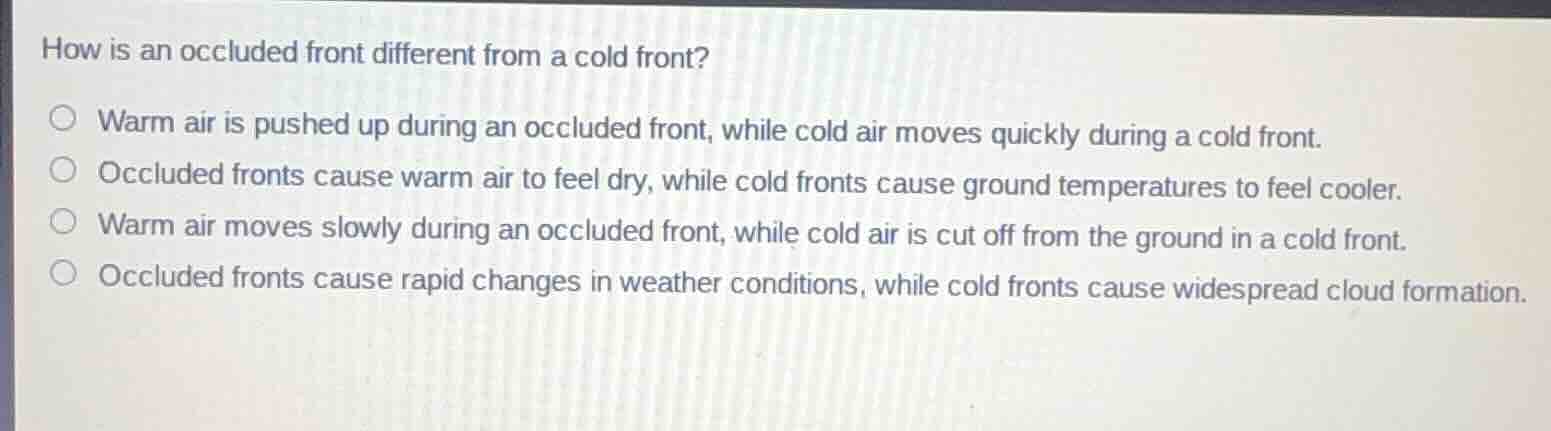
how is an occluded front different from a cold front?
warm air is pushed up during an occluded front, while cold air moves quickly during a cold front.
occluded fronts cause warm air to feel dry, while cold fronts cause ground temperatures to feel cooler.
warm air moves slowly during an occluded front, while cold air is cut off from the ground in a cold front.
occluded fronts cause rapid changes in weather conditions, while cold fronts cause widespread cloud formation.
An occluded front forms when a fast-moving cold front overtakes a warm front, pushing the warm air mass entirely upward off the ground. A cold front occurs when a cold air mass moves quickly into and displaces a warm air mass, forcing warm air upward. Let's analyze each option:
- The first option correctly states that warm air is pushed up in an occluded front, and cold air moves quickly in a cold front.
- The second option is incorrect: occluded fronts do not make warm air feel dry, and cold fronts lower temperatures by displacing warm air, not just making ground temps "feel" cooler.
- The third option is incorrect: warm air is pushed upward (not moving slowly near the surface) in an occluded front, and cold air stays near the ground in a cold front.
- The fourth option is incorrect: cold fronts cause rapid weather changes, while occluded fronts bring prolonged, steady precipitation.

Snap & solve any problem in the app
Get step-by-step solutions on Sovi AI
Photo-based solutions with guided steps
Explore more problems and detailed explanations
A. Warm air is pushed up during an occluded front, while cold air moves quickly during a cold front.