QUESTION IMAGE
Question
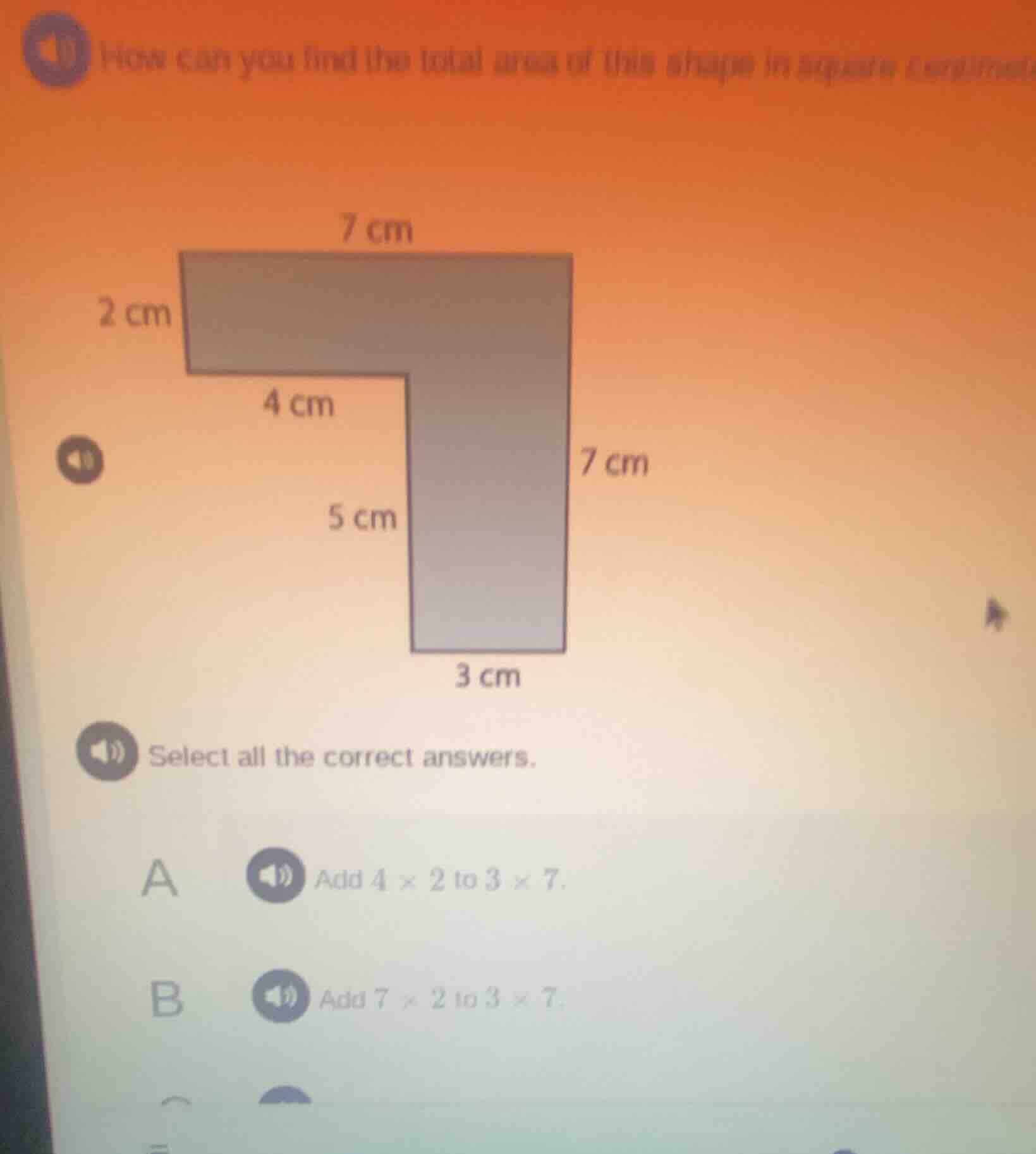
how can you find the total area of this shape in square centimeters? select all the correct answers. a add 4 × 2 to 3 × 7. b add 7 × 2 to 3 × 7.
Step1: Analyze Option A
The shape can be divided into two rectangles. One rectangle could have dimensions \(4 \, \text{cm}\) (length) and \(2 \, \text{cm}\) (width), and the other could have dimensions \(3 \, \text{cm}\) (width) and \(7 \, \text{cm}\) (height). The area of the first rectangle is \(4\times2\) and the second is \(3\times7\). Adding them gives the total area. But wait, actually, let's re - check the dimensions. Wait, the top rectangle: the length should be \(7 \, \text{cm}\) (since the top side is \(7 \, \text{cm}\)) and width \(2 \, \text{cm}\), and the bottom rectangle: width \(3 \, \text{cm}\) and height \(7 \, \text{cm}\). Wait, no, maybe another way. Wait, the vertical rectangle: width \(3 \, \text{cm}\), height \(7 \, \text{cm}\), area \(3\times7\). The horizontal rectangle: length \(7 \, \text{cm}\) (since the top is \(7 \, \text{cm}\)) and width \(2 \, \text{cm}\), area \(7\times2\). Wait, but option A says \(4\times2\). Wait, maybe I made a mistake. Wait, the horizontal part: the length of the horizontal rectangle (the top one) is \(7 \, \text{cm}\), but if we look at the indentation, the length of the horizontal rectangle (the top part) can also be considered as \(4 + 3=7 \, \text{cm}\), and width \(2 \, \text{cm}\). The vertical rectangle: width \(3 \, \text{cm}\), height \(7 \, \text{cm}\). So the area of the top rectangle is \(7\times2\) and the vertical one is \(3\times7\). But option A is \(4\times2+3\times7\). Wait, \(4 + 3=7\), so \(4\times2+3\times2=(4 + 3)\times2 = 7\times2\), no, \(4\times2\) is not equal to \(7\times2\). Wait, maybe the correct way is: the shape can be divided into a top rectangle (length \(7 \, \text{cm}\), width \(2 \, \text{cm}\)) and a bottom rectangle (width \(3 \, \text{cm}\), height \(7 \, \text{cm}\)). So area of top is \(7\times2\), area of bottom is \(3\times7\). So option B: \(7\times2+3\times7\) is correct. Wait, but let's check option A again. If we take the top rectangle as length \(4 \, \text{cm}\) and width \(2 \, \text{cm}\), and the right - hand rectangle as width \(3 \, \text{cm}\) and height \(7 \, \text{cm}\), but then we are missing the part between \(4 \, \text{cm}\) and \(7 \, \text{cm}\) (which is \(3 \, \text{cm}\)). So actually, the correct division is top rectangle (length \(7 \, \text{cm}\), width \(2 \, \text{cm}\)) and bottom rectangle (width \(3 \, \text{cm}\), height \(7 \, \text{cm}\)). So the area of top is \(7\times2\), area of bottom is \(3\times7\), so option B is correct. Wait, but maybe the question has a typo or my analysis is wrong. Wait, let's calculate the area in two ways.
First way: Divide the shape into a top rectangle (length \(7 \, \text{cm}\), width \(2 \, \text{cm}\)) and a bottom rectangle (width \(3 \, \text{cm}\), height \(7 \, \text{cm}\)). Area of top: \(7\times2 = 14\), area of bottom: \(3\times7=21\), total area \(14 + 21=35\).
Second way: Divide into a left - indent rectangle (length \(4 \, \text{cm}\), width \(2 \, \text{cm}\)) and a right - hand rectangle (width \(3 \, \text{cm}\), height \(7 \, \text{cm}\)) and a middle part? No, that's not right. Wait, \(4\times2+3\times7 = 8+21 = 29\), which is wrong. \(7\times2+3\times7=14 + 21 = 35\). So option B is correct. Wait, but the original problem says "select all the correct answers". Maybe I made a mistake in the division. Wait, another way: the shape is a \(7\times7\) square with a \(4\times5\) rectangle cut out? No, \(7\times7=49\), \(4\times5 = 20\), \(49-20 = 29\), which is not matching. Wait, no, the height of the vertical rectangle is \(7 \, \text{cm}\), the width…

Snap & solve any problem in the app
Get step-by-step solutions on Sovi AI
Photo-based solutions with guided steps
Explore more problems and detailed explanations
A. Add \(4\times2\) to \(3\times7\)