QUESTION IMAGE
Question
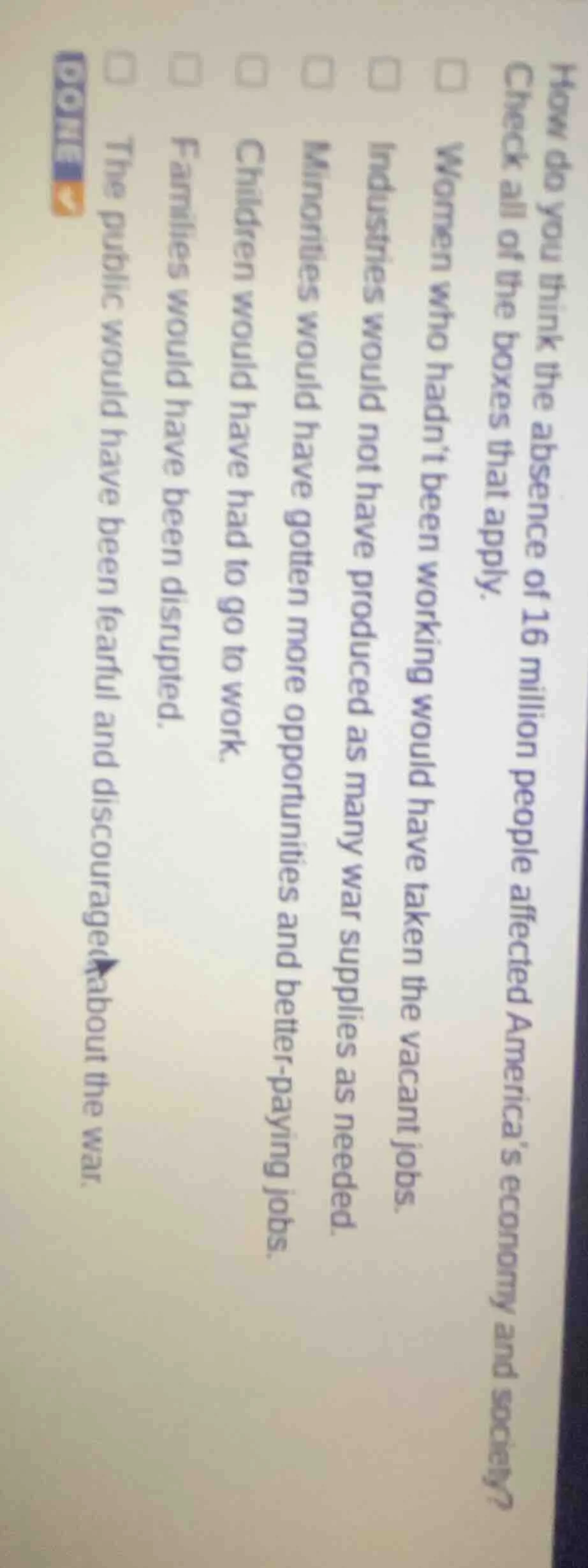
how do you think the absence of 16 million people affected america’s economy and society?
check all of the boxes that apply.
women who hadn’t been working would have taken the vacant jobs.
industries would not have produced as many war supplies as needed.
minorities would have gotten more opportunities and better - paying jobs.
children would have had to go to work.
families would have been disrupted.
the public would have been fearful and discouraged about the war.
To determine the correct options, we analyze the impact of the absence of 16 million people (likely related to a historical context like wartime labor, e.g., soldiers or workers deployed).
- "Women who hadn't been working would have taken the vacant jobs": In historical contexts (like WWII), women filled jobs left by men who went to war. If those 16 million (e.g., soldiers) were absent, women (previously not working) would take those jobs.
- "Industries would not have produced as many war supplies as needed": If 16 million people (workers, soldiers, etc.) were absent, labor and production capacity would drop, so war supplies production would be insufficient.
- "Minorities would have gotten more opportunities and better - paying jobs": With fewer people (16 million absent), job competition would decrease, so minorities (who faced discrimination) would have more job opportunities and better pay.
- "Children would have had to go to work": In times of labor shortage (due to 16 million absent), even children might be forced to work to meet labor demands.
- "Families would have been disrupted": The absence of 16 million people (e.g., family members going to war or being away for work) would disrupt family structures.
- "The public would have been fearful and discouraged about the war": The absence of a large number of people (maybe soldiers or key workers) could lead to public fear about the war's outcome and discouragement.

Snap & solve any problem in the app
Get step-by-step solutions on Sovi AI
Photo-based solutions with guided steps
Explore more problems and detailed explanations
- Women who hadn't been working would have taken the vacant jobs.
- Industries would not have produced as many war supplies as needed.
- Minorities would have gotten more opportunities and better - paying jobs.
- Children would have had to go to work.
- Families would have been disrupted.
- The public would have been fearful and discouraged about the war.