QUESTION IMAGE
Question
Question was provided via image upload.
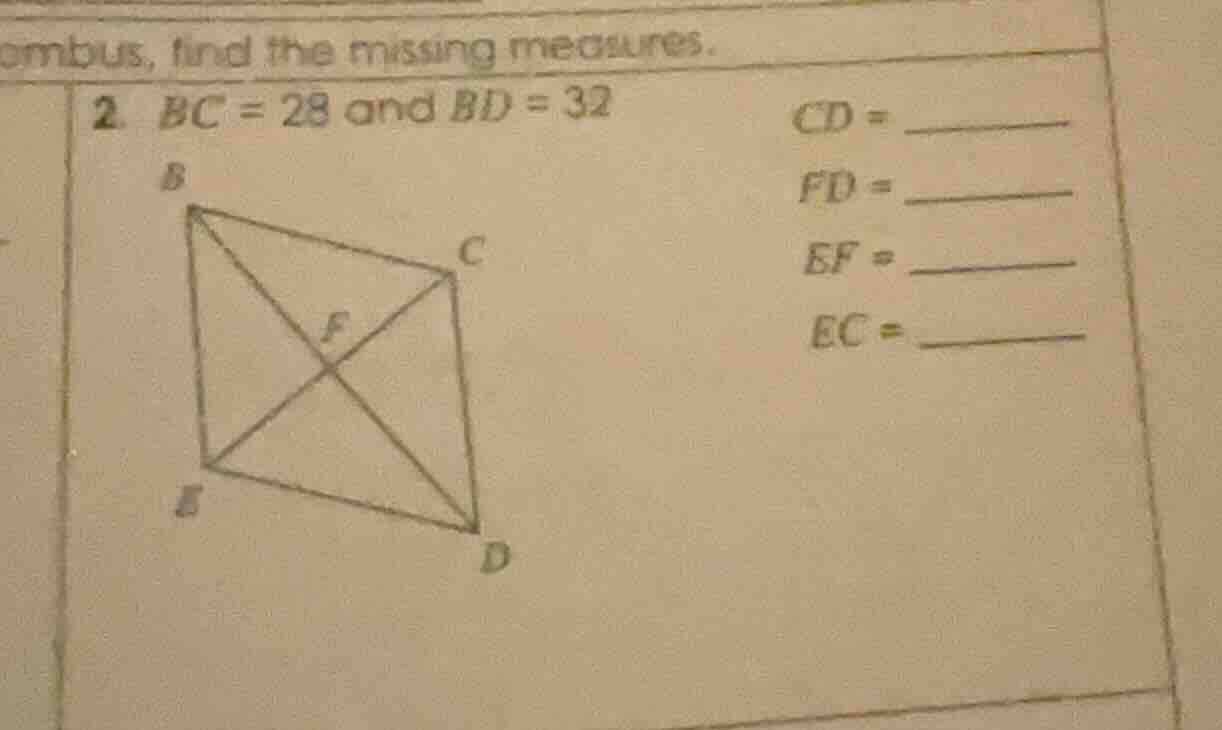
Step1: Find CD (rhombus sides equal)
All sides of a rhombus are congruent, so $CD = BC$.
$CD = 28$
Step2: Find FD (diagonals bisect each other)
Diagonals of a rhombus bisect one another, so $FD = \frac{BD}{2}$.
$FD = \frac{32}{2} = 16$
Step3: Find BF (half of diagonal BD)
BF is half of BD, so $BF = \frac{BD}{2}$.
$BF = \frac{32}{2} = 16$
Step4: Find FC (Pythagorean theorem)
Rhombus diagonals are perpendicular, so $\triangle BFC$ is right-angled. Use Pythagorean theorem: $FC = \sqrt{BC^2 - BF^2}$.
$FC = \sqrt{28^2 - 16^2} = \sqrt{784 - 256} = \sqrt{528} = 4\sqrt{33}$
Step5: Find EF (diagonals bisect each other)
Diagonals bisect each other, so $EF = FC$.
$EF = 4\sqrt{33}$
Step6: Find EC (sum of EF and FC)
EC is the full diagonal, so $EC = EF + FC = 2 \times FC$.
$EC = 2 \times 4\sqrt{33} = 8\sqrt{33}$

Snap & solve any problem in the app
Get step-by-step solutions on Sovi AI
Photo-based solutions with guided steps
Explore more problems and detailed explanations
$CD = 28$
$FD = 16$
$EF = 4\sqrt{33}$
$EC = 8\sqrt{33}$