QUESTION IMAGE
Question
Question was provided via image upload.
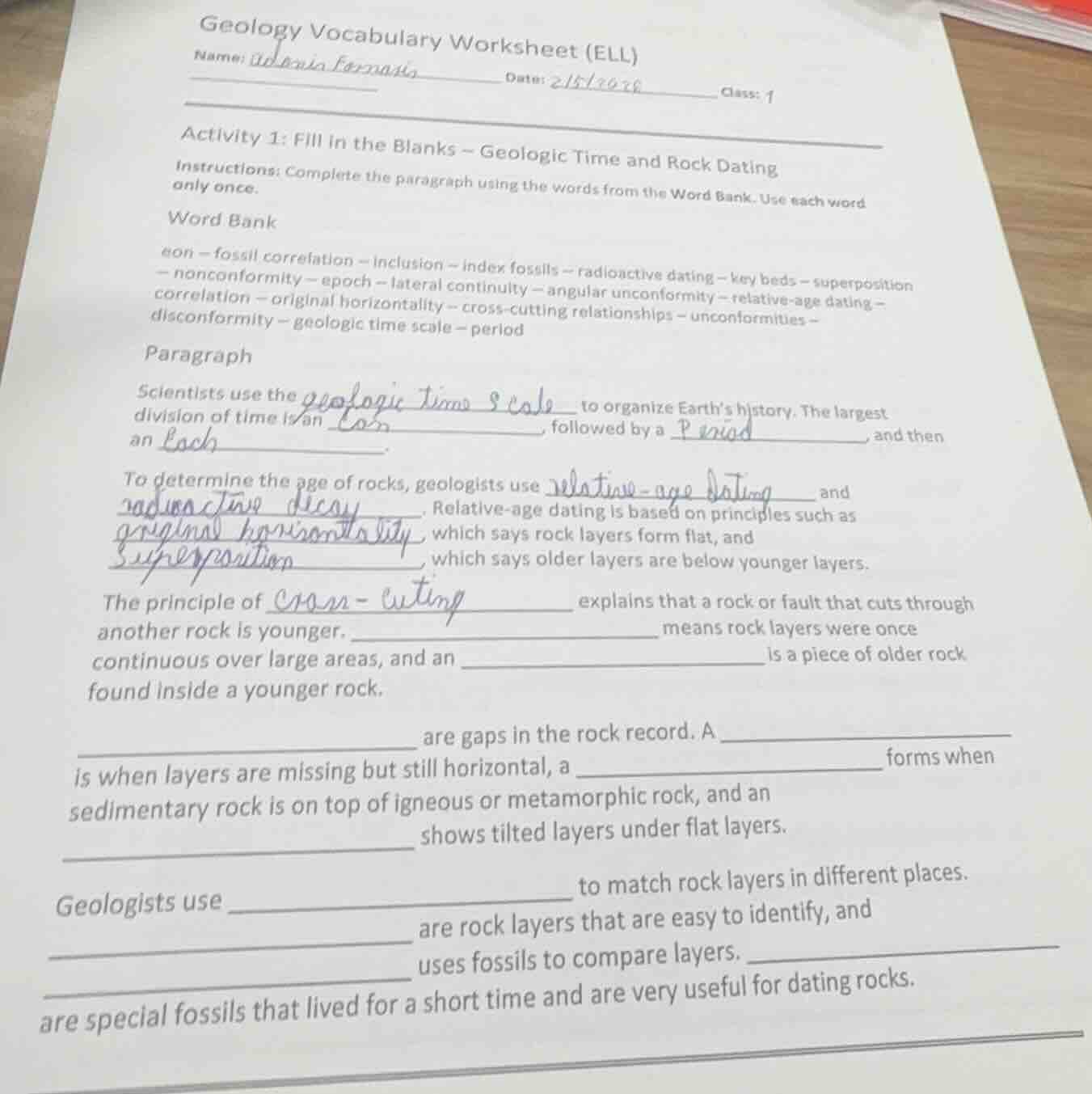
To solve this fill - in - the - blanks problem about geologic time and rock dating, we analyze each blank based on the concepts of geology:
1. First blank (organize Earth's history)
Scientists use the geologic time scale to organize Earth's history. This is a fundamental concept in geology that divides Earth's history into different time units.
2. Largest division of time
The largest division of time is an eon. Eons are the broadest category in the geologic time scale.
3. Next division after eon
After an eon, the next division is a era? Wait, no, looking at the word bank, after eon, it's a period? Wait, no, the word bank has eon, period, epoch. Wait, the correct order from largest to smaller is eon, era, period, epoch? But in the word bank, we have eon, period, epoch. Wait, maybe the worksheet's word bank has eon, period, epoch. So after eon, it's a period, and then an epoch.
4. Methods to determine rock age
To determine the age of rocks, geologists use relative - age dating and radioactive dating. Relative - age dating gives the order of rocks (which is older/younger) and radioactive dating gives the absolute age.
5. Principles of relative - age dating (rock layers form flat)
The principle that says rock layers form flat is original horizontality.
6. Older layers below younger layers
The principle that says older layers are below younger layers is superposition.
7. Rock or fault cutting through is younger
The principle of cross - cutting relationships explains that a rock or fault that cuts through another rock is younger.
8. Rock layers were once continuous
Lateral continuity means rock layers were once continuous over large areas.
9. Piece of older rock in younger rock
An inclusion is a piece of older rock found inside a younger rock.
10. Gaps in the rock record
Unconformities are gaps in the rock record.
11. Layers missing but horizontal
A disconformity forms when layers are missing but still horizontal.
12. Sedimentary on top of igneous/metamorphic
A nonconformity forms when sedimentary rock is on top of igneous or metamorphic rock.
13. Tilted layers under flat layers
An angular unconformity shows tilted layers under flat layers.
14. Match rock layers in different places
Geologists use correlation (or fossil correlation from the word bank? Wait, the word bank has "correlation" and "fossil correlation". Wait, the general term for matching rock layers is correlation, and more specifically, fossil correlation or using key beds/index fossils. But from the word bank, we have "correlation". Wait, the first part: Geologists use correlation to match rock layers in different places.
15. Easy - to - identify rock layers
Key beds are rock layers that are easy to identify.
16. Using fossils to compare layers
Fossil correlation uses fossils to compare layers.
17. Special fossils for dating rocks
Index fossils are special fossils that lived for a short time and are very useful for dating rocks.
Now, filling in the blanks with the correct terms from the word bank:
- Scientists use the \(\boldsymbol{\text{geologic time scale}}\) to organize Earth's history. The largest division of time is an \(\boldsymbol{\text{eon}}\), followed by a \(\boldsymbol{\text{period}}\), and then an \(\boldsymbol{\text{epoch}}\).
- To determine the age of rocks, geologists use \(\boldsymbol{\text{relative - age dating}}\) and \(\boldsymbol{\text{radioactive dating}}\). Relative - age d…

Snap & solve any problem in the app
Get step-by-step solutions on Sovi AI
Photo-based solutions with guided steps
Explore more problems and detailed explanations
To solve this fill - in - the - blanks problem about geologic time and rock dating, we analyze each blank based on the concepts of geology:
1. First blank (organize Earth's history)
Scientists use the geologic time scale to organize Earth's history. This is a fundamental concept in geology that divides Earth's history into different time units.
2. Largest division of time
The largest division of time is an eon. Eons are the broadest category in the geologic time scale.
3. Next division after eon
After an eon, the next division is a era? Wait, no, looking at the word bank, after eon, it's a period? Wait, no, the word bank has eon, period, epoch. Wait, the correct order from largest to smaller is eon, era, period, epoch? But in the word bank, we have eon, period, epoch. Wait, maybe the worksheet's word bank has eon, period, epoch. So after eon, it's a period, and then an epoch.
4. Methods to determine rock age
To determine the age of rocks, geologists use relative - age dating and radioactive dating. Relative - age dating gives the order of rocks (which is older/younger) and radioactive dating gives the absolute age.
5. Principles of relative - age dating (rock layers form flat)
The principle that says rock layers form flat is original horizontality.
6. Older layers below younger layers
The principle that says older layers are below younger layers is superposition.
7. Rock or fault cutting through is younger
The principle of cross - cutting relationships explains that a rock or fault that cuts through another rock is younger.
8. Rock layers were once continuous
Lateral continuity means rock layers were once continuous over large areas.
9. Piece of older rock in younger rock
An inclusion is a piece of older rock found inside a younger rock.
10. Gaps in the rock record
Unconformities are gaps in the rock record.
11. Layers missing but horizontal
A disconformity forms when layers are missing but still horizontal.
12. Sedimentary on top of igneous/metamorphic
A nonconformity forms when sedimentary rock is on top of igneous or metamorphic rock.
13. Tilted layers under flat layers
An angular unconformity shows tilted layers under flat layers.
14. Match rock layers in different places
Geologists use correlation (or fossil correlation from the word bank? Wait, the word bank has "correlation" and "fossil correlation". Wait, the general term for matching rock layers is correlation, and more specifically, fossil correlation or using key beds/index fossils. But from the word bank, we have "correlation". Wait, the first part: Geologists use correlation to match rock layers in different places.
15. Easy - to - identify rock layers
Key beds are rock layers that are easy to identify.
16. Using fossils to compare layers
Fossil correlation uses fossils to compare layers.
17. Special fossils for dating rocks
Index fossils are special fossils that lived for a short time and are very useful for dating rocks.
Now, filling in the blanks with the correct terms from the word bank:
- Scientists use the \(\boldsymbol{\text{geologic time scale}}\) to organize Earth's history. The largest division of time is an \(\boldsymbol{\text{eon}}\), followed by a \(\boldsymbol{\text{period}}\), and then an \(\boldsymbol{\text{epoch}}\).
- To determine the age of rocks, geologists use \(\boldsymbol{\text{relative - age dating}}\) and \(\boldsymbol{\text{radioactive dating}}\). Relative - age dating is based on principles such as \(\boldsymbol{\text{original horizontality}}\), which says rock layers form flat, and \(\boldsymbol{\text{superposition}}\), which says older layers are below younger layers.
- The principle of \(\boldsymbol{\text{cross - cutting relationships}}\) explains that a rock or fault that cuts through another rock is younger. \(\boldsymbol{\text{Lateral continuity}}\) means rock layers were once continuous over large areas, and an \(\boldsymbol{\text{inclusion}}\) is a piece of older rock found inside a younger rock.
- \(\boldsymbol{\text{Unconformities}}\) are gaps in the rock record. A \(\boldsymbol{\text{disconformity}}\) forms when layers are missing but still horizontal, a \(\boldsymbol{\text{nonconformity}}\) forms when sedimentary rock is on top of igneous or metamorphic rock, and an \(\boldsymbol{\text{angular unconformity}}\) shows tilted layers under flat layers.
- Geologists use \(\boldsymbol{\text{correlation}}\) to match rock layers in different places. \(\boldsymbol{\text{Key beds}}\) are rock layers that are easy to identify, and \(\boldsymbol{\text{fossil correlation}}\) uses fossils to compare layers. \(\boldsymbol{\text{Index fossils}}\) are special fossils that lived for a short time and are very useful for dating rocks.
If we assume that we just need to fill the first few blanks as per the hand - written start:
From the hand - written part:
- Scientists use the \(\boldsymbol{\text{geologic time scale}}\) to organize Earth's history. The largest division of time is an \(\boldsymbol{\text{eon}}\), followed by a \(\boldsymbol{\text{period}}\), and then an \(\boldsymbol{\text{epoch}}\).
- To determine the age of rocks, geologists use \(\boldsymbol{\text{relative - age dating}}\) and \(\boldsymbol{\text{radioactive dating}}\). Relative - age dating is based on principles such as \(\boldsymbol{\text{original horizontality}}\), which says rock layers form flat, and \(\boldsymbol{\text{superposition}}\), which says older layers are below younger layers.
- The principle of \(\boldsymbol{\text{cross - cutting relationships}}\) explains that a rock or fault that cuts through another rock is younger. \(\boldsymbol{\text{Lateral continuity}}\) means rock layers were once continuous over large areas, and an \(\boldsymbol{\text{inclusion}}\) is a piece of older rock found inside a younger rock.
- \(\boldsymbol{\text{Unconformities}}\) are gaps in the rock record. A \(\boldsymbol{\text{disconformity}}\) forms when layers are missing but still horizontal, a \(\boldsymbol{\text{nonconformity}}\) forms when sedimentary rock is on top of igneous or metamorphic rock, and an \(\boldsymbol{\text{angular unconformity}}\) shows tilted layers under flat layers.
- Geologists use \(\boldsymbol{\text{correlation}}\) to match rock layers in different places. \(\boldsymbol{\text{Key beds}}\) are rock layers that are easy to identify, and \(\boldsymbol{\text{fossil correlation}}\) uses fossils to compare layers. \(\boldsymbol{\text{Index fossils}}\) are special fossils that lived for a short time and are very useful for dating rocks.
The filled - in blanks (based on the hand - written start and the analysis) would be:
- geologic time scale
- eon
- period
- epoch
- relative - age dating
- radioactive dating
- original horizontality
- superposition
- cross - cutting relationships
- Lateral continuity
- inclusion
- Unconformities
- disconformity
- nonconformity
- angular unconformity
- correlation
- Key beds
- fossil correlation
- Index fossils
Since the problem is about filling in the blanks for a geology worksheet, the answers are based on the geological concepts and the word bank provided.
Final Answers (for the blanks in order as per the paragraph):
- geologic time scale
- eon
- period
- epoch
- relative - age dating
- radioactive dating
- original horizontality
- superposition
- cross - cutting relationships
- Lateral continuity
- inclusion
- Unconformities
- disconformity
- nonconformity
- angular unconformity
- correlation
- Key beds
- fossil correlation
- Index fossils