QUESTION IMAGE
Question
Question was provided via image upload.
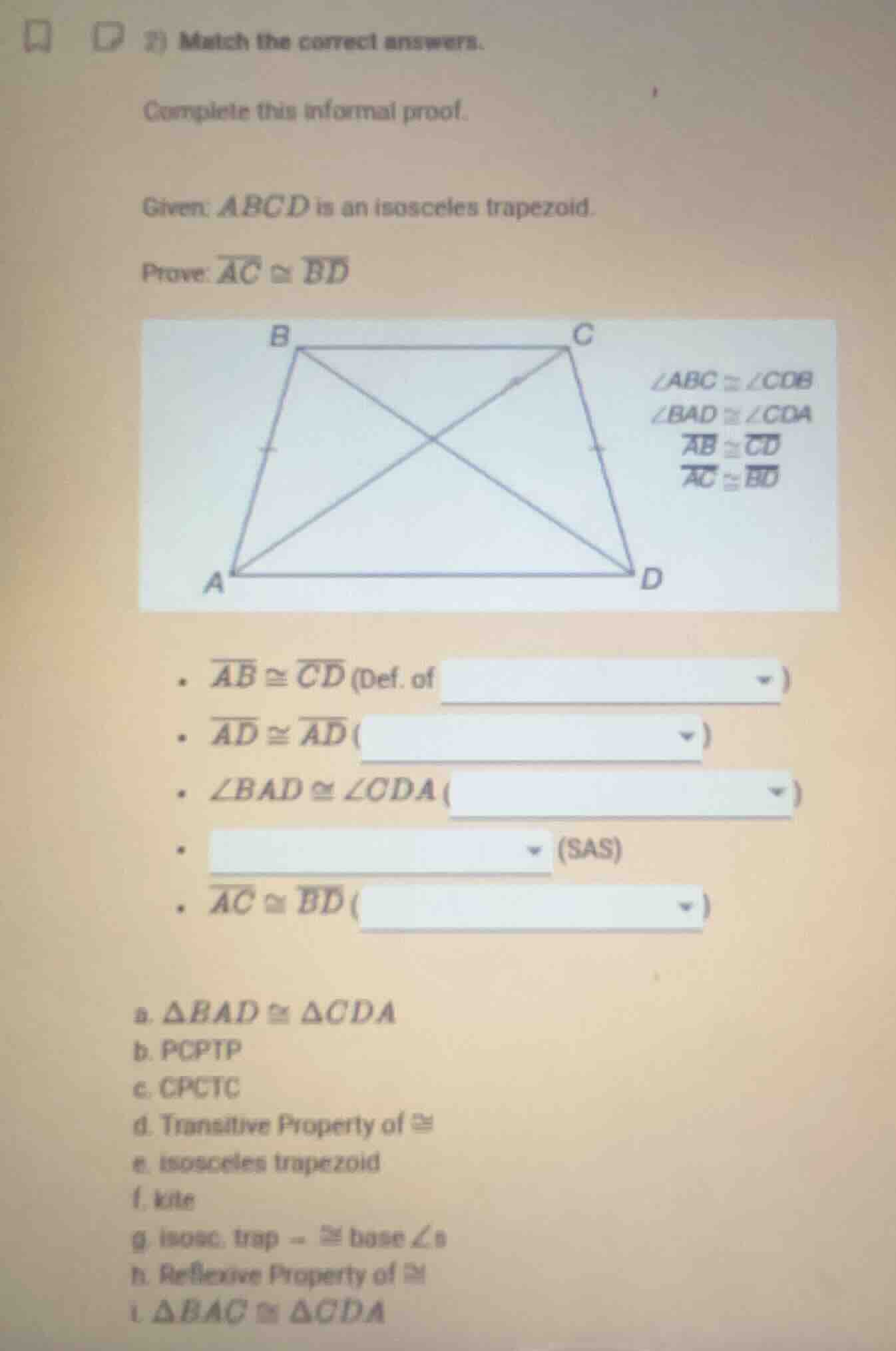
Step 1: Analyze \(\overline{AB} \cong \overline{CD}\)
In an isosceles trapezoid, the non - parallel sides (legs) are congruent? No, wait, in an isosceles trapezoid, the legs are congruent? Wait, no, the definition of an isosceles trapezoid is a trapezoid with the non - parallel sides (legs) congruent? Wait, no, actually, in an isosceles trapezoid, the base angles are equal and the non - parallel sides (legs) are congruent? Wait, no, the two pairs of base angles are equal, and the legs (the non - parallel sides) are congruent. But also, the bases are the parallel sides. Wait, the first statement: \(\overline{AB} \cong \overline{CD}\). In an isosceles trapezoid, the legs (if \(AB\) and \(CD\) are the legs) or the bases? Wait, the given trapezoid is \(ABCD\), with \(AD\) and \(BC\) as the bases (since it's a trapezoid, \(AD\parallel BC\))? Wait, no, maybe \(AB\) and \(CD\) are the legs. Wait, the definition of an isosceles trapezoid: a trapezoid in which the non - parallel sides (legs) are congruent. So \(\overline{AB} \cong \overline{CD}\) is by the definition of an isosceles trapezoid. So the first blank: e (isosceles trapezoid).
Step 2: Analyze \(\overline{AD} \cong \overline{AD}\)
A segment is congruent to itself by the Reflexive Property of Congruence. So the second blank: h (Reflexive Property of \(\cong\)).
Step 3: Analyze \(\angle BAD \cong \angle CDA\)
In an isosceles trapezoid, the base angles are congruent. The base angles are the angles adjacent to each base. So \(\angle BAD\) and \(\angle CDA\) are base angles of the isosceles trapezoid, so they are congruent by the property "isosc. trap -- \(\cong\) base \(\angle\)s". So the third blank: g (isosc. trap -- \(\cong\) base \(\angle\)s).
Step 4: Analyze the SAS congruence
We have \(\overline{AB} \cong \overline{CD}\), \(\overline{AD} \cong \overline{AD}\), and \(\angle BAD \cong \angle CDA\). So by SAS (Side - Angle - Side) congruence criterion, \(\triangle BAD \cong \triangle CDA\). So the fourth blank: a (\(\triangle BAD \cong \triangle CDA\)).
Step 5: Analyze \(\overline{AC} \cong \overline{BD}\)
If two triangles are congruent, then their corresponding parts (sides and angles) are congruent. This is the CPCTC (Corresponding Parts of Congruent Triangles are Congruent) theorem. Since \(\triangle BAD \cong \triangle CDA\), the corresponding sides \(\overline{AC}\) and \(\overline{BD}\) (wait, in \(\triangle BAD\) and \(\triangle CDA\), the corresponding sides: \(BA\) corresponds to \(CD\), \(AD\) corresponds to \(DA\), and \(BD\) corresponds to \(AC\)). So by CPCTC, \(\overline{AC} \cong \overline{BD}\). So the fifth blank: c (CPCTC).

Snap & solve any problem in the app
Get step-by-step solutions on Sovi AI
Photo-based solutions with guided steps
Explore more problems and detailed explanations
- \(\overline{AB} \cong \overline{CD}\) (Def. of \(\boldsymbol{e}\) (isosceles trapezoid))
- \(\overline{AD} \cong \overline{AD}\) (\(\boldsymbol{h}\) (Reflexive Property of \(\cong\)))
- \(\angle BAD \cong \angle CDA\) (\(\boldsymbol{g}\) (isosc. trap -- \(\cong\) base \(\angle\)s))
- \(\boldsymbol{a}\) (\(\triangle BAD \cong \triangle CDA\)) (SAS)
- \(\overline{AC} \cong \overline{BD}\) (\(\boldsymbol{c}\) (CPCTC))