QUESTION IMAGE
Question
Question was provided via image upload.
Brief Explanations
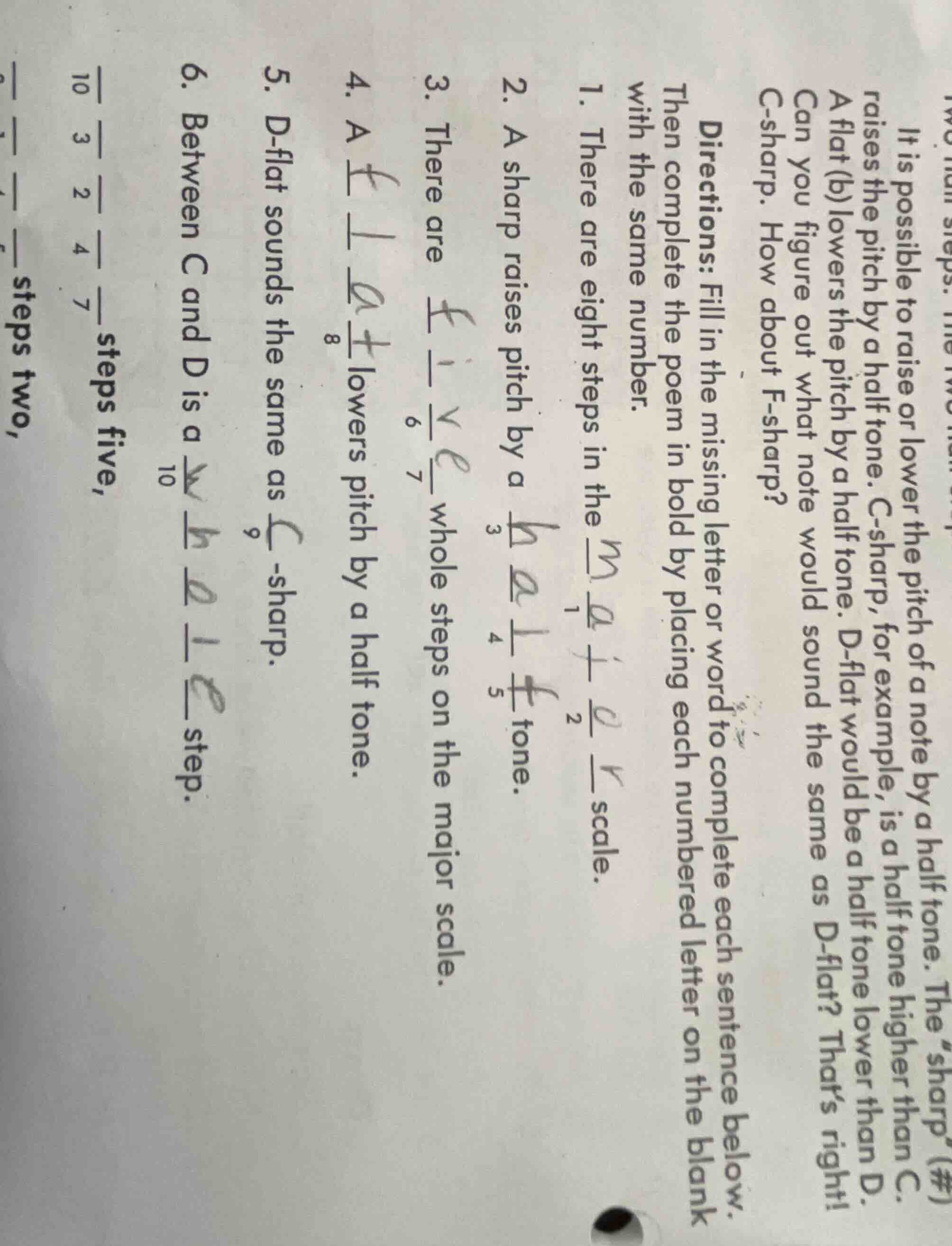
- A standard major scale has 8 sequential pitch steps (octave).
- By definition, a sharp symbol raises a note's pitch by one half-tone.
- A major scale follows the step pattern W-W-H-W-W-W-H, which totals 5 whole (W) steps.
- By definition, a flat symbol lowers a note's pitch by one half-tone.
- C-sharp (half-step above C) and D-flat (half-step below D) are enharmonic equivalents (same pitch).
- The interval between consecutive natural notes C and D is one full whole step.
- D-flat and C-sharp are enharmonic equivalents, as stated in the prompt's example.
- F-sharp (half-step above F) and G-flat (half-step below G) are enharmonic equivalents.

Snap & solve any problem in the app
Get step-by-step solutions on Sovi AI
Photo-based solutions with guided steps
Explore more problems and detailed explanations
- There are eight steps in the major scale.
- A sharp raises pitch by a half tone.
- There are five whole steps on the major scale.
- A flat lowers pitch by a half tone.
- D-flat sounds the same as C-sharp.
- Between C and D is a whole step.
- (The note equivalent to D-flat is) C-sharp
- (The note equivalent to F-sharp is) G-flat