QUESTION IMAGE
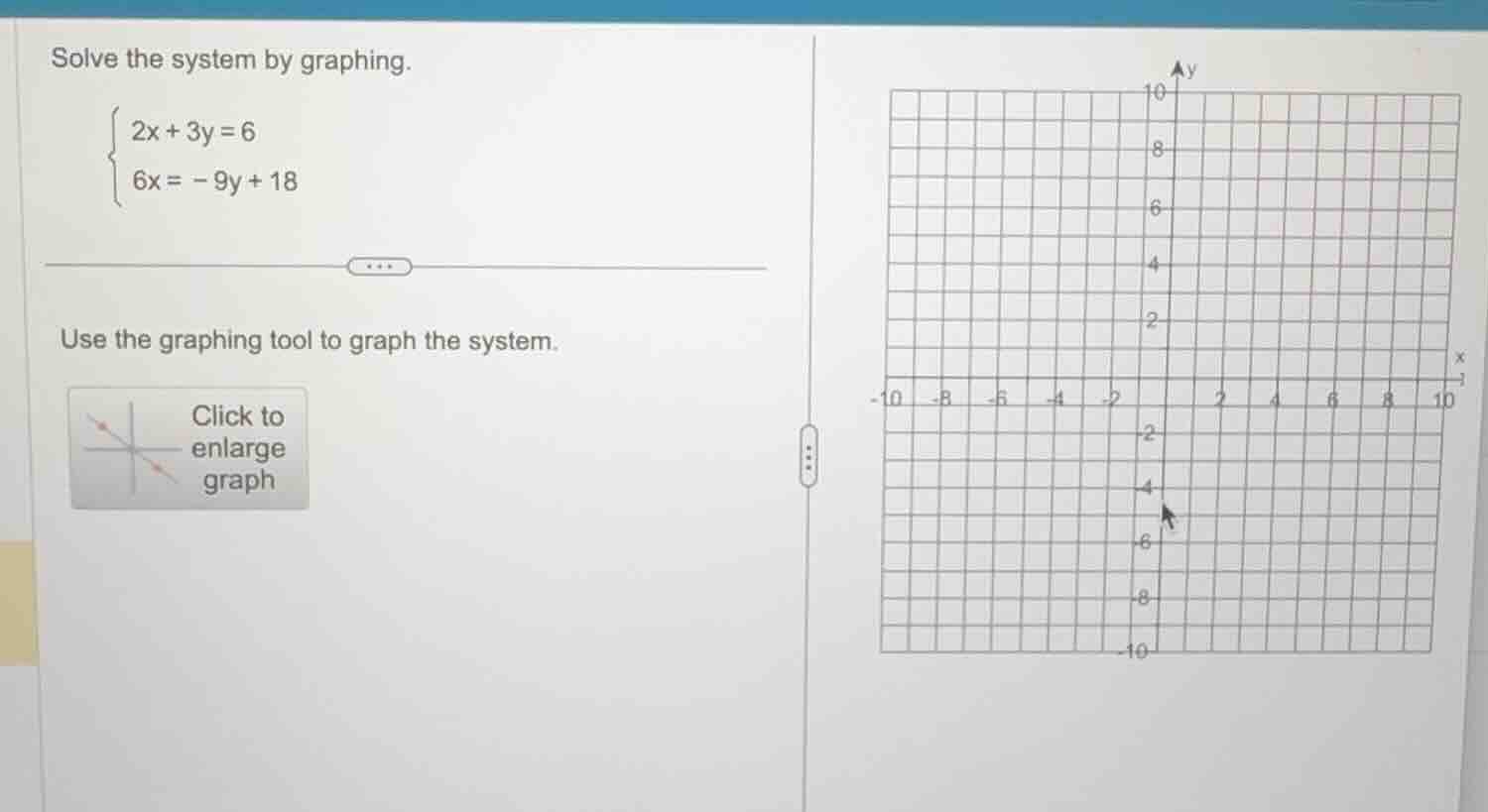
Question
Question was provided via image upload.
Step1: Rewrite first equation in slope - intercept form
The slope - intercept form of a line is \(y = mx + b\), where \(m\) is the slope and \(b\) is the y - intercept.
For the equation \(2x+3y = 6\), we solve for \(y\):
Subtract \(2x\) from both sides: \(3y=-2x + 6\)
Divide both sides by 3: \(y=-\frac{2}{3}x + 2\)
Step2: Rewrite second equation in slope - intercept form
For the equation \(6x=-9y + 18\), we solve for \(y\):
First, add \(9y\) to both sides: \(9y+6x = 18\)
Subtract \(6x\) from both sides: \(9y=-6x + 18\)
Divide both sides by 9: \(y=-\frac{6}{9}x + 2=-\frac{2}{3}x + 2\)
Step3: Analyze the two lines
Since both equations, when rewritten in slope - intercept form, are \(y =-\frac{2}{3}x+2\), this means that the two lines are identical (they have the same slope and the same y - intercept). When two lines in a system of linear equations are identical, the system has infinitely many solutions, and the solution set is all the points that lie on the line \(y =-\frac{2}{3}x + 2\) (or equivalently, on the line represented by either of the original equations).

Snap & solve any problem in the app
Get step-by-step solutions on Sovi AI
Photo-based solutions with guided steps
Explore more problems and detailed explanations
The system of equations has infinitely many solutions, and the solution set is all ordered pairs \((x,y)\) such that \(2x + 3y=6\) (or \(6x=-9y + 18\)), which can be written as \(\{(x,y)\mid y =-\frac{2}{3}x + 2,x\in\mathbb{R}\}\)