QUESTION IMAGE
Question
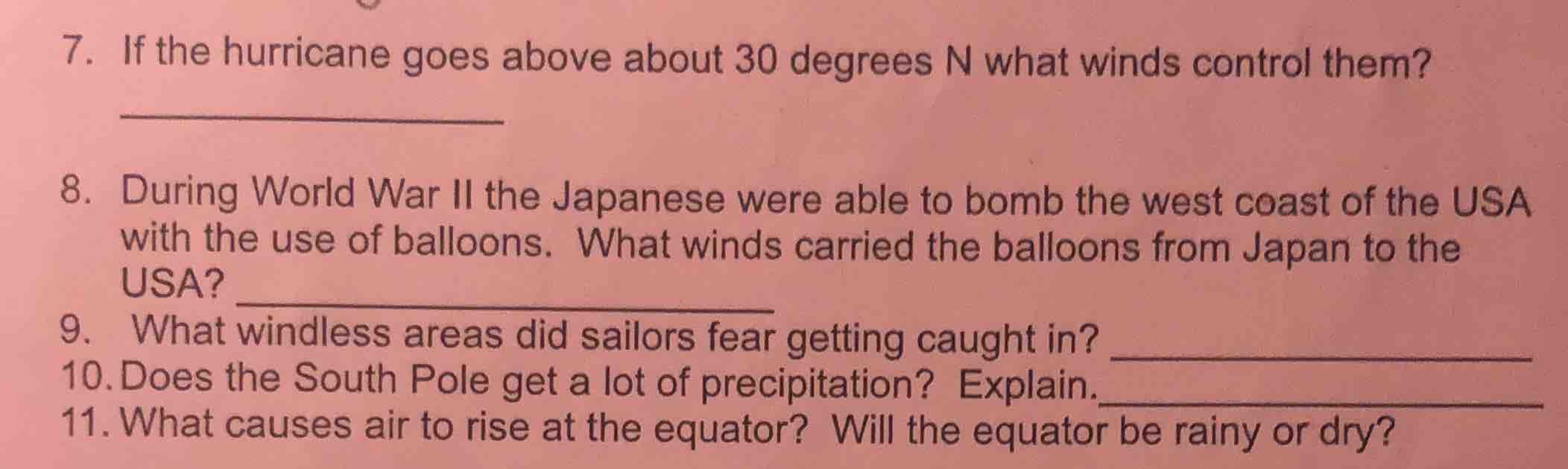
- if the hurricane goes above about 30 degrees n what winds control them?
- during world war ii the japanese were able to bomb the west coast of the usa with the use of balloons. what winds carried the balloons from japan to the usa?
- what windless areas did sailors fear getting caught in?
- does the south pole get a lot of precipitation? explain.
- what causes air to rise at the equator? will the equator be rainy or dry?
Brief Explanations
- Above 30°N, the prevailing wind belt is the westerlies, which steer hurricanes once they move out of the trade wind zone.
- The high-altitude jet stream called the polar jet stream, specifically the westerly jet stream in the Northern Hemisphere, carried the Japanese balloon bombs eastward from Japan to the US West Coast during WWII.
- Sailors feared the horse latitudes, subtropical windless zones around 30°N/S, and the doldrums, equatorial windless zone, where calm conditions could trap ships for long periods.
- The South Pole receives very little precipitation. It is a polar desert; cold air holds almost no moisture, and the high elevation and stable atmospheric circulation prevent significant rainfall/snowfall, with annual precipitation equivalent to less than 50 mm of water.
- At the equator, intense direct solar radiation heats the air, causing it to expand and rise. Rising air cools, condenses, and forms heavy rainfall, so the equator is rainy.

Snap & solve any problem in the app
Get step-by-step solutions on Sovi AI
Photo-based solutions with guided steps
Explore more problems and detailed explanations
- The westerlies (prevailing westerly winds)
- The jet stream (specifically the Northern Hemisphere westerly jet stream)
- The doldrums (equatorial calms) and horse latitudes (subtropical calms)
- No, the South Pole does not get a lot of precipitation. It is a cold polar desert with extremely low moisture in the air, leading to minimal annual precipitation.
- Intense solar heating warms equatorial air, making it rise. The equator is rainy.