QUESTION IMAGE
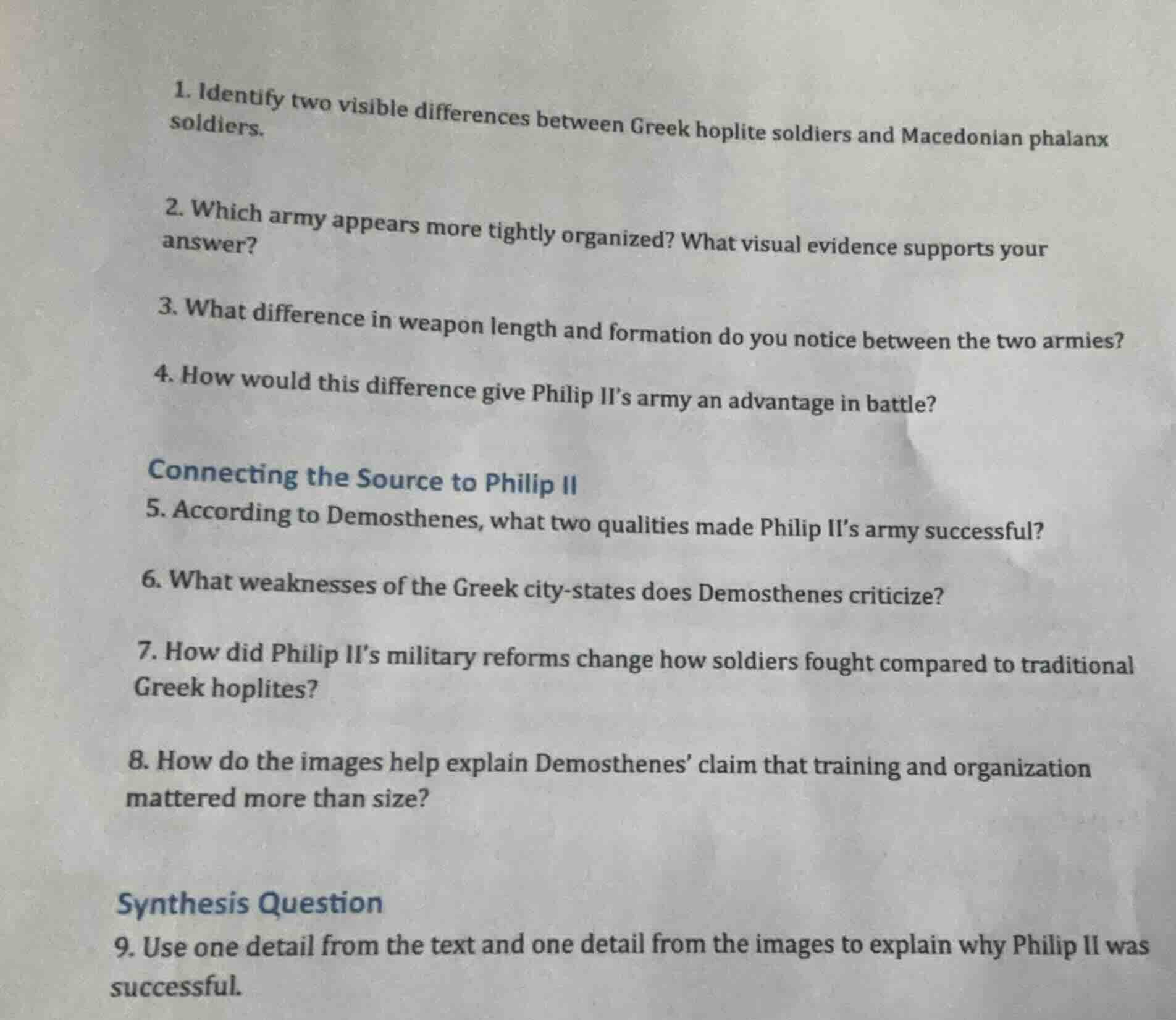
Question
- identify two visible differences between greek hoplite soldiers and macedonian phalanx soldiers.
- which army appears more tightly organized? what visual evidence supports your answer?
- what difference in weapon length and formation do you notice between the two armies?
- how would this difference give philip ii’s army an advantage in battle?
connecting the source to philip ii
- according to demosthenes, what two qualities made philip ii’s army successful?
- what weaknesses of the greek city - states does demosthenes criticize?
- how did philip ii’s military reforms change how soldiers fought compared to traditional greek hoplites?
- how do the images help explain demosthenes’ claim that training and organization mattered more than size?
synthesis question
- use one detail from the text and one detail from the images to explain why philip ii was successful.
Response
Question 1
Brief Explanations
- Shield Type: Greek hoplites typically used large, round, convex shields (aspis) that covered much of their body, while Macedonian phalanx soldiers used smaller, more rectangular or oval shields that were held in a way to allow for the use of long pikes.
- Weapon Length: Greek hoplites used shorter spears (usually around 6 - 9 feet), whereas Macedonian phalanx soldiers wielded much longer sarissas (pikes) that could be 12 - 20 feet long.
Brief Explanations
The Macedonian phalanx appears more tightly organized. Visual evidence includes the soldiers in the phalanx standing very close together in neat, uniform rows and columns, with their long sarissas all pointing in a similar direction, creating a more cohesive and ordered formation compared to the Greek hoplites, who may appear more spread out or with less uniform spacing and weapon alignment.
Brief Explanations
- Weapon Length: Greek hoplites have shorter spears (6 - 9 ft), and Macedonian phalanx soldiers have much longer sarissas (12 - 20 ft).
- Formation: Greek hoplites form a more loose - looking, sometimes less uniform battle line (hoplite phalanx but with more individual spacing), while Macedonian phalanx soldiers form a very tight, dense formation with soldiers packed closely together in multiple rows and columns, creating a more rigid and coordinated block.

Snap & solve any problem in the app
Get step-by-step solutions on Sovi AI
Photo-based solutions with guided steps
Explore more problems and detailed explanations
- Shield Type: Greek hoplites used large, round aspis shields; Macedonian phalanx soldiers used smaller, more rectangular/oval shields.
- Weapon Length: Greek hoplites used shorter spears (6 - 9 ft); Macedonian phalanx soldiers used longer sarissas (12 - 20 ft).