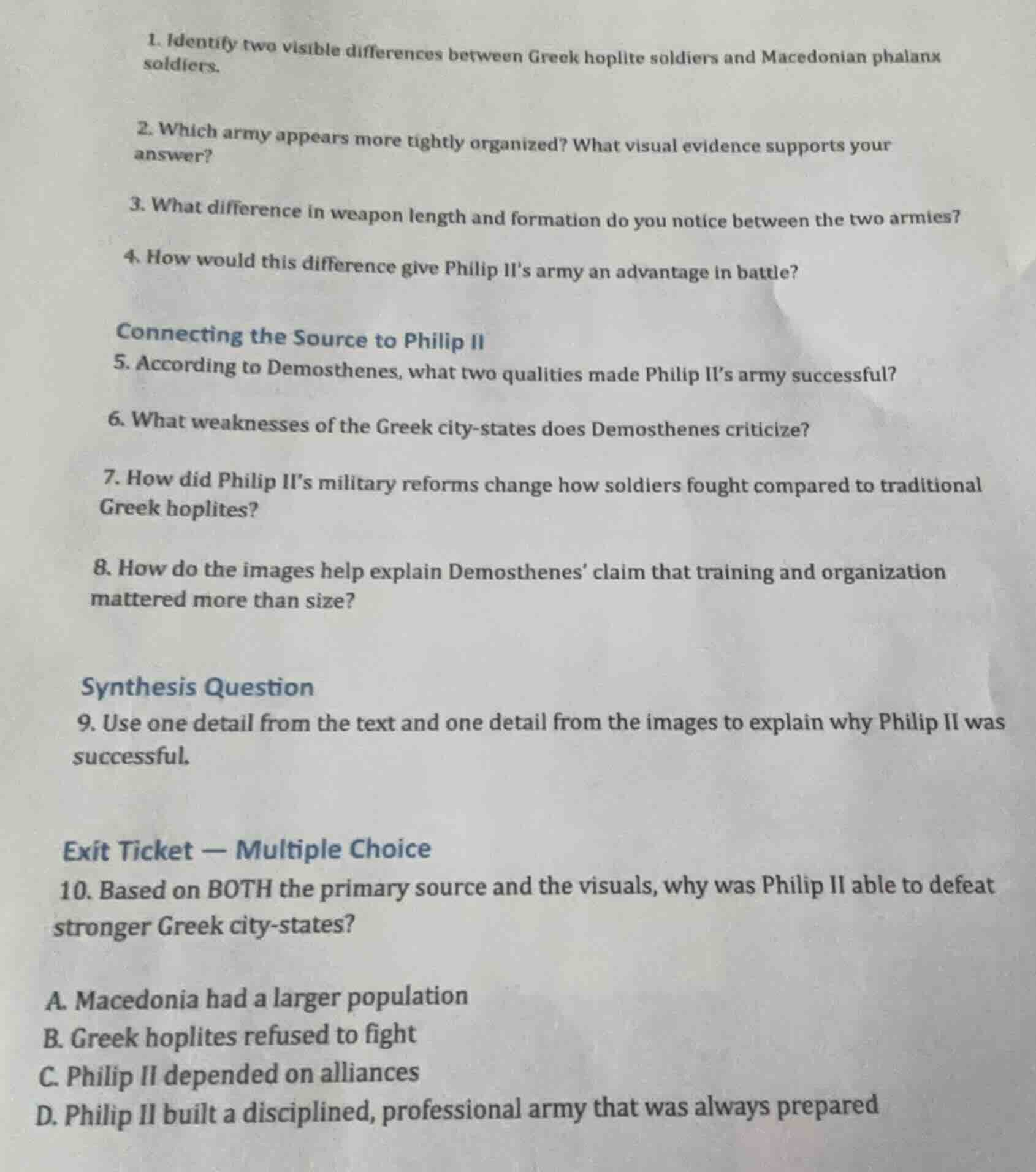
QUESTION IMAGE
Question
- identify two visible differences between greek hoplite soldiers and macedonian phalanx soldiers.
- which army appears more tightly organized? what visual evidence supports your answer?
- what difference in weapon length and formation do you notice between the two armies?
- how would this difference give philip ii’s army an advantage in battle?
connecting the source to philip ii
- according to demosthenes, what two qualities made philip ii’s army successful?
- what weaknesses of the greek city - states does demosthenes criticize?
- how did philip ii’s military reforms change how soldiers fought compared to traditional greek hoplites?
- how do the images help explain demosthenes’ claim that training and organization mattered more than size?
synthesis question
- use one detail from the text and one detail from the images to explain why philip ii was successful.
exit ticket — multiple choice
- based on both the primary source and the visuals, why was philip ii able to defeat stronger greek city - states?
a. macedonia had a larger population
b. greek hoplites refused to fight
c. philip ii depended on alliances
d. philip ii built a disciplined, professional army that was always prepared
Response
Question 10
Brief Explanations
To answer this, we analyze each option:
- Option A: The question's context (from previous questions about organization, weapon differences) doesn't support population size as the reason.
- Option B: There's no indication Greek hoplites refused to fight.
- Option C: The text and visuals focus on Philip II's army reforms (discipline, organization) not alliances.
- Option D: Previous questions show Philip II's army (Macedonian phalanx) was more organized, had better weaponry/training. Demosthenes' view and visual evidence of tight organization support a disciplined, professional army that was prepared.

Snap & solve any problem in the app
Get step-by-step solutions on Sovi AI
Photo-based solutions with guided steps
Explore more problems and detailed explanations
D. Philip II built a disciplined, professional army that was always prepared