QUESTION IMAGE
Question
identifying geometric figures
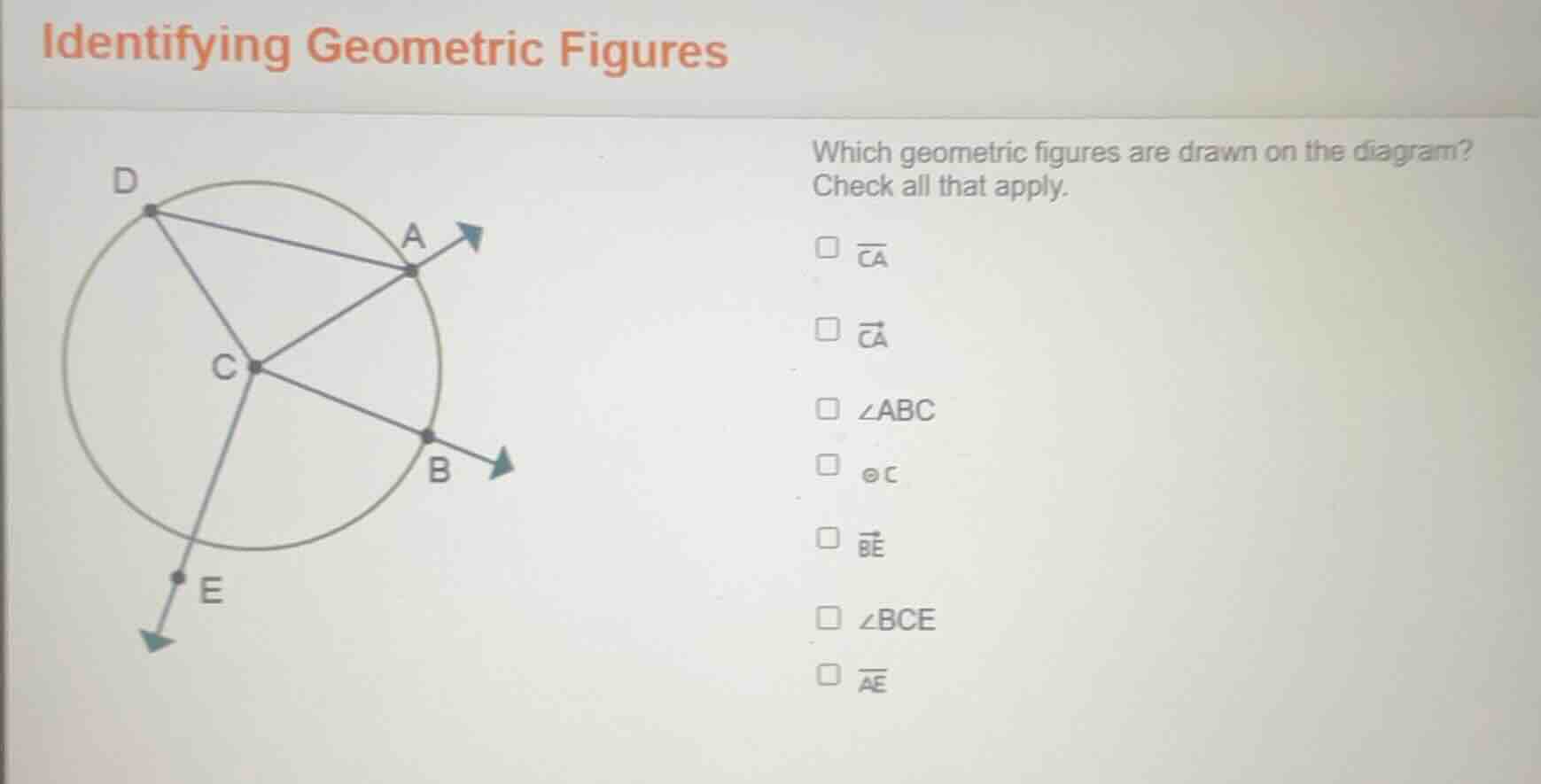
which geometric figures are drawn on the diagram?
check all that apply.
□ \\(\overline{ca}\\)
□ \\(\vec{ca}\\)
□ \\(\angle abc\\)
□ \\(\odot c\\)
□ \\(\overline{be}\\)
□ \\(\angle bce\\)
□ \\(\overline{ae}\\)
Brief Explanations
- Analyze \(\overline{CA}\): It is a line segment from \(C\) to \(A\), present as \(CA\) is a radius.
- Analyze \(\overrightarrow{CA}\): A ray starting at \(C\) and going through \(A\), which matches the diagram (from \(C\) to \(A\) with an arrow at \(A\) extended? Wait, the diagram has a ray from \(C\) through \(A\) (the arrow at \(A\) direction). Wait, \(\overrightarrow{CA}\) is ray from \(C\) to \(A\) (arrow at \(A\) end). The diagram shows a ray starting at \(C\) and passing through \(A\) (with the arrow beyond \(A\)), so \(\overrightarrow{CA}\) is present.
- Analyze \(\angle ABC\): The angle would be at \(B\) with sides \(BA\) and \(BC\), but in the diagram, there's no point \(B\) as a vertex for such an angle (the point \(B\) is on the ray from \(C\) through \(B\), but no angle at \(B\) with \(A\) and \(C\) as shown). So this is not present.
- Analyze \(\odot C\): A circle with center \(C\), which is the diagram (the circle centered at \(C\)), so this is present.
- Analyze \(\overline{BE}\): A line segment from \(B\) to \(E\)? The diagram has a ray from \(C\) through \(B\) and another ray from \(C\) through \(E\) (wait, \(E\) is on the ray opposite to \(B\)? Wait, the diagram shows a ray from \(C\) through \(B\) (arrow at \(B\) extended) and a ray from \(C\) through \(E\) (arrow at \(E\) extended, opposite to \(B\)). So \(\overline{BE}\) would be a segment, but in the diagram, \(B\) and \(E\) are on a straight line through \(C\), but is there a segment? Wait, no, the diagram has rays, not a segment between \(B\) and \(E\). Wait, maybe I misread. Wait, the options: \(\overline{BE}\) is a segment, but in the diagram, \(B\) is on one ray, \(E\) on another (opposite ray through \(C\)), so \(B\), \(C\), \(E\) are colinear, but is there a segment \(BE\)? No, the diagram has rays, not a segment. So \(\overline{BE}\) is not present.
- Analyze \(\angle BCE\): The angle at \(C\) with sides \(CB\) and \(CE\). Since \(B\), \(C\), \(E\) are colinear (opposite rays), the angle would be a straight angle (180 degrees), but is \(\angle BCE\) drawn? Wait, \(CB\) is a ray, \(CE\) is a ray opposite to \(CB\) (since \(E\) is on the ray from \(C\) opposite to \(B\)), so \(\angle BCE\) is a straight angle, but is it considered? Wait, the diagram shows \(C\) as center, with rays \(CA\), \(CB\), \(CE\) (wait, \(E\) is on the ray from \(C\) opposite to \(B\), so \(CB\) and \(CE\) are opposite rays, so \(\angle BCE\) is a straight angle. But is that angle drawn? The diagram has the ray \(CB\) (through \(B\)) and ray \(CE\) (through \(E\)), so the angle at \(C\) between \(CB\) and \(CE\) is 180 degrees, so \(\angle BCE\) is present (as a straight angle). Wait, but let's check again.
- Analyze \(\overline{AE}\): A segment from \(A\) to \(E\)? The diagram has \(A\) on one ray, \(E\) on another (opposite to \(B\)), so \(A\) and \(E\) are not on the same line, so no segment \(AE\) is drawn.
Wait, let's re - evaluate each option:
- \(\overline{CA}\): Line segment from \(C\) to \(A\) – present (as \(CA\) is a radius).
- \(\overrightarrow{CA}\): Ray from \(C\) to \(A\) (with arrow at \(A\) end, as the diagram has a ray starting at \(C\) and passing through \(A\) with an arrow beyond \(A\)) – present.
- \(\angle ABC\): Angle at \(B\) – not present, no angle at \(B\) with sides \(AB\) and \(BC\) (the diagram doesn't show such an angle).
- \(\odot C\): Circle with center \(C\) – present (the diagram is a circle centered at \(C\)).
- \(\overline{BE}\): Segment from \(B\) to \(E\) – not present, \(B\) and \(E\) are on a straight line through \(C\), but the d…

Snap & solve any problem in the app
Get step-by-step solutions on Sovi AI
Photo-based solutions with guided steps
Explore more problems and detailed explanations
\(\overline{CA}\), \(\overrightarrow{CA}\), \(\odot C\), \(\angle BCE\) (the checkboxes for these options should be selected)