QUESTION IMAGE
Question
identifying trigonometric ratios to estimate side lengths
what are the correct trigonometric ratios that could be
used to determine the length of ln? check all that apply.
$\sin(20^{\circ}) = \frac{ln}{8}$
$\cos(70^{\circ}) = \frac{8}{ln}$
$\tan(70^{\circ}) = \frac{ln}{mn}$
$\sin(20^{\circ}) = \frac{8}{ln}$
$\cos(70^{\circ}) = \frac{ln}{8}$
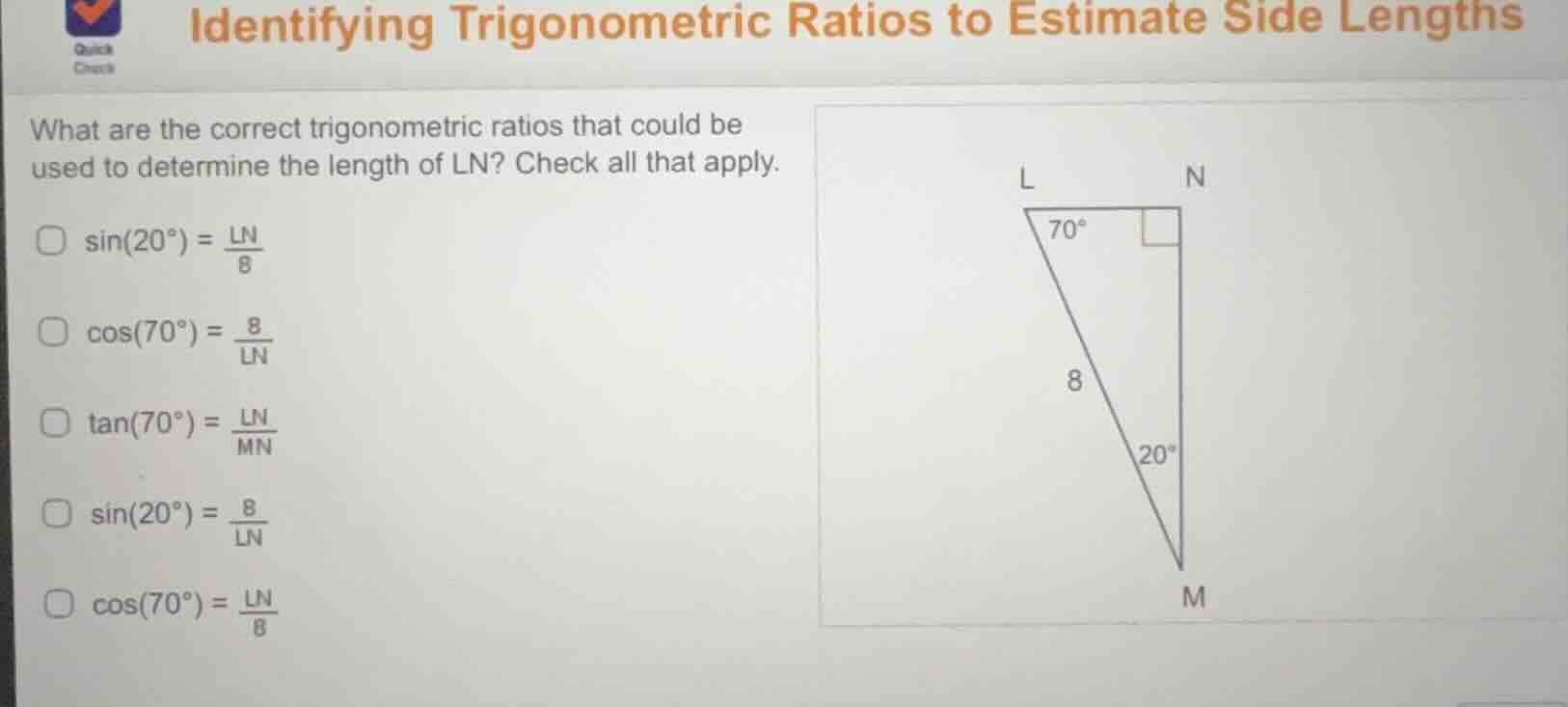
(image of right triangle lnm with right angle at n, angle at l is 70°, angle at m is 20°, hypotenuse lm is 8)
First, let's recall the trigonometric ratios in a right triangle: $\sin(\theta)=\frac{\text{opposite}}{\text{hypotenuse}}$, $\cos(\theta)=\frac{\text{adjacent}}{\text{hypotenuse}}$, $\tan(\theta)=\frac{\text{opposite}}{\text{adjacent}}$.
In triangle $LMN$, $\angle N = 90^\circ$, hypotenuse $LM = 8$, $\angle L = 70^\circ$, $\angle M = 20^\circ$.
Step 1: Analyze $\sin(20^\circ)=\frac{LN}{8}$
For $\angle M = 20^\circ$, the opposite side to $20^\circ$ is $LN$, and hypotenuse is $LM = 8$. So $\sin(20^\circ)=\frac{\text{opposite}}{\text{hypotenuse}}=\frac{LN}{8}$. This is correct.
Step 2: Analyze $\cos(70^\circ)=\frac{8}{LN}$
For $\angle L = 70^\circ$, adjacent side would be $LN$? Wait, no. Wait, $\cos(70^\circ)=\frac{\text{adjacent}}{\text{hypotenuse}}$. For $\angle L = 70^\circ$, adjacent side is $LN$, hypotenuse is $LM = 8$. So $\cos(70^\circ)=\frac{LN}{8}$, not $\frac{8}{LN}$. So this is incorrect.
Step 3: Analyze $\tan(70^\circ)=\frac{LN}{MN}$
For $\angle L = 70^\circ$, opposite side is $MN$, adjacent side is $LN$. So $\tan(70^\circ)=\frac{MN}{LN}$, not $\frac{LN}{MN}$. So this is incorrect.
Step 4: Analyze $\sin(20^\circ)=\frac{8}{LN}$
From step 1, we know $\sin(20^\circ)=\frac{LN}{8}$, so this is incorrect.
Step 5: Analyze $\cos(70^\circ)=\frac{LN}{8}$
For $\angle L = 70^\circ$, adjacent side is $LN$, hypotenuse is $LM = 8$. So $\cos(70^\circ)=\frac{\text{adjacent}}{\text{hypotenuse}}=\frac{LN}{8}$. This is correct. Also, since $\cos(70^\circ)=\sin(20^\circ)$ (because $\cos(\theta)=\sin(90^\circ - \theta)$), and we saw $\sin(20^\circ)=\frac{LN}{8}$, so $\cos(70^\circ)=\frac{LN}{8}$ is also correct. Wait, and also the first option $\sin(20^\circ)=\frac{LN}{8}$ is correct. Wait, let's re - check.
Wait, the first option: $\sin(20^\circ)=\frac{LN}{8}$: for angle M (20 degrees), opposite is LN, hypotenuse is 8. So that's correct.
The fifth option: $\cos(70^\circ)=\frac{LN}{8}$: for angle L (70 degrees), adjacent is LN, hypotenuse is 8. Since $\cos(70^\circ)=\sin(20^\circ)$ (because $\cos\alpha=\sin(90^\circ - \alpha)$), so $\cos(70^\circ)=\sin(20^\circ)=\frac{LN}{8}$. So the first option ($\sin(20^\circ)=\frac{LN}{8}$) and the fifth option ($\cos(70^\circ)=\frac{LN}{8}$) are correct.
Wait, let's re - evaluate each option:
- $\sin(20^\circ)=\frac{LN}{8}$: Angle M is 20°, opposite side is LN, hypotenuse is 8. $\sin(20^\circ)=\frac{\text{opposite}}{\text{hypotenuse}}=\frac{LN}{8}$. Correct.
- $\cos(70^\circ)=\frac{8}{LN}$: Angle L is 70°, adjacent side is LN, hypotenuse is 8. $\cos(70^\circ)=\frac{\text{adjacent}}{\text{hypotenuse}}=\frac{LN}{8}
eq\frac{8}{LN}$. Incorrect.
- $\tan(70^\circ)=\frac{LN}{MN}$: Angle L is 70°, opposite side is MN, adjacent side is LN. $\tan(70^\circ)=\frac{\text{opposite}}{\text{adjacent}}=\frac{MN}{LN}
eq\frac{LN}{MN}$. Incorrect.
- $\sin(20^\circ)=\frac{8}{LN}$: As per 1, $\sin(20^\circ)=\frac{LN}{8}$, so this is incorrect.
- $\cos(70^\circ)=\frac{LN}{8}$: Angle L is 70°, adjacent side is LN, hypotenuse is 8. $\cos(70^\circ)=\frac{\text{adjacent}}{\text{hypotenuse}}=\frac{LN}{8}$. Correct.

Snap & solve any problem in the app
Get step-by-step solutions on Sovi AI
Photo-based solutions with guided steps
Explore more problems and detailed explanations
$\sin(20^{\circ})=\frac{LN}{8}$, $\cos(70^{\circ})=\frac{LN}{8}$ (i.e., the first and the fifth options)