QUESTION IMAGE
Question
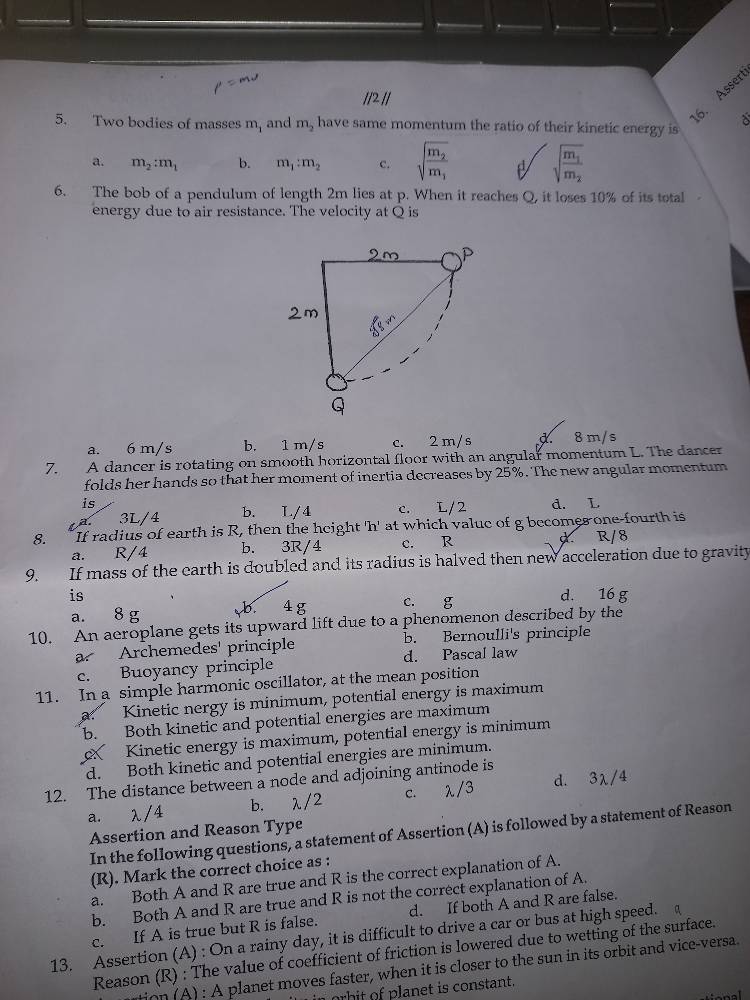
ii/2//5. two bodies of masses $m_1$ and $m_2$ have same momentum the ratio of their kinetic energy isa. $m_2:m_1$ b. $m_1:m_2$ c. $sqrt{\frac{m_2}{m_1}}$ d. $sqrt{\frac{m_1}{m_2}}$6. the bob of a pendulum of length 2m lies at p. when it reaches q, it loses 10% of its total energy due to air resistance. the velocity at q isa. 6 m/s b. 1 m/s c. 2 m/s d. 8 m/s7. a dancer is rotating on smooth horizontal floor with an angular momentum l. the dancer folds her hands so that her moment of inertia decreases by 25%. the new angular momentum isa. 3l/4 b. l/4 c. l/2 d. l8. if radius of earth is r, then the height h at which value of g becomes one-fourth isa. r/4 b. 3r/4 c. r d. r/89. if mass of the earth is doubled and its radius is halved then new acceleration due to gravity isa. 8g b. 4g c. g d. 16g10. an aeroplane gets its upward lift due to a phenomenon described by thea. archimedes principle b. bernoullis principlec. buoyancy principle d. pascal law11. in a simple harmonic oscillator, at the mean positiona. kinetic energy is minimum, potential energy is maximumb. both kinetic and potential energies are maximumc. kinetic energy is maximum, potential energy is minimumd. both kinetic and potential energies are minimum12. the distance between a node and adjoining antinode isa. $lambda/4$ b. $lambda/2$ c. $lambda/3$ d. $3lambda/4$assertion and reason typein the following questions, a statement of assertion (a) is followed by a statement of reason (r). mark the correct choice as :a. both a and r are true and r is the correct explanation of a.b. both a and r are true and r is not the correct explanation of a.c. if a is true but r is false. d. if both a and r are false.13. assertion (a) : on a rainy day, it is difficult to drive a car or bus at high speed.reason (r) : the value of coefficient of friction is lowered due to wetting of the surface.assertion (a) : a planet moves faster, when it is closer to the sun in its orbit and vice-versa.reason (a) : in orbit of planet is constant.
Question 5
Step1: Relate momentum and KE
Kinetic energy $KE = \frac{p^2}{2m}$, where $p$ is momentum.
Step2: Take ratio of KEs
Given $p_1=p_2=p$, so $\frac{KE_1}{KE_2}=\frac{\frac{p^2}{2m_1}}{\frac{p^2}{2m_2}}=\frac{m_2}{m_1}$
Step1: Define initial total energy
At P, total energy $E = mgh$, where $h=2\ \text{m}$ (vertical drop from P to Q).
Step2: Calculate remaining energy at Q
90% of energy remains: $0.9E = \frac{1}{2}mv^2$
Step3: Substitute E and solve for v
$0.9 \times mg \times 2 = \frac{1}{2}mv^2$
Cancel $m$, $g=10\ \text{m/s}^2$:
$0.9 \times 10 \times 2 = \frac{1}{2}v^2$
$18 = \frac{v^2}{2} \implies v^2=36 \implies v=6\ \text{m/s}$
Step1: Recall angular momentum law
In absence of external torque, angular momentum $L$ is conserved.

Snap & solve any problem in the app
Get step-by-step solutions on Sovi AI
Photo-based solutions with guided steps
Explore more problems and detailed explanations
a. $m_2:m_1$
---