QUESTION IMAGE
Question
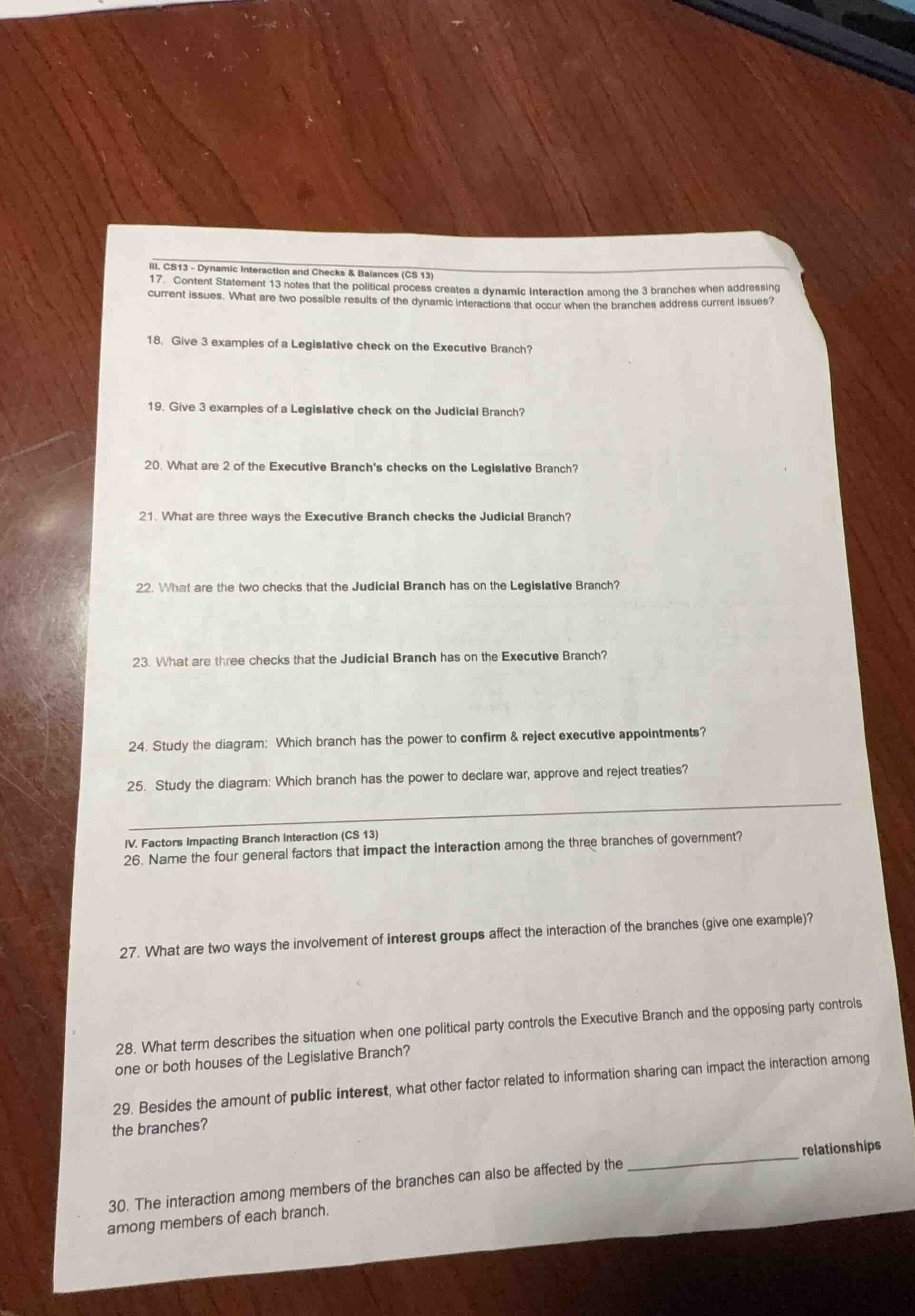
iii. cs13 - dynamic interaction and checks & balances (cs 13)
- content statement 13 notes that the political process creates a dynamic interaction among the 3 branches when addressing current issues. what are two possible results of the dynamic interactions that occur when the branches address current issues?
- give 3 examples of a legislative check on the executive branch?
- give 3 examples of a legislative check on the judicial branch?
- what are 2 of the executive branch’s checks on the legislative branch?
- what are three ways the executive branch checks the judicial branch?
- what are the two checks that the judicial branch has on the legislative branch?
- what are three checks that the judicial branch has on the executive branch?
- study the diagram: which branch has the power to confirm & reject executive appointments?
- study the diagram: which branch has the power to declare war, approve and reject treaties?
iv. factors impacting branch interaction (cs 13)
- name the four general factors that impact the interaction among the three branches of government?
- what are two ways the involvement of interest groups affect the interaction of the branches (give one example)?
- what term describes the situation when one political party controls the executive branch and the opposing party controls one or both houses of the legislative branch?
- besides the amount of public interest, what other factor related to information sharing can impact the interaction among the branches?
- the interaction among members of the branches can also be affected by the ___________________ relationships among members of each branch.
Brief Explanations
- Results of branch interactions include policy compromise (to pass legislation) and gridlock (no action on issues).
- Legislative checks on the Executive include overriding a presidential veto, impeaching/removing the president, and approving executive appointments.
- Legislative checks on the Judicial include impeaching/removing federal judges, setting the number of federal courts, and confirming federal judicial nominees.
- Executive checks on the Legislative include vetoing legislation and calling special sessions of Congress.
- Executive checks on the Judicial include nominating federal judges, granting pardons to federal offenders, and refusing to enforce court rulings.
- Judicial checks on the Legislative include declaring laws unconstitutional (judicial review) and interpreting vague laws.
- Judicial checks on the Executive include declaring executive actions unconstitutional, issuing subpoenas to executive officials, and ruling executive orders invalid.
- The Legislative Branch (Senate) confirms/rejects executive appointments.
- The Legislative Branch (Congress) declares war and approves/rejects treaties.
- Four factors impacting branch interaction are partisan control, public opinion, interest group pressure, and institutional norms.
- Interest groups can lobby all branches to align policy with their goals (e.g., gun rights groups lobbying Congress to pass pro-gun laws and the president to sign them) and file lawsuits to push the judiciary to rule in their favor.
- Divided government describes this situation.
- The accuracy and transparency of information shared between branches is another factor.
- Partisan (political party) relationships impact branch member interactions.

Snap & solve any problem in the app
Get step-by-step solutions on Sovi AI
Photo-based solutions with guided steps
Explore more problems and detailed explanations
- 1. Policy compromise to pass bipartisan legislation; 2. Political gridlock with no policy action
- 1. Overriding a presidential veto (requires 2/3 vote in both chambers); 2. Impeaching and removing the president or executive officials; 3. Confirming or rejecting presidential nominees for executive positions
- 1. Impeaching and removing federal judges; 2. Setting the number and jurisdiction of federal courts; 3. Confirming or rejecting federal judicial nominees
- 1. Vetoing bills passed by Congress; 2. Calling special sessions of Congress
- 1. Nominating federal judges and Supreme Court justices; 2. Granting pardons and clemency to federal offenders; 3. Refusing to enforce federal court rulings
- 1. Declaring federal laws unconstitutional via judicial review; 2. Interpreting the meaning of ambiguous laws
- 1. Declaring executive orders or actions unconstitutional; 2. Issuing subpoenas to compel executive officials to testify or provide documents; 3. Ruling that executive branch actions violate federal law
- The Legislative Branch (specifically the U.S. Senate)
- The Legislative Branch (U.S. Congress, with the Senate handling treaty approval)
- 1. Partisan control of branches; 2. Public opinion and constituent pressure; 3. Interest group influence; 4. Institutional rules and norms
- 1. Interest groups can lobby all three branches to advance their policy priorities (example: environmental groups lobbying Congress to pass climate legislation, the president to sign it, and the courts to uphold it); 2. Interest groups can file amicus curiae briefs to influence judicial decisions that impact inter-branch policy implementation
- Divided government
- The transparency and accuracy of information shared between the branches (or the speed of information sharing)
- Partisan (political party)