QUESTION IMAGE
Question
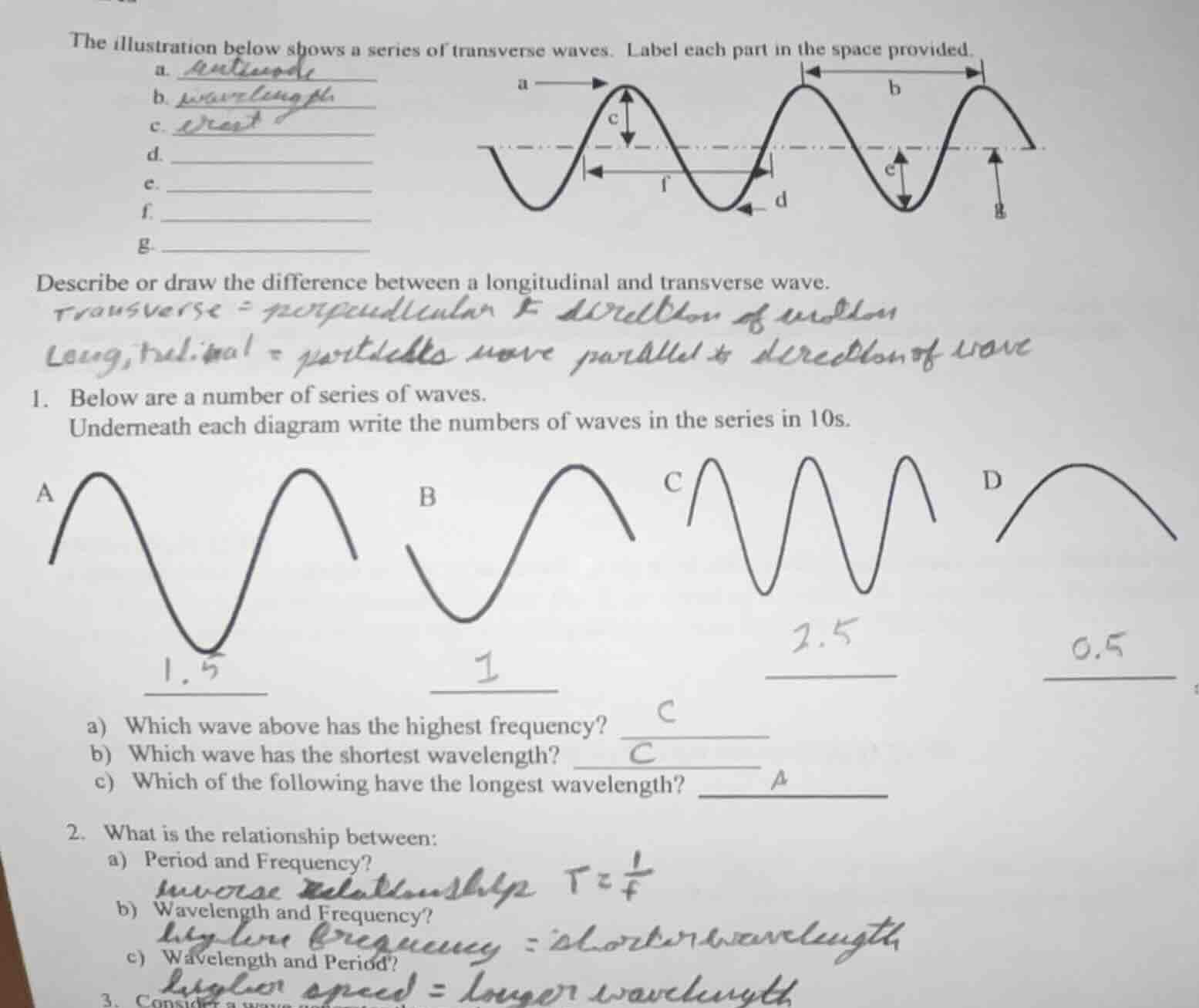
the illustration below shows a series of transverse waves. label each part in the space provided.
a.
b.
c.
d.
e.
f.
g.
describe or draw the difference between a longitudinal and transverse wave.
- below are a number of series of waves.
underneath each diagram write the numbers of waves in the series in 10s.
a) which wave above has the highest frequency?
b) which wave has the shortest wavelength?
c) which of the following have the longest wavelength?
- what is the relationship between:
a) period and frequency?
b) wavelength and frequency?
c) wavelength and period?
- consider
First, verify the wave part labels:
- a: Peak/crest (highest point of wave)
- b: Wavelength (distance between 2 identical points)
- c: Amplitude (height from midline to peak)
- d: Trough (lowest point of wave)
- e: Amplitude (height from midline to trough)
- f: Wavelength (distance between 2 troughs)
- g: Rest/midline (undisturbed position)
For wave counts (10s):
- Wave A: 2 full waves (the handwritten 1.5 is incorrect; the diagram shows 2 complete cycles)
- Wave B: 1 full wave
- Wave C: 3 full waves (the handwritten 2.5 is incorrect; the diagram shows 3 complete cycles)
- Wave D: 0.5 (half a wave, handwritten value is correct)
For frequency/wavelength questions:
- Frequency = number of waves per unit time; more waves = higher frequency.
- Wavelength = distance between wave cycles; tighter waves = shorter wavelength.
For wave relationships:
- Period ($T$) is time per wave, frequency ($f$) is waves per time, so they are inversely related.
- For constant wave speed, higher frequency means shorter wavelength (inverse relationship).
- For constant wave speed, longer period means longer wavelength (direct relationship).

Snap & solve any problem in the app
Get step-by-step solutions on Sovi AI
Photo-based solutions with guided steps
Explore more problems and detailed explanations
Wave Part Labels:
a. Crest/Peak
b. Wavelength
c. Amplitude
d. Trough
e. Amplitude
f. Wavelength
g. Rest Position/Midline
Longitudinal vs Transverse Wave:
Transverse wave: Particle motion is perpendicular to the direction of wave travel.
Longitudinal wave: Particle motion is parallel to the direction of wave travel.
1. Wave Counts in 10s:
A: 2
B: 1
C: 3
D: 0.5
a) Highest frequency: C
b) Shortest wavelength: C
c) Longest wavelength: D
2. Wave Relationships:
a) Period and Frequency: Inverse relationship, $T=\frac{1}{f}$
b) Wavelength and Frequency: Inverse relationship (at constant wave speed: $\lambda = \frac{v}{f}$; higher frequency = shorter wavelength)
c) Wavelength and Period: Direct relationship (at constant wave speed: $\lambda = vT$; longer period = longer wavelength)