QUESTION IMAGE
Question
illustrative mathematics - geometry
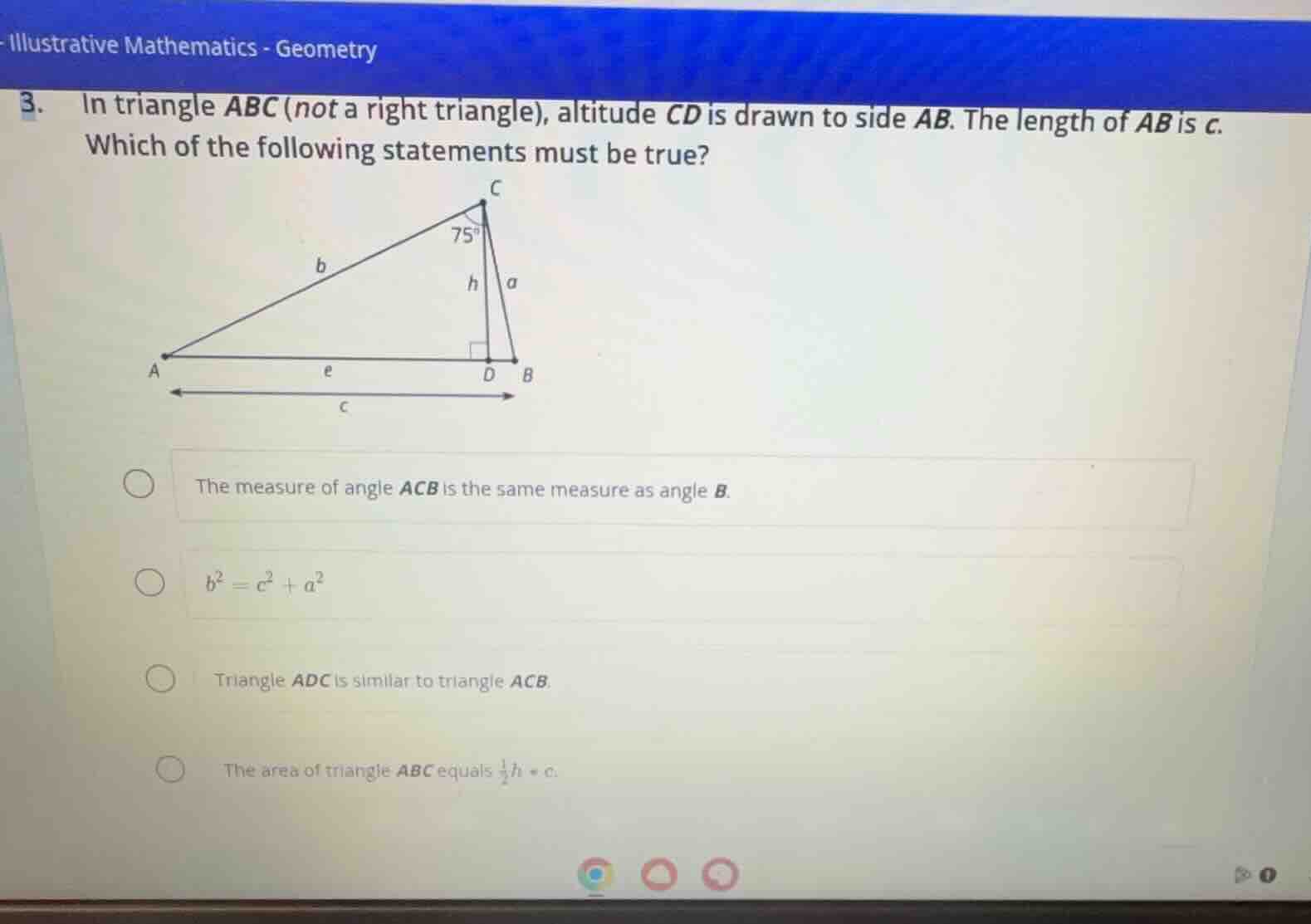
- in triangle abc (not a right triangle), altitude cd is drawn to side ab. the length of ab is c. which of the following statements must be true?
image of triangle abc with altitude cd, labels: b, h, a, e, c, 75° angle at c, right angle at d
options:
- the measure of angle acb is the same measure as angle b.
- ( b^2 = c^2 + a^2 )
- triangle adc is similar to triangle acb.
- the area of triangle abc equals ( \frac{1}{2}h cdot c ).
Step1: Analyze each option
- Option 1: Angle \( ACB \) is \( 75^\circ \), angle \( B \) is part of triangle \( CDB \). There's no reason they must be equal. So this is false.
- Option 2: \( b^2 = c^2 + a^2 \) is Pythagorean theorem, but triangle \( ABC \) is not a right triangle, so this is false.
- Option 3: Triangle \( ADC \) and triangle \( ACB \): \( \angle A \) is common, \( \angle ADC = \angle ACB \)? No, \( \angle ADC = 90^\circ \), \( \angle ACB = 75^\circ \), so not similar. This is false.
- Option 4: Area of a triangle is \( \frac{1}{2} \times \text{base} \times \text{height} \). Here, base is \( AB = c \), height is \( CD = h \), so area is \( \frac{1}{2}h \cdot c \). This is true.

Snap & solve any problem in the app
Get step-by-step solutions on Sovi AI
Photo-based solutions with guided steps
Explore more problems and detailed explanations
The area of triangle \( ABC \) equals \( \frac{1}{2}h \cdot c \).