QUESTION IMAGE
Question
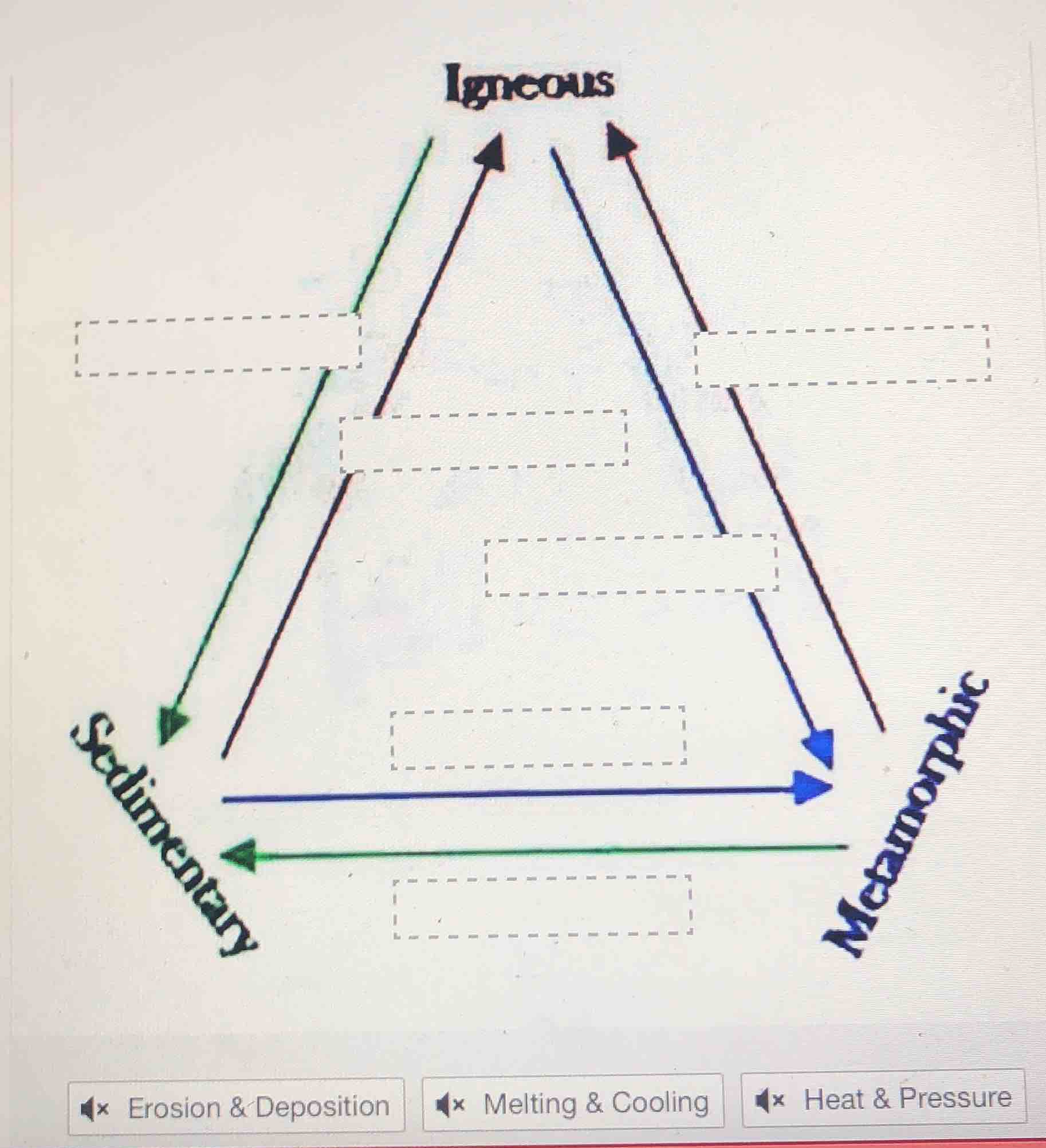
the image shows a diagram of the rock cycle with three rock types: igneous, sedimentary, and metamorphic. there are arrows between them and dashed rectangles to fill in, along with labels at the bottom: erosion & deposition, melting & cooling, heat & pressure.
To solve the rock cycle diagram, we analyze the processes that transform each rock type:
Step 1: Identify "Melting & Cooling"
- Igneous rocks form from the melting of other rocks (to form magma) and then cooling (solidifying magma/lava). So the arrow from the "Melting & Cooling" process should point to Igneous (since melting other rocks and cooling creates igneous rocks).
Step 2: Identify "Heat & Pressure"
- Metamorphic rocks form from existing rocks (igneous, sedimentary, or other metamorphic) subjected to heat and pressure. So the "Heat & Pressure" process should connect to Metamorphic (e.g., sedimentary → metamorphic via heat/pressure, or igneous → metamorphic via heat/pressure).
Step 3: Identify "Erosion & Deposition"
- Sedimentary rocks form from the erosion of existing rocks (breaking them into sediments) and deposition (sediments accumulating and lithifying). So the "Erosion & Deposition" process should connect to Sedimentary (e.g., igneous → sedimentary via erosion/deposition, or metamorphic → sedimentary via erosion/deposition).
Step 4: Map Processes to Arrows
- Melting & Cooling: Connects to Igneous (creates igneous rocks from melted material).
- Heat & Pressure: Connects to Metamorphic (transforms rocks into metamorphic rocks).
- Erosion & Deposition: Connects to Sedimentary (forms sedimentary rocks from eroded sediments).
For example, the arrow from Sedimentary to Igneous would involve Melting & Cooling (sedimentary rock melts, then cools to form igneous). The arrow from Igneous to Sedimentary would involve Erosion & Deposition (igneous rock erodes, sediments deposit to form sedimentary). The arrow from Sedimentary to Metamorphic would involve Heat & Pressure (sedimentary rock is metamorphosed), and so on.
Final Diagram Setup (Key Connections):
- Melting & Cooling → Igneous (process of forming igneous rocks).
- Heat & Pressure → Metamorphic (process of forming metamorphic rocks).
- Erosion & Deposition → Sedimentary (process of forming sedimentary rocks).
If the question is to label the dashed boxes with the processes, the answers would align with the rock cycle logic above. For example:
- The box connecting to Igneous (from other rocks) uses Melting & Cooling.
- The box connecting to Metamorphic (from other rocks) uses Heat & Pressure.
- The box connecting to Sedimentary (from other rocks) uses Erosion & Deposition.
(Note: The exact dashed box labels depend on the arrow directions, but the process - rock type relationships follow the logic of the rock cycle.)

Snap & solve any problem in the app
Get step-by-step solutions on Sovi AI
Photo-based solutions with guided steps
Explore more problems and detailed explanations
To solve the rock cycle diagram, we analyze the processes that transform each rock type:
Step 1: Identify "Melting & Cooling"
- Igneous rocks form from the melting of other rocks (to form magma) and then cooling (solidifying magma/lava). So the arrow from the "Melting & Cooling" process should point to Igneous (since melting other rocks and cooling creates igneous rocks).
Step 2: Identify "Heat & Pressure"
- Metamorphic rocks form from existing rocks (igneous, sedimentary, or other metamorphic) subjected to heat and pressure. So the "Heat & Pressure" process should connect to Metamorphic (e.g., sedimentary → metamorphic via heat/pressure, or igneous → metamorphic via heat/pressure).
Step 3: Identify "Erosion & Deposition"
- Sedimentary rocks form from the erosion of existing rocks (breaking them into sediments) and deposition (sediments accumulating and lithifying). So the "Erosion & Deposition" process should connect to Sedimentary (e.g., igneous → sedimentary via erosion/deposition, or metamorphic → sedimentary via erosion/deposition).
Step 4: Map Processes to Arrows
- Melting & Cooling: Connects to Igneous (creates igneous rocks from melted material).
- Heat & Pressure: Connects to Metamorphic (transforms rocks into metamorphic rocks).
- Erosion & Deposition: Connects to Sedimentary (forms sedimentary rocks from eroded sediments).
For example, the arrow from Sedimentary to Igneous would involve Melting & Cooling (sedimentary rock melts, then cools to form igneous). The arrow from Igneous to Sedimentary would involve Erosion & Deposition (igneous rock erodes, sediments deposit to form sedimentary). The arrow from Sedimentary to Metamorphic would involve Heat & Pressure (sedimentary rock is metamorphosed), and so on.
Final Diagram Setup (Key Connections):
- Melting & Cooling → Igneous (process of forming igneous rocks).
- Heat & Pressure → Metamorphic (process of forming metamorphic rocks).
- Erosion & Deposition → Sedimentary (process of forming sedimentary rocks).
If the question is to label the dashed boxes with the processes, the answers would align with the rock cycle logic above. For example:
- The box connecting to Igneous (from other rocks) uses Melting & Cooling.
- The box connecting to Metamorphic (from other rocks) uses Heat & Pressure.
- The box connecting to Sedimentary (from other rocks) uses Erosion & Deposition.
(Note: The exact dashed box labels depend on the arrow directions, but the process - rock type relationships follow the logic of the rock cycle.)