QUESTION IMAGE
Question
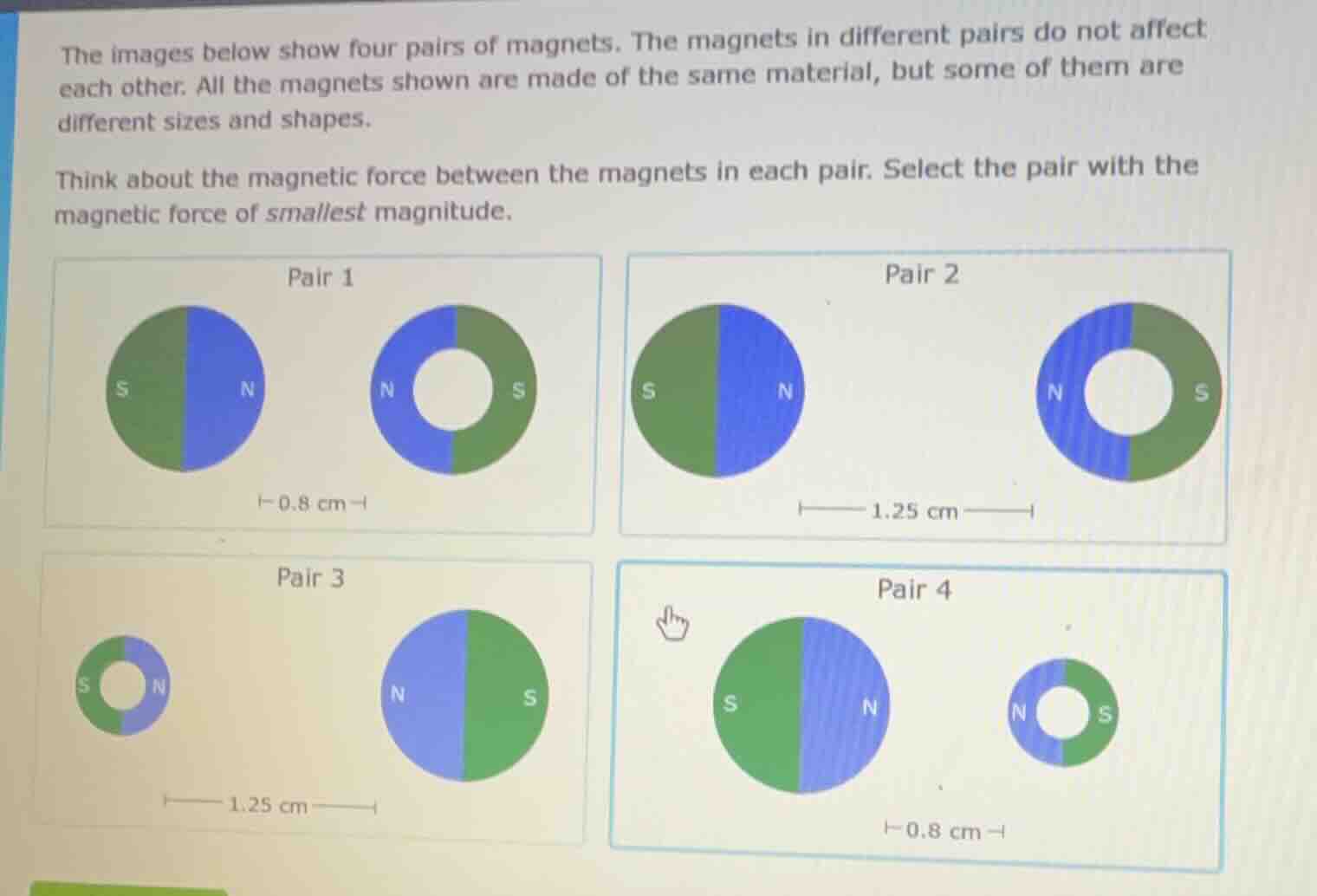
the images below show four pairs of magnets. the magnets in different pairs do not affect each other. all the magnets shown are made of the same material, but some of them are different sizes and shapes. think about the magnetic force between the magnets in each pair. select the pair with the magnetic force of smallest magnitude. pair 1: two magnets (one solid circle, one ring) with distance 0.8 cm. pair 2: two magnets (one solid circle, one ring) with distance 1.25 cm. pair 3: two magnets (one small ring, one solid circle) with distance 1.25 cm. pair 4: two magnets (one large solid circle, one small ring) with distance 0.8 cm.
Step1: Recall factors affecting magnetic force
The magnetic force between two magnets depends on two main factors: the distance between them and the strength of the magnets (related to their size, since same material). The formula for magnetic force (similar to inverse - square law for some magnetic interactions) implies that as the distance between magnets increases, the magnetic force magnitude decreases, and as the size (amount of magnetic material) decreases, the magnetic force magnitude decreases.
Step2: Analyze distance and size for each pair
- Pair 1: Distance = 0.8 cm, magnets have a certain size (the solid circle and the ring - shaped magnet, both with relatively normal size for this set).
- Pair 2: Distance = 1.25 cm, which is larger than 0.8 cm, and the magnets are of similar size to Pair 1's magnets.
- Pair 3: Distance = 1.25 cm (same as Pair 2), but one magnet is a small ring - shaped magnet (smaller size, so weaker magnetic strength) and the other is a large solid - like magnet. However, the small size of one magnet reduces its magnetic strength, but the distance is large. But we also have to consider the combination.
- Pair 4: Distance = 0.8 cm (same as Pair 1), but one magnet is a small ring - shaped magnet (smaller size, weaker magnetic strength) and the other is a large solid - like magnet.
Now, for magnetic force, both distance and magnetic strength (from size) matter. The magnetic force is proportional to the product of the magnetic strengths of the two magnets and inversely proportional to the square of the distance (approximately, for simple cases).
First, consider the distance factor: Pair 2 and Pair 3 have a larger distance (1.25 cm) than Pair 1 and Pair 4 (0.8 cm). Among Pair 2 and Pair 3, Pair 3 has one magnet with a smaller size (weaker magnetic strength) compared to Pair 2's magnets. But wait, actually, the key is that the magnetic force depends on both the distance between the magnets and the amount of magnetic material (since same material, more material means stronger magnet).
Wait, let's re - evaluate. The magnetic force between two magnets: the strength of each magnet is related to its volume (since same material, density and magnetic properties per unit volume are same). So a smaller magnet has less magnetic material, so weaker magnetic field, so the force between two magnets is $F\propto\frac{m_1\times m_2}{d^2}$, where $m_1$ and $m_2$ are the "magnetic masses" (related to volume) and $d$ is the distance.
For Pair 3: One magnet is small (low $m_1$) and the other is large (high $m_2$), distance $d = 1.25$ cm. For Pair 2: Both magnets are of normal size (higher $m_1$ and $m_2$ compared to Pair 3's small magnet), distance $d = 1.25$ cm. So $m_1\times m_2$ for Pair 2 is larger than for Pair 3, but distance is same. However, we also have Pair 4: distance $d = 0.8$ cm, but one magnet is small (low $m_1$) and one is large (high $m_2$). Pair 1: both magnets are of normal size, distance $d = 0.8$ cm.
Now, the combination of distance and size: Pair 3 has a large distance (1.25 cm) and one weak (small) magnet, Pair 2 has large distance (1.25 cm) and two normal - sized magnets, Pair 1 has small distance (0.8 cm) and two normal - sized magnets, Pair 4 has small distance (0.8 cm) and one weak magnet.
But actually, the main factor here is the distance first. The larger the distance, the smaller the force (since $F\propto\frac{1}{d^2}$). Among the pairs with large distance (Pair 2 and Pair 3), Pair 3 has one magnet with a smaller size (so $m_1\times m_2$ is smaller) than Pair 2. But wai…

Snap & solve any problem in the app
Get step-by-step solutions on Sovi AI
Photo-based solutions with guided steps
Explore more problems and detailed explanations
Step1: Recall factors affecting magnetic force
The magnetic force between two magnets depends on two main factors: the distance between them and the strength of the magnets (related to their size, since same material). The formula for magnetic force (similar to inverse - square law for some magnetic interactions) implies that as the distance between magnets increases, the magnetic force magnitude decreases, and as the size (amount of magnetic material) decreases, the magnetic force magnitude decreases.
Step2: Analyze distance and size for each pair
- Pair 1: Distance = 0.8 cm, magnets have a certain size (the solid circle and the ring - shaped magnet, both with relatively normal size for this set).
- Pair 2: Distance = 1.25 cm, which is larger than 0.8 cm, and the magnets are of similar size to Pair 1's magnets.
- Pair 3: Distance = 1.25 cm (same as Pair 2), but one magnet is a small ring - shaped magnet (smaller size, so weaker magnetic strength) and the other is a large solid - like magnet. However, the small size of one magnet reduces its magnetic strength, but the distance is large. But we also have to consider the combination.
- Pair 4: Distance = 0.8 cm (same as Pair 1), but one magnet is a small ring - shaped magnet (smaller size, weaker magnetic strength) and the other is a large solid - like magnet.
Now, for magnetic force, both distance and magnetic strength (from size) matter. The magnetic force is proportional to the product of the magnetic strengths of the two magnets and inversely proportional to the square of the distance (approximately, for simple cases).
First, consider the distance factor: Pair 2 and Pair 3 have a larger distance (1.25 cm) than Pair 1 and Pair 4 (0.8 cm). Among Pair 2 and Pair 3, Pair 3 has one magnet with a smaller size (weaker magnetic strength) compared to Pair 2's magnets. But wait, actually, the key is that the magnetic force depends on both the distance between the magnets and the amount of magnetic material (since same material, more material means stronger magnet).
Wait, let's re - evaluate. The magnetic force between two magnets: the strength of each magnet is related to its volume (since same material, density and magnetic properties per unit volume are same). So a smaller magnet has less magnetic material, so weaker magnetic field, so the force between two magnets is $F\propto\frac{m_1\times m_2}{d^2}$, where $m_1$ and $m_2$ are the "magnetic masses" (related to volume) and $d$ is the distance.
For Pair 3: One magnet is small (low $m_1$) and the other is large (high $m_2$), distance $d = 1.25$ cm. For Pair 2: Both magnets are of normal size (higher $m_1$ and $m_2$ compared to Pair 3's small magnet), distance $d = 1.25$ cm. So $m_1\times m_2$ for Pair 2 is larger than for Pair 3, but distance is same. However, we also have Pair 4: distance $d = 0.8$ cm, but one magnet is small (low $m_1$) and one is large (high $m_2$). Pair 1: both magnets are of normal size, distance $d = 0.8$ cm.
Now, the combination of distance and size: Pair 3 has a large distance (1.25 cm) and one weak (small) magnet, Pair 2 has large distance (1.25 cm) and two normal - sized magnets, Pair 1 has small distance (0.8 cm) and two normal - sized magnets, Pair 4 has small distance (0.8 cm) and one weak magnet.
But actually, the main factor here is the distance first. The larger the distance, the smaller the force (since $F\propto\frac{1}{d^2}$). Among the pairs with large distance (Pair 2 and Pair 3), Pair 3 has one magnet with a smaller size (so $m_1\times m_2$ is smaller) than Pair 2. But wait, no, let's look at the visual:
Wait, the problem is to find the pair with the smallest magnitude of magnetic force. Let's list the distance and the size of magnets:
- Pair 1: Distance = 0.8 cm, magnets: solid circle and ring, both with "medium" size.
- Pair 2: Distance = 1.25 cm, magnets: solid circle and ring, both with "medium" size (same as Pair 1's magnets in terms of visual size).
- Pair 3: Distance = 1.25 cm, magnets: small ring and large solid circle.
- Pair 4: Distance = 0.8 cm, magnets: large solid circle and small ring.
Now, the magnetic force is determined by two things: how far apart the magnets are (larger distance means smaller force) and how strong each magnet is (smaller magnet means weaker force).
For Pair 3: The distance is 1.25 cm (large), and one magnet is small (weak), so the product of their magnetic strengths is small, and the distance is large. For Pair 2: distance is 1.25 cm (large), but both magnets are medium - sized (stronger than Pair 3's small magnet), so the product of their magnetic strengths is larger than Pair 3's. For Pair 1 and Pair 4: distance is 0.8 cm (small), so the force from distance is larger than Pair 2 and Pair 3.
Now, between Pair 2 and Pair 3: Pair 3 has one magnet with a smaller size (so less magnetic material, weaker magnet) than Pair 2. So even though the distance is the same (1.25 cm) for Pair 2 and Pair 3, the product of the magnetic strengths of Pair 3's magnets is smaller than Pair 2's. But wait, is that correct?
Wait, no, maybe I made a mistake. Let's think again. The magnetic force between two magnets: if you have two magnets, the force is stronger when they are closer and when they are larger (more magnetic material). So to get the smallest force, we need the largest distance and the smallest magnets.
Pair 3: distance = 1.25 cm (large), and one magnet is small (small ring), the other is large? Wait, no, in Pair 3, one is a small ring - shaped magnet (left) and the other is a large solid - like magnet (right). So the small ring has less magnetic material, so its magnetic strength is low. The large magnet has high magnetic strength. But the force between them is $F\propto\frac{m_1\times m_2}{d^2}$. So $m_1$ (small) and $m_2$ (large), so $m_1\times m_2$ is smaller than $m_1\times m_2$ for Pair 2 (where both $m_1$ and $m_2$ are medium - sized). And $d$ is same (1.25 cm) for Pair 2 and Pair 3. So $F_{Pair3}\propto\frac{small\times large}{(1.25)^2}$ and $F_{Pair2}\propto\frac{medium\times medium}{(1.25)^2}$. Since $small\times large Now, compare Pair 3 with Pair 4: Pair 4 has distance = 0.8 cm (small) and $m_1$ (large) and $m_2$ (small), so $F_{Pair4}\propto\frac{large\times small}{(0.8)^2}$. Pair 3: $F_{Pair3}\propto\frac{small\times large}{(1.25)^2}$. Since $(0.8)^2 = 0.64$ and $(1.25)^2=1.5625$, so $\frac{1}{(0.8)^2}>\frac{1}{(1.25)^2}$. So even though the product $m_1\times m_2$ is the same (small×large) for Pair 3 and Pair 4, the distance term makes $F_{Pair3} Now, compare Pair 3 with Pair 1: Pair 1 has distance = 0.8 cm and $m_1\times m_2$ (medium×medium), so $F_{Pair1}\propto\frac{medium\times medium}{(0.8)^2}$, which is larger than $F_{Pair3}$ because both the product $m_1\times m_2$ is larger and the distance term is smaller (so $\frac{1}{d^2}$ is larger). So the pair with the smallest magnetic force magnitude is Pair 3? Wait, no, wait the visual: Wait, maybe I messed up the magnet polarities? No, the problem is about the magnitude of the magnetic force, regardless of attraction or repulsion (since magnitude is absolute). Wait, let's look at the sizes again. Pair 3: the left magnet is a small ring, the right is a large circle. Pair 2: both magnets are of the same size as Pair 1's magnets. Pair 4: left is a large circle, right is a small ring. Pair 1: left is a medium - sized circle, right is a medium - sized ring. Wait, another approach: the magnetic force between two magnets is strongest when they are close together and when they are large (more magnetic material). So to find the smallest force, we need the weakest magnets (smallest size) and the largest distance. Pair 3 has a small magnet (left) and a large magnet (right), but the distance is large (1.25 cm). Pair 2 has two medium - sized magnets and large distance (1.25 cm). Pair 1 has two medium - sized magnets and small distance (0.8 cm). Pair 4 has a large and a small magnet and small distance (0.8 cm). Since the distance in Pair 2 and Pair 3 is larger than in Pair 1 and Pair 4, we can eliminate Pair 1 and Pair 4 first. Now, between Pair 2 and Pair 3: Pair 3 has one small magnet (less magnetic material), so the force between them should be smaller than Pair 2, because the force depends on the product of the magnetic strengths of the two magnets. A smaller magnet means a weaker magnetic field, so the force between a small and a large magnet (in Pair 3) is less than the force between two medium - sized magnets (in Pair 2) at the same distance. Wait, but let's check the distance again. Pair 3's distance is 1.25 cm, same as Pair 2. But the magnetic strength of a magnet is proportional to its volume (since same material). So if one magnet in Pair 3 is smaller (volume $V_1$) and the other is larger (volume $V_2$), and in Pair 2 both have volume $V$ (medium - sized), then the product of magnetic strengths for Pair 3 is $k\times V_1\times V_2$ (where $k$ is a constant for the material) and for Pair 2 is $k\times V\times V$. Since $V_1 < V$ and $V_2$ (the large one in Pair 3) – wait, no, the large one in Pair 3 is similar to the medium - sized ones in Pair 2? Maybe not. Maybe the small ring in Pair 3 is much smaller than the medium - sized magnets in Pair 2. Alternatively, maybe the key is that the distance is the main factor here. The larger the distance, the smaller the force. Among the pairs, Pair 2 and Pair 3 have the largest distance (1.25 cm). Now, between these two, which has the smaller force? Since the magnets in Pair 3 are of different sizes (one small, one large) and in Pair 2 are of same (medium) size, the force in Pair 3 is smaller because the small magnet has less magnetic material, so the interaction between a small and a large magnet is weaker than between two medium - sized magnets at the same distance. Wait, but I think I made a mistake earlier. Let's look at the problem again. The question is to select the pair with the magnetic force of smallest magnitude. Let's consider the distance: The force is inversely proportional to the square of the distance (approximately), so the larger the distance, the smaller the force. So Pair 2 and Pair 3 have smaller force potential than Pair 1 and Pair 4. Now, the magnetic force also depends on the strength of each magnet. The strength of a magnet is related to its size (more material, stronger magnet). So in Pair 2, both magnets are of a certain size (let's say size A). In Pair 3, one magnet is size B (smaller than A) and the other is size A (or larger? No, the left magnet in Pair 3 is a small ring, the right is a large circle. Wait, maybe the left magnet in Pair 3 is smaller than the magnets in Pair 2, and the right magnet in Pair 3 is larger than the magnets in Pair 2. But the force between two magnets is $F = k\frac{m_1m_2}{d^2}$, where $m_1$ and $m_2$ are the magnetic moments (related to size). So if $m_1$ is small and $m_2$ is large, $m_1m_2$ is smaller than $m\times m$ (where $m$ is the magnetic moment of Pair 2's magnets) if $m_1 Assuming that the small magnet in Pair 3 has a magnetic moment much smaller than the medium - sized magnets in Pair 2, then $m_1m_2$ (Pair 3) < $m\times m$ (Pair 2). Since $d$ is the same for Pair 2 and Pair 3, then $F_{Pair3} So the pair with the smallest magnetic force magnitude is Pair 3. Wait, but let's check the visual again. Wait, maybe I got the pairs wrong. Wait, Pair 3: the left magnet is a small ring, right is a large circle, distance 1.25 cm. Pair 4: left is a large circle, right is a small ring, distance 0.8 cm. Pair 1: left is a medium circle, right is a medium ring, distance 0.8 cm. Pair 2: left is a medium circle, right is a medium ring, distance 1.25 cm. Oh! Wait a minute, I think I mis - identified the magnets. The left magnet in Pair 1, Pair 2, and Pair 4 (the solid - looking circle) – maybe they are the same size? And the right magnet (the ring - shaped) in Pair 1, Pair 2, and Pair 3 (the ring - shaped) – maybe the ring - shaped magnets in Pair 1, Pair 2 are the same size, and the ring - shaped in Pair 3 and Pair 4 are the same (small) size. So let's re - define: Now, let's list each pair: Now, since $r < R$, then $M\times r Now, compare $F_2$ and $F_3$: $F_2\propto\frac{M\times R}{(1.25)^2}$, $F_3\propto\frac{M\times r}{(1.25)^2}$. Since $r < R$, $F_3 Compare $F_3$ and $F_4$: $F_3\propto\frac{M\times r}{(1.25)^2}$, $F_4\propto\frac{M\times r}{(0.8)^2}$. Since $(1.25)^2 > (0.8)^2$, $\frac{1}{(1.25)^2}<\frac{1}{(0.8)^2}$, so $F_3 Compare $F_3$ and $F_1$: $F_1\propto\frac{M\times R}{(0.8)^2}$, $F_3\propto\frac{M\times r}{(1.25)^2}$. Since $r < R$ and $(1.25)^2>(0.8)^2$, $F_3 So among