QUESTION IMAGE
Question
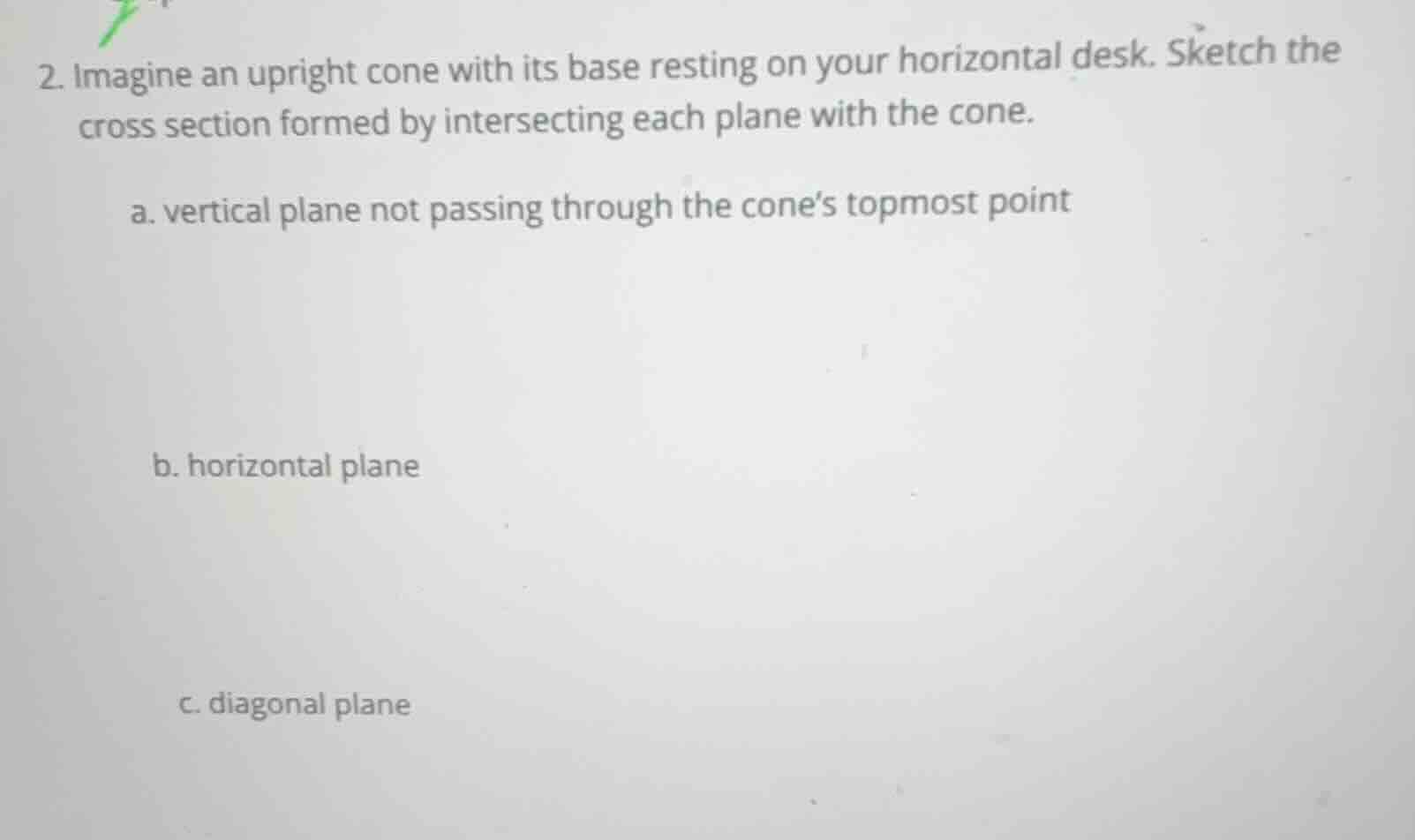
- imagine an upright cone with its base resting on your horizontal desk. sketch the cross section formed by intersecting each plane with the cone.
\ta. vertical plane not passing through the cones topmost point
\tb. horizontal plane
\tc. diagonal plane
Part a
An upright cone has a circular base and a pointed top. A vertical plane not passing through the top will intersect the cone, creating a shape with two curved sides and two straight (or curved, depending on perspective) edges? Wait, no. Actually, when a vertical plane (parallel to the axis? No, wait, a vertical plane not through the top—so if the cone is upright with base on the desk, a vertical plane (like a plane going up and down, perpendicular to the desk) that doesn't pass through the apex (top point) will intersect the cone to form a hyperbola? Wait, no, maybe a parabola or a hyperbola? Wait, no, let's think again. The cone's axis is vertical (since it's upright on the desk). A vertical plane (so containing the vertical axis? No, the problem says "not passing through the cone’s topmost point", so the vertical plane is parallel to the axis? Wait, no, a vertical plane could be, for example, a plane that's vertical (perpendicular to the desk) but offset from the axis. So when you slice a cone with a vertical plane not through the apex, the cross - section is a hyperbola? Wait, no, maybe a parabola? Wait, no, let's recall conic sections. The four conic sections are circle, ellipse, parabola, hyperbola. A vertical plane through the axis (passing through the apex) gives a triangle. A vertical plane not through the axis (and not parallel to the side) will give a hyperbola? Wait, no, maybe I'm mixing up. Let's take a right - circular cone. The axis is vertical. A vertical plane (so in the plane of the axis is a triangle). A vertical plane parallel to a generator (the side of the cone) gives a parabola. A vertical plane not parallel to a generator and not through the axis gives a hyperbola? Wait, no, maybe I need to correct. Actually, when the cutting plane is vertical (same direction as the cone's axis) and does not pass through the apex, and is not parallel to the cone's side, the cross - section is a hyperbola. But maybe in this case, since it's an upright cone on the desk, a vertical plane (perpendicular to the desk) not through the top (apex) will intersect the cone to form a hyperbola? Wait, no, perhaps a parabola? Wait, no, let's think of the cone as having a circular base with center at the origin (on the desk, z = 0) and apex at (0,0,h) (z = h). A vertical plane, say x = a (a≠0), will intersect the cone. The cone's equation is \(x^{2}+y^{2}=(\frac{r}{h}(h - z))^{2}\), where r is the radius of the base (z = 0, so \(x^{2}+y^{2}=r^{2}\)). Substituting x = a into the cone's equation: \(a^{2}+y^{2}=(\frac{r}{h}(h - z))^{2}\), which can be rewritten as \(y^{2}=(\frac{r}{h}(h - z))^{2}-a^{2}\), which is a hyperbola (since it's of the form \(y^{2}-(\frac{r}{h}(h - z))^{2}=-a^{2}\), or multiplying both sides by - 1, \((\frac{r}{h}(h - z))^{2}-y^{2}=a^{2}\), which is a hyperbola in the y - z plane). But maybe for a simpler understanding, when you have an upright cone on the desk, and you cut it with a vertical plane (up - down plane) that doesn't go through the top, the cross - section is a hyperbola. But maybe the answer is a hyperbola, but the question says "sketch", but since we are explaining, the cross - section is a hyperbola (or maybe a parabola, depending on the angle). Wait, maybe I made a mistake. Let's consider a cone with height h and base radius r. A vertical plane (perpendicular to the desk) not through the apex. If the plane is parallel to the side of the cone, it's a parabola. If it's not parallel, it's a hyperbola. But maybe in the context of a basic geometry problem, the answer is a hyperbola? Wait, no, maybe the cross -…
A horizontal plane (parallel to the desk, since the cone is resting on the desk) will intersect the upright cone. The base of the cone is a circle on the desk (z = 0). A horizontal plane at a height z (where \(0\leq z\lt h\), h is the height of the cone) will intersect the cone. The cone's equation is \(x^{2}+y^{2}=(\frac{r}{h}(h - z))^{2}\), where r is the radius of the base (at z = 0, \(x^{2}+y^{2}=r^{2}\)). For a horizontal plane (constant z), this equation represents a circle with radius \(r'=\frac{r}{h}(h - z)\). So the cross - section formed by a horizontal plane intersecting the cone is a circle (or a circular disk, but as a cross - section, it's a circle).
A diagonal plane (a plane that is neither horizontal nor vertical, and not passing through the apex) will intersect the cone. The cross - section formed will be an ellipse (unless the plane is parallel to the side of the cone, in which case it could be a parabola, but generally, for a diagonal plane cutting a cone, the cross - section is an ellipse). An ellipse is a closed, curved shape that is symmetric about two axes. The size of the ellipse (its major and minor axes) will depend on the angle of the diagonal plane relative to the cone.

Snap & solve any problem in the app
Get step-by-step solutions on Sovi AI
Photo-based solutions with guided steps
Explore more problems and detailed explanations
The cross - section formed by a vertical plane not passing through the cone’s topmost point is a hyperbola (or a parabola depending on the exact angle of the plane, but generally a hyperbola for a vertical plane offset from the axis and not through the apex). When sketching, it will have two curved branches (if hyperbola) or a single curved line (if parabola) with the cone's surface as the boundary.